 Add to Chrome
 Add to Firefox
 Add to Edge
Agentic AI-RAN: Enabling Intent-Driven, Explainable and Self-Evolving Open RAN Intelligence
Feb 27, 2026
Open RAN (O-RAN) exposes rich control and telemetry interfaces across the Non-RT RIC, Near-RT RIC, and distributed units, but also makes it harder to operate multi-tenant, multi-objective RANs in a safe and auditable manner. In parallel, agentic AI systems with explicit planning, tool use, memory, and self-management offer a natural way to structure long-lived control loops. This article surveys how such agentic controllers can be brought into O-RAN: we review the O-RAN architecture, contrast agentic controllers with conventional ML/RL xApps, and organise the task landscape around three clusters: network slice life-cycle, radio resource management (RRM) closed loops, and cross-cutting security, privacy, and compliance. We then introduce a small set of agentic primitives (Plan-Act-Observe-Reflect, skills as tool use, memory and evidence, and self-management gates) and show, in a multi-cell O-RAN simulation, how they improve slice life-cycle and RRM performance compared to conventional baselines and ablations that remove individual primitives. Security, privacy, and compliance are discussed as architectural constraints and open challenges for standards-aligned deployments. This framework achieves an average 8.83\% reduction in resource usage across three classic network slices.

Diffusion-based Generative Multicasting with Intent-aware Semantic Decomposition
Nov 04, 2024
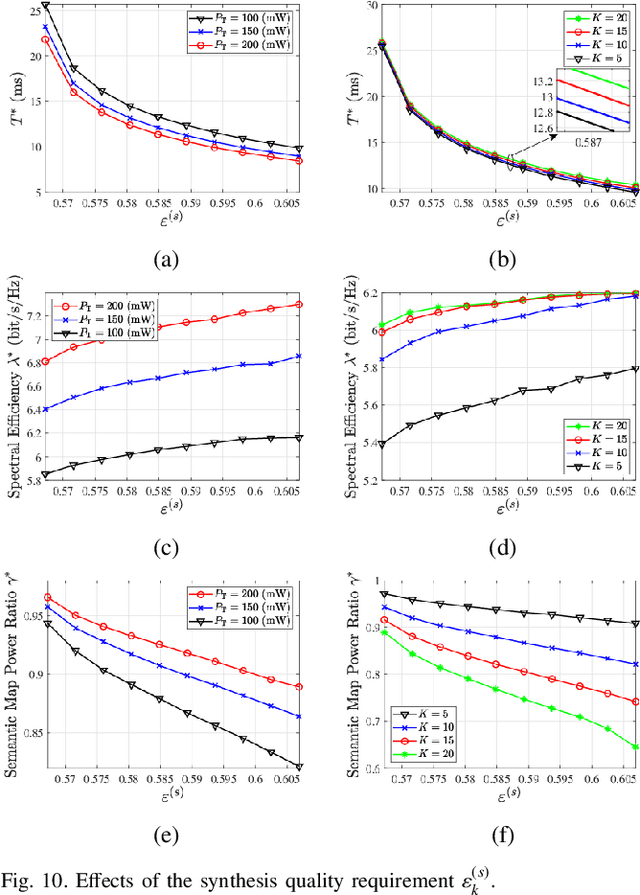


Generative diffusion models (GDMs) have recently shown great success in synthesizing multimedia signals with high perceptual quality enabling highly efficient semantic communications in future wireless networks. In this paper, we develop an intent-aware generative semantic multicasting framework utilizing pre-trained diffusion models. In the proposed framework, the transmitter decomposes the source signal to multiple semantic classes based on the multi-user intent, i.e. each user is assumed to be interested in details of only a subset of the semantic classes. The transmitter then sends to each user only its intended classes, and multicasts a highly compressed semantic map to all users over shared wireless resources that allows them to locally synthesize the other classes, i.e. non-intended classes, utilizing pre-trained diffusion models. The signal retrieved at each user is thereby partially reconstructed and partially synthesized utilizing the received semantic map. This improves utilization of the wireless resources, with better preserving privacy of the non-intended classes. We design a communication/computation-aware scheme for per-class adaptation of the communication parameters, such as the transmission power and compression rate to minimize the total latency of retrieving signals at multiple receivers, tailored to the prevailing channel conditions as well as the users reconstruction/synthesis distortion/perception requirements. The simulation results demonstrate significantly reduced per-user latency compared with non-generative and intent-unaware multicasting benchmarks while maintaining high perceptual quality of the signals retrieved at the users.