 Add to Chrome
 Add to Firefox
 Add to Edge
From Prediction to Diagnosis: Reasoning-Aware AI for Photovoltaic Defect Inspection
Mar 24, 2026
Reliable photovoltaic defect identification is essential for maintaining energy yield, ensuring warranty compliance, and enabling scalable inspection of rapidly expanding solar fleets. Although recent advances in computer vision have improved automated defect detection, most existing systems operate as opaque classifiers that provide limited diagnostic insight for high-stakes energy infrastructure. Here we introduce REVL-PV, a vision-language framework that embeds domain-specific diagnostic reasoning into multimodal learning across electroluminescence, thermal, and visible-light imagery. By requiring the model to link visual evidence to plausible defect mechanisms before classification, the framework produces structured diagnostic reports aligned with professional photovoltaic inspection practice. Evaluated on 1,927 real-world modules spanning eight defect categories, REVL-PV achieves 93\% classification accuracy while producing interpretable diagnostic rationales and maintaining strong robustness under realistic image corruptions. A blind concordance study with a certified solar inspection expert shows strong semantic alignment between model explanations and expert assessments across defect identification, root-cause attribution, and visual descriptions. These results demonstrate that reasoning-aware multimodal learning establishes a general paradigm for trustworthy AI-assisted inspection of photovoltaic energy infrastructure.

Deep-Learning-based Frequency-Domain Watermarking for Energy System Time Series Data Asset Protection
Nov 11, 2025Data has been regarded as a valuable asset with the fast development of artificial intelligence technologies. In this paper, we introduce deep-learning neural network-based frequency-domain watermarking for protecting energy system time series data assets and secure data authenticity when being shared or traded across communities. First, the concept and desired watermarking characteristics are introduced. Second, a deep-learning neural network-based watermarking model with specially designed loss functions and network structure is proposed to embed watermarks into the original dataset. Third, a frequency-domain data preprocessing method is proposed to eliminate the frequency bias of neural networks when learning time series datasets to enhance the model performances. Last, a comprehensive watermarking performance evaluation framework is designed for measuring its invisibility, restorability, robustness, secrecy, false-positive detection, generalization, and capacity. Case studies based on practical load and photovoltaic time series datasets demonstrate the effectiveness of the proposed method.
Data-Driven Distributionally Robust Scheduling of Community Integrated Energy Systems with Uncertain Renewable Generations Considering Integrated Demand Response
Jan 28, 2023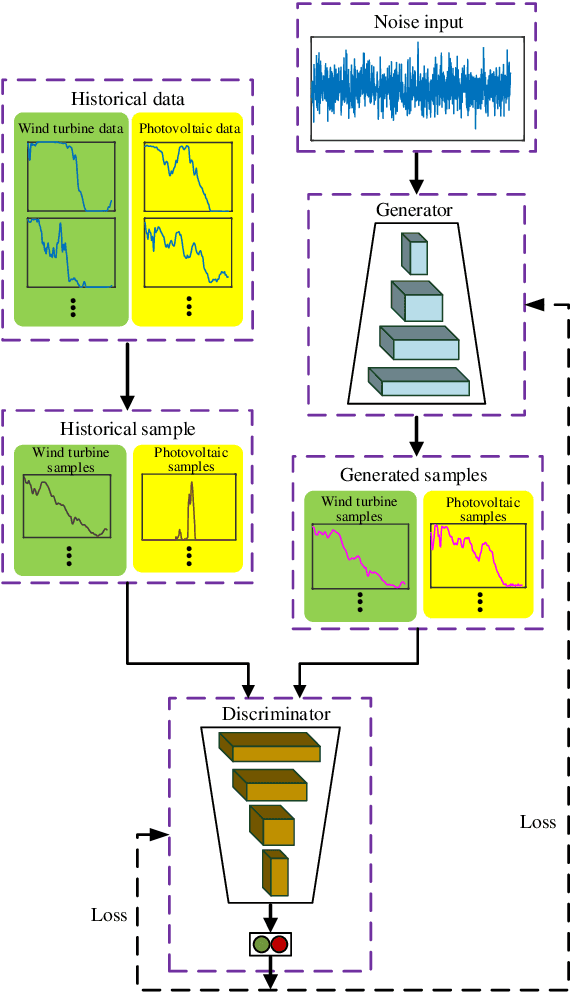
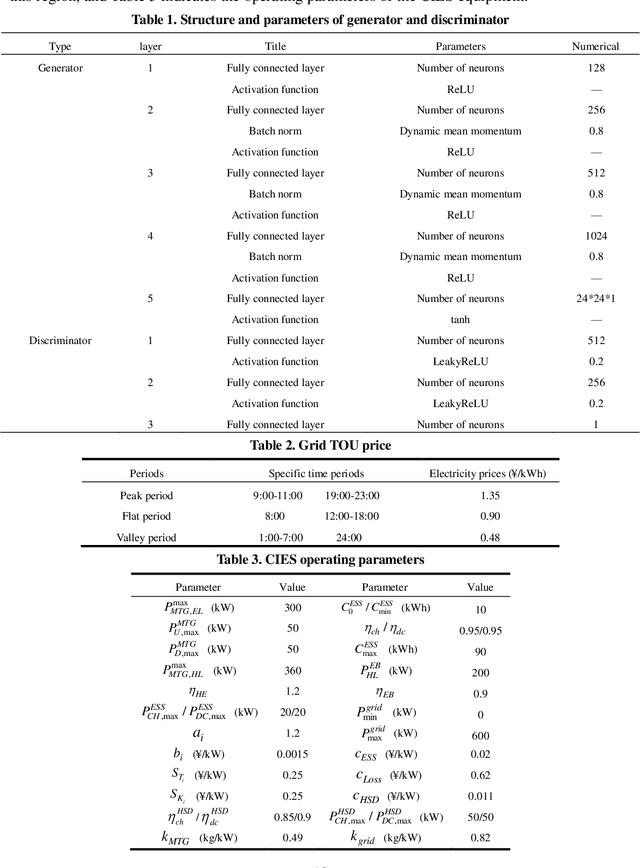
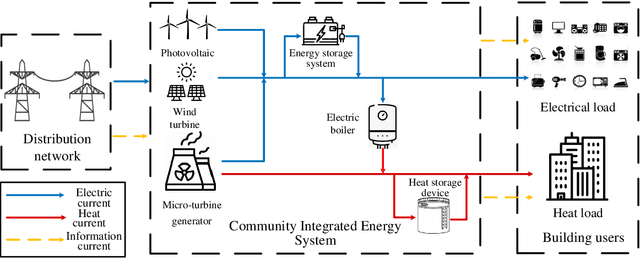
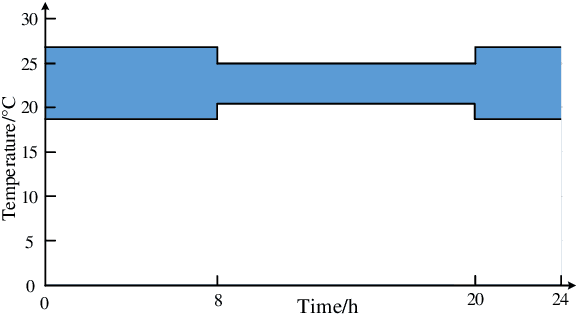
A community integrated energy system (CIES) is an important carrier of the energy internet and smart city in geographical and functional terms. Its emergence provides a new solution to the problems of energy utilization and environmental pollution. To coordinate the integrated demand response and uncertainty of renewable energy generation (RGs), a data-driven two-stage distributionally robust optimization (DRO) model is constructed. A comprehensive norm consisting of the 1-norm and infinity-norm is used as the uncertainty probability distribution information set, thereby avoiding complex probability density information. To address multiple uncertainties of RGs, a generative adversarial network based on the Wasserstein distance with gradient penalty is proposed to generate RG scenarios, which has wide applicability. To further tap the potential of the demand response, we take into account the ambiguity of human thermal comfort and the thermal inertia of buildings. Thus, an integrated demand response mechanism is developed that effectively promotes the consumption of renewable energy. The proposed method is simulated in an actual CIES in North China. In comparison with traditional stochastic programming and robust optimization, it is verified that the proposed DRO model properly balances the relationship between economical operation and robustness while exhibiting stronger adaptability. Furthermore, our approach outperforms other commonly used DRO methods with better operational economy, lower renewable power curtailment rate, and higher computational efficiency.
* Accepted by Applied Energy