 Add to Chrome
 Add to Firefox
 Add to Edge
A Controlled Diagnostic Study of Hardware-Induced Distortions in Hardware-Aware Training
May 10, 2026
Hardware-aware training (HAT) is widely used to improve the robustness of neural networks on non-ideal AI accelerators, such as analog in-memory computing (IMC) systems. However, not all hardware-induced distortions are equally compensable by training. This paper presents a diagnostic framework that models hardware non-idealities as structured perturbations of the forward operator and evaluates their compatibility with gradient-based optimization. We analyze six representative perturbation classes--read noise, variability, drift, stuck-at faults, IR-drop, and ADC discretization--and identify three key diagnostics: gradient expectation consistency, bounded gradient variance, and non-degenerate sensitivity. Our results show a clear separation between perturbations that can be compensated by HAT and those that consistently break optimization. This provides practical guidance for hardware-software co-design, clarifying which non-idealities can be addressed at the training level and which require circuit-, architecture-, or calibration-level mitigation. This study should be interpreted as a controlled empirical analysis under vanilla forward-perturbation HAT, rather than as a universal theory of hardware-aware training.

When Adaptation Fails: A Gradient-Based Diagnosis of Collapsed Gating in Vision-Language Prompt Learning
May 10, 2026Adaptive prompting mechanisms have been proposed to enhance vision-language models by dynamically tailoring prompts to inputs. However, in frozen few-shot prompt learning with CLIP-style backbones, we systematically observe that adaptive gates and prompt-selection modules often collapse: they produce nearly constant outputs, contribute negligible gradient signals, and frequently fail to outperform fixed prompts. To further explore this issue, we present a systematic diagnostic study to uncover the underlying causes and conditions of adaptation failure. Through controlled experiments across datasets and multiple prompt learning architectures, we identify two recurring failure modes: gradient magnitude imbalance and gate degradation. Our findings invite a re-examination of indiscriminately adding architectural complexity in parameter-efficient learning and clarify when prompt-level adaptive gating is, and is not, effective in this regime.
Jailbreaking Frontier Foundation Models Through Intention Deception
Apr 27, 2026Large (vision-)language models exhibit remarkable capability but remain highly susceptible to jailbreaking. Existing safety training approaches aim to have the model learn a refusal boundary between safe and unsafe, based on the user's intent. It has been found that this binary training regime often leads to brittleness, since the user intent cannot reliably be evaluated, especially if the attacker obfuscates their intent, and also makes the system seem unhelpful. In response, frontier models, such as GPT-5, have shifted from refusal-based safeguards to safe completion, that aims to maximize helpfulness while obeying safety constraints. However, safe completion could be exploited when a user pretends their intention is benign. Specifically, this intent inversion would be effective in multi-turn conversation, where the attacker has multiple opportunities to reinforce their deceptively benign intent. In this work, we introduce a novel multi-turn jailbreaking method that exploits this vulnerability. Our approach gradually builds conversational trust by simulating benign-seeming intentions and by exploiting the consistency property of the model, ultimately guiding the target model toward harmful, detailed outputs. Most crucially, our approach also uncovered an additional class of model vulnerability that we call para-jailbreaking that has been unnoticed up to now. Para-jailbreaking describes the situation where the model may not reveal harmful direct reply to the attack query, however the information that it reveals is nevertheless harmful. Our contributions are threefold. First, it achieves high success rates against frontier models including GPT-5-thinking and Claude-Sonnet-4.5. Second, our approach revealed and addressed para-jailbreaking harmful output. Third, experiments on multimodal VLM models showed that our approach outperformed state-of-the-art models.
Your Reasoning Benchmark May Not Test Reasoning: Revealing Perception Bottleneck in Abstract Reasoning Benchmarks
Dec 24, 2025Reasoning benchmarks such as the Abstraction and Reasoning Corpus (ARC) and ARC-AGI are widely used to assess progress in artificial intelligence and are often interpreted as probes of core, so-called ``fluid'' reasoning abilities. Despite their apparent simplicity for humans, these tasks remain challenging for frontier vision-language models (VLMs), a gap commonly attributed to deficiencies in machine reasoning. We challenge this interpretation and hypothesize that the gap arises primarily from limitations in visual perception rather than from shortcomings in inductive reasoning. To verify this hypothesis, we introduce a two-stage experimental pipeline that explicitly separates perception and reasoning. In the perception stage, each image is independently converted into a natural-language description, while in the reasoning stage a model induces and applies rules using these descriptions. This design prevents leakage of cross-image inductive signals and isolates reasoning from perception bottlenecks. Across three ARC-style datasets, Mini-ARC, ACRE, and Bongard-LOGO, we show that the perception capability is the dominant factor underlying the observed performance gap by comparing the two-stage pipeline with against standard end-to-end one-stage evaluation. Manual inspection of reasoning traces in the VLM outputs further reveals that approximately 80 percent of model failures stem from perception errors. Together, these results demonstrate that ARC-style benchmarks conflate perceptual and reasoning challenges and that observed performance gaps may overstate deficiencies in machine reasoning. Our findings underscore the need for evaluation protocols that disentangle perception from reasoning when assessing progress in machine intelligence.
Interactive and Expressive Code-Augmented Planning with Large Language Models
Nov 21, 2024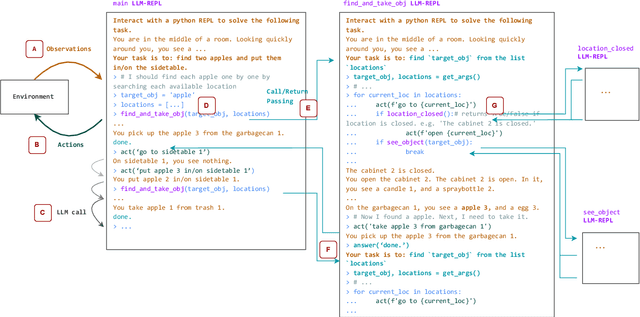
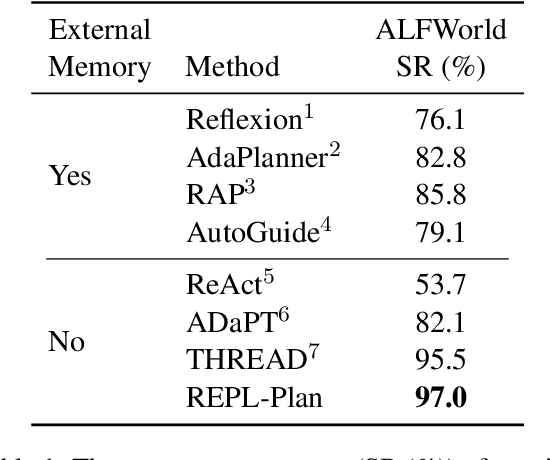
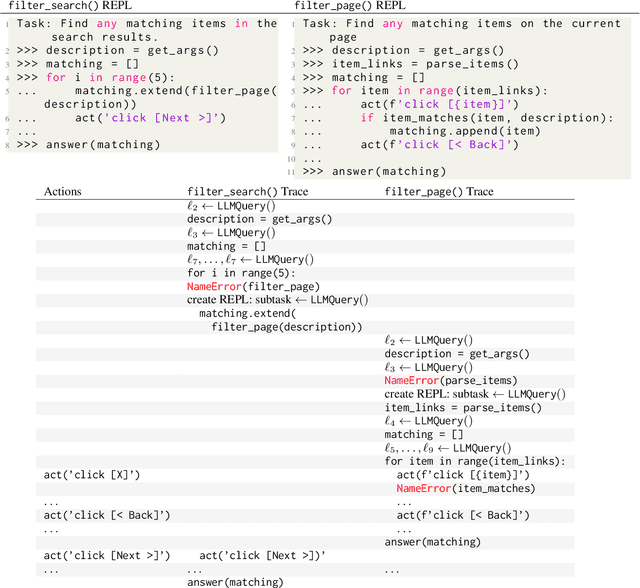
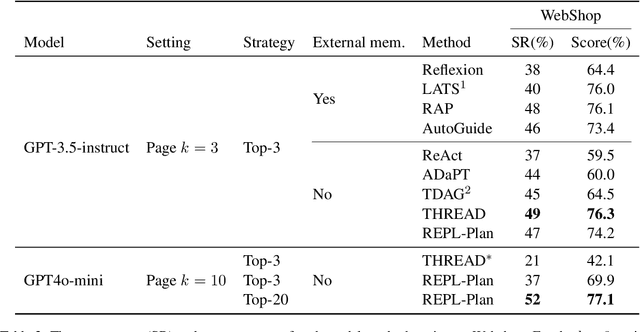
Large Language Models (LLMs) demonstrate strong abilities in common-sense reasoning and interactive decision-making, but often struggle with complex, long-horizon planning tasks. Recent techniques have sought to structure LLM outputs using control flow and other code-adjacent techniques to improve planning performance. These techniques include using variables (to track important information) and functions (to divide complex tasks into smaller re-usable sub-tasks). However, purely code-based approaches can be error-prone and insufficient for handling ambiguous or unstructured data. To address these challenges, we propose REPL-Plan, an LLM planning approach that is fully code-expressive (it can utilize all the benefits of code) while also being dynamic (it can flexibly adapt from errors and use the LLM for fuzzy situations). In REPL-Plan, an LLM solves tasks by interacting with a Read-Eval-Print Loop (REPL), which iteratively executes and evaluates code, similar to language shells or interactive code notebooks, allowing the model to flexibly correct errors and handle tasks dynamically. We demonstrate that REPL-Plan achieves strong results across various planning domains compared to previous methods.
$\texttt{dattri}$: A Library for Efficient Data Attribution
Oct 06, 2024


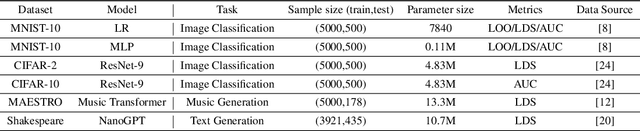
Data attribution methods aim to quantify the influence of individual training samples on the prediction of artificial intelligence (AI) models. As training data plays an increasingly crucial role in the modern development of large-scale AI models, data attribution has found broad applications in improving AI performance and safety. However, despite a surge of new data attribution methods being developed recently, there lacks a comprehensive library that facilitates the development, benchmarking, and deployment of different data attribution methods. In this work, we introduce $\texttt{dattri}$, an open-source data attribution library that addresses the above needs. Specifically, $\texttt{dattri}$ highlights three novel design features. Firstly, $\texttt{dattri}$ proposes a unified and easy-to-use API, allowing users to integrate different data attribution methods into their PyTorch-based machine learning pipeline with a few lines of code changed. Secondly, $\texttt{dattri}$ modularizes low-level utility functions that are commonly used in data attribution methods, such as Hessian-vector product, inverse-Hessian-vector product or random projection, making it easier for researchers to develop new data attribution methods. Thirdly, $\texttt{dattri}$ provides a comprehensive benchmark framework with pre-trained models and ground truth annotations for a variety of benchmark settings, including generative AI settings. We have implemented a variety of state-of-the-art efficient data attribution methods that can be applied to large-scale neural network models, and will continuously update the library in the future. Using the developed $\texttt{dattri}$ library, we are able to perform a comprehensive and fair benchmark analysis across a wide range of data attribution methods. The source code of $\texttt{dattri}$ is available at https://github.com/TRAIS-Lab/dattri.
Adversarial Attacks on Data Attribution
Sep 09, 2024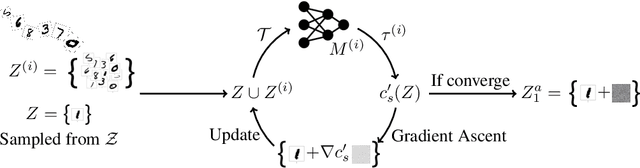



Data attribution aims to quantify the contribution of individual training data points to the outputs of an AI model, which has been used to measure the value of training data and compensate data providers. Given the impact on financial decisions and compensation mechanisms, a critical question arises concerning the adversarial robustness of data attribution methods. However, there has been little to no systematic research addressing this issue. In this work, we aim to bridge this gap by detailing a threat model with clear assumptions about the adversary's goal and capabilities, and by proposing principled adversarial attack methods on data attribution. We present two such methods, Shadow Attack and Outlier Attack, both of which generate manipulated datasets to adversarially inflate the compensation. The Shadow Attack leverages knowledge about the data distribution in the AI applications, and derives adversarial perturbations through "shadow training", a technique commonly used in membership inference attacks. In contrast, the Outlier Attack does not assume any knowledge about the data distribution and relies solely on black-box queries to the target model's predictions. It exploits an inductive bias present in many data attribution methods - outlier data points are more likely to be influential - and employs adversarial examples to generate manipulated datasets. Empirically, in image classification and text generation tasks, the Shadow Attack can inflate the data-attribution-based compensation by at least 200%, while the Outlier Attack achieves compensation inflation ranging from 185% to as much as 643%.