 Add to Chrome
 Add to Firefox
 Add to Edge
A BIM-enabled, Agent-based Discrete-event Simulation Platform for Robotic Studies: A Method based on Graph Theory
Jul 18, 2026
Indoor robots are increasingly employed for facility management tasks such as cleaning and inspection. These applications primarily rely on navigation and can be effectively supported by predefined routes or perception-driven Simultaneous Localization and Mapping (SLAM) techniques. However, more complex tasks, such as locating and repairing leaking pipes, require not only navigation but also access to building information, including the location, geometry, material, and operational attributes of components. Existing navigation approaches provide only limited environmental understanding and cannot readily supply such information. In contrast, Building Information Modeling (BIM) contains rich geometric, semantic, and operational information that remains largely underutilized in robotic applications. This study proposes a BIM-enabled, agent-based simulation platform for knowledge-driven indoor robot navigation and operation planning. Within the framework, indoor environments are discretized into grid cells that are mapped to graph nodes and classified as target, obstacle, or regular nodes according to their spatial relationships with building elements. Traversal costs are assigned to edges connecting neighboring nodes, enabling graph-theoretic algorithms to compute efficient and collision-free navigation paths while avoiding obstacles. Simulation results demonstrate that the proposed graph representation enables efficient and collision-free navigation. A key limitation associated with coarse discretization, namely overlap between target-occupied and obstacle-occupied cells, is identified and mitigated through grid refinement, improving spatial accuracy and path feasibility. The proposed platform supports virtual evaluation of robotic operations prior to deployment and provides a foundation for BIM-informed robotic systems in facility management.

SmartHomeSecure: Automated Detection and Repair of Smart Home Configuration Errors Using Large Language Models
Jul 07, 2026Smart home automation platforms increasingly rely on user-authored YAML configuration files to define device behaviors, but these files are prone to syntax, formatting, and semantic logic errors that can cause automation failures and safety risks. Existing YAML validators, static analysis tools, and general-purpose large language models offer limited support for end-to-end diagnosis and repair because they lack domain-specific understanding and validated correction workflows. This paper presents SmartHomeSecure, a prototype for automated detection and repair of Home Assistant configuration errors using lightweight program analysis and constraint-guided large language model generation. SmartHomeSecure parses YAML files, detects syntactic and common semantic errors, normalizes error context, applies deterministic auto-fixes for routine defects, and constructs constrained prompts that guide LLMs toward minimal and structurally valid repairs. The system is implemented as a modular web application with four layers: UI Shell, Feature Orchestrator, Domain Engine, and Integration Layer. Its repair pipeline was evaluated on 100 real-world Home Assistant YAML files with manually injected errors across five categories: syntax/parsing, indentation, mapping, sequence, and scalar quoting errors. Four models were tested: gpt-oss-20b, gpt-oss-120b, llama-3.1-8b, and llama-3.3-70b. Results show that three models achieved 100% error detection accuracy, with repair success rates ranging from 87% to 93%. Manual verification found no hallucinated or incorrect repairs among successful outputs. These findings suggest that combining domain-aware program analysis with constrained generative AI is a feasible approach for improving the reliability and usability of smart home configuration repair.
A Comprehensive Indoor Environment Dataset from Single-family Houses in the US
Oct 05, 2023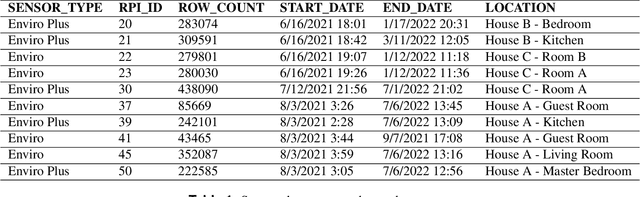
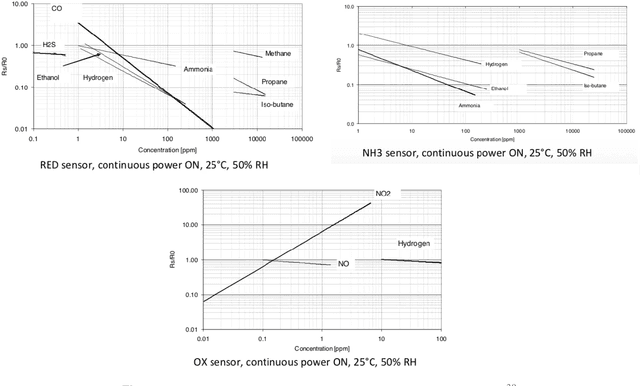
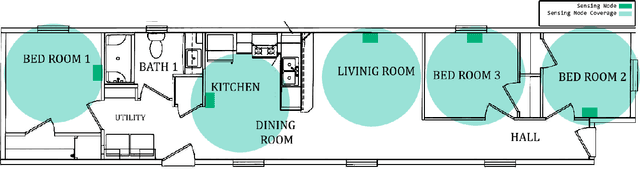
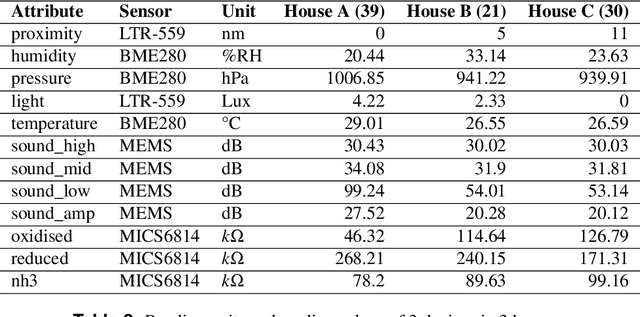
The paper describes a dataset comprising indoor environmental factors such as temperature, humidity, air quality, and noise levels. The data was collected from 10 sensing devices installed in various locations within three single-family houses in Virginia, USA. The objective of the data collection was to study the indoor environmental conditions of the houses over time. The data were collected at a frequency of one record per minute for a year, combining over 2.5 million records. The paper provides actual floor plans with sensor placements to aid researchers and practitioners in creating reliable building performance models. The techniques used to collect and verify the data are also explained in the paper. The resulting dataset can be employed to enhance models for building energy consumption, occupant behavior, predictive maintenance, and other relevant purposes.
Machine learning approach in the development of building occupant personas
Jul 19, 2022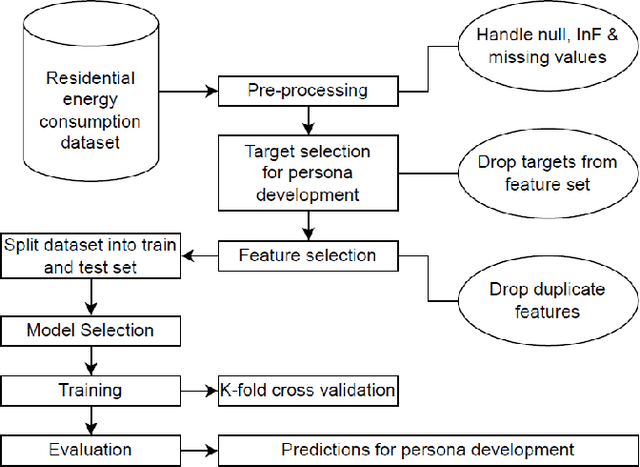
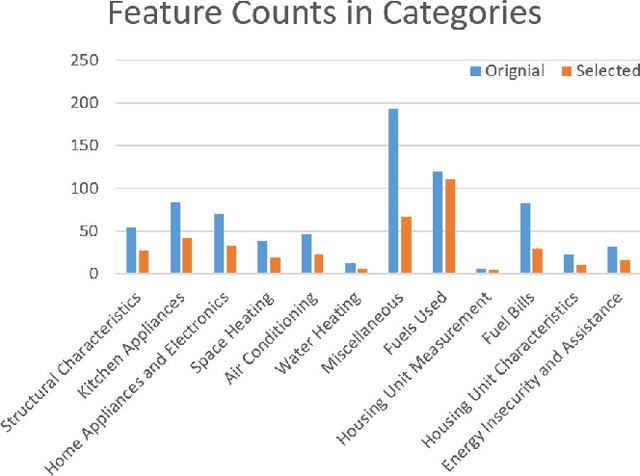

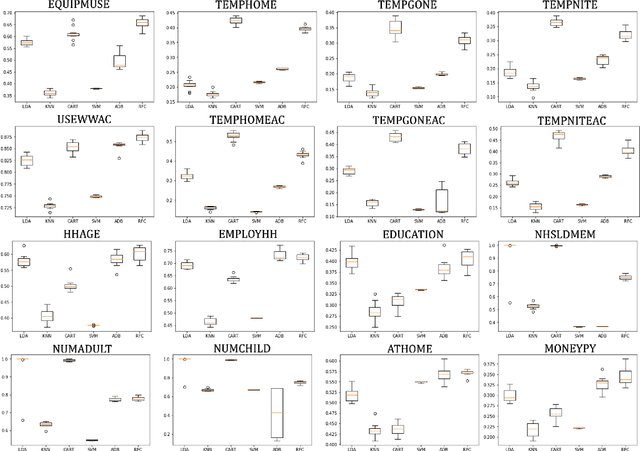
The user persona is a communication tool for designers to generate a mental model that describes the archetype of users. Developing building occupant personas is proven to be an effective method for human-centered smart building design, which considers occupant comfort, behavior, and energy consumption. Optimization of building energy consumption also requires a deep understanding of occupants' preferences and behaviors. The current approaches to developing building occupant personas face a major obstruction of manual data processing and analysis. In this study, we propose and evaluate a machine learning-based semi-automated approach to generate building occupant personas. We investigate the 2015 Residential Energy Consumption Dataset with five machine learning techniques - Linear Discriminant Analysis, K Nearest Neighbors, Decision Tree (Random Forest), Support Vector Machine, and AdaBoost classifier - for the prediction of 16 occupant characteristics, such as age, education, and, thermal comfort. The models achieve an average accuracy of 61% and accuracy over 90% for attributes including the number of occupants in the household, their age group, and preferred usage of heating or cooling equipment. The results of the study show the feasibility of using machine learning techniques for the development of building occupant persona to minimize human effort.
Global Contrast Masked Autoencoders Are Powerful Pathological Representation Learners
May 21, 2022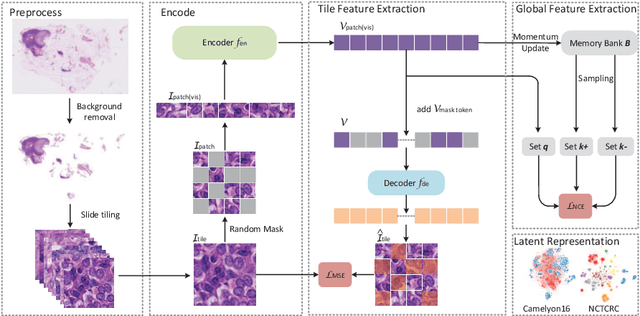
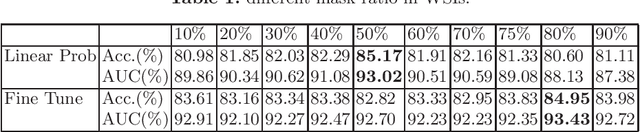
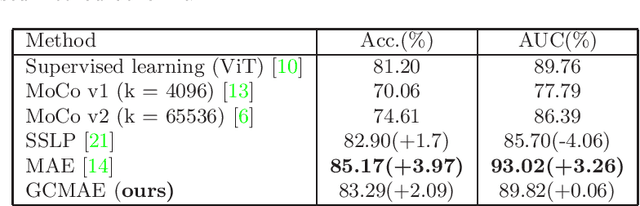
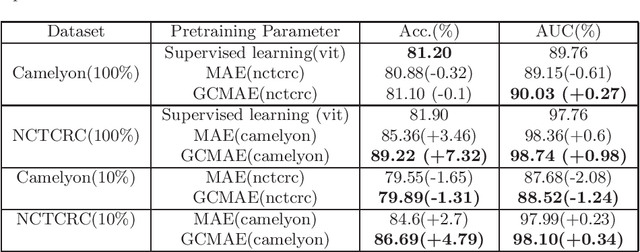
Based on digital whole slide scanning technique, artificial intelligence algorithms represented by deep learning have achieved remarkable results in the field of computational pathology. Compared with other medical images such as Computed Tomography (CT) or Magnetic Resonance Imaging (MRI), pathological images are more difficult to annotate, thus there is an extreme lack of data sets that can be used for supervised learning. In this study, a self-supervised learning (SSL) model, Global Contrast Masked Autoencoders (GCMAE), is proposed, which has the ability to represent both global and local domain-specific features of whole slide image (WSI), as well as excellent cross-data transfer ability. The Camelyon16 and NCTCRC datasets are used to evaluate the performance of our model. When dealing with transfer learning tasks with different data sets, the experimental results show that GCMAE has better linear classification accuracy than MAE, which can reach 81.10% and 89.22% respectively. Our method outperforms the previous state-of-the-art algorithm and even surpass supervised learning (improved by 3.86% on NCTCRC data sets). The source code of this paper is publicly available at https://github.com/StarUniversus/gcmae
A Deep Reinforcement Learning Framework for Rapid Diagnosis of Whole Slide Pathological Images
May 05, 2022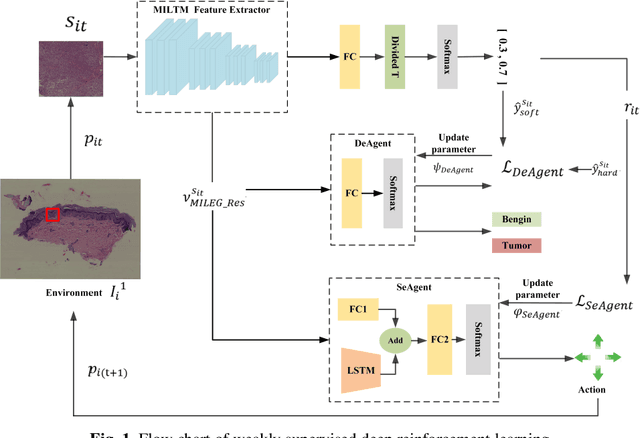
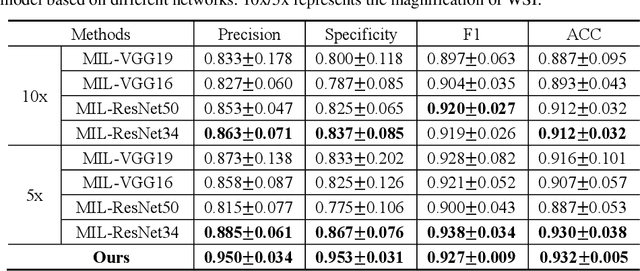
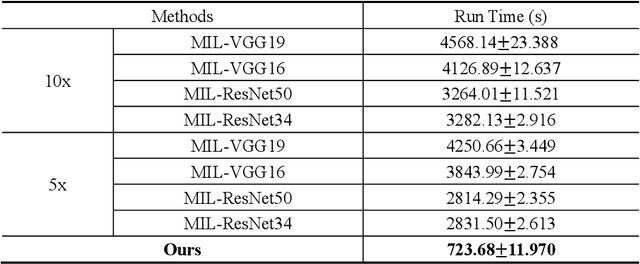
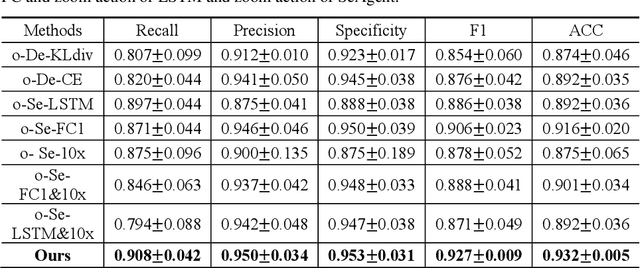
The deep neural network is a research hotspot for histopathological image analysis, which can improve the efficiency and accuracy of diagnosis for pathologists or be used for disease screening. The whole slide pathological image can reach one gigapixel and contains abundant tissue feature information, which needs to be divided into a lot of patches in the training and inference stages. This will lead to a long convergence time and large memory consumption. Furthermore, well-annotated data sets are also in short supply in the field of digital pathology. Inspired by the pathologist's clinical diagnosis process, we propose a weakly supervised deep reinforcement learning framework, which can greatly reduce the time required for network inference. We use neural network to construct the search model and decision model of reinforcement learning agent respectively. The search model predicts the next action through the image features of different magnifications in the current field of view, and the decision model is used to return the predicted probability of the current field of view image. In addition, an expert-guided model is constructed by multi-instance learning, which not only provides rewards for search model, but also guides decision model learning by the knowledge distillation method. Experimental results show that our proposed method can achieve fast inference and accurate prediction of whole slide images without any pixel-level annotations.