 Add to Chrome
 Add to Firefox
 Add to Edge
LieTrunc-QNN: Lie Algebra Truncation and Quantum Expressivity Phase Transition from LiePrune to Provably Stable Quantum Neural Networks
Apr 03, 2026
Quantum Machine Learning (QML) is fundamentally limited by two challenges: barren plateaus (exponentially vanishing gradients) and the fragility of parameterized quantum circuits under noise. Despite extensive empirical studies, a unified theoretical framework remains lacking. We introduce LieTrunc-QNN, an algebraic-geometric framework that characterizes trainability via Lie-generated dynamics. Parameterized quantum circuits are modeled as Lie subalgebras of u(2^n), whose action induces a Riemannian manifold of reachable quantum states. Expressivity is reinterpreted as intrinsic manifold dimension and geometry. We establish a geometric capacity-plateau principle: increasing effective dimension leads to exponential gradient suppression due to concentration of measure. By restricting to structured Lie subalgebras (LieTrunc), the manifold is contracted, preventing concentration and preserving non-degenerate gradients. We prove two main results: (1) a trainability lower bound for LieTrunc-QNN, and (2) that the Fubini-Study metric rank is bounded by the algebraic span of generators, showing expressivity is governed by structure rather than parameter count. Compact Lie subalgebras also provide inherent robustness to perturbations. Importantly, we establish a polynomial trainability regime where gradient variance decays polynomially instead of exponentially. Experiments (n=2-6) validate the theory: LieTrunc-QNN maintains stable gradients and high effective dimension, while random truncation leads to metric rank collapse. At n=6, full metric rank is preserved (rank=16). Results support a scaling law between gradient variance and effective dimension. This work provides a unified geometric framework for QNN design, linking Lie algebra, manifold geometry, and optimization.

Enhancing Imbalanced Electrocardiogram Classification: A Novel Approach Integrating Data Augmentation through Wavelet Transform and Interclass Fusion
Jan 14, 2026Imbalanced electrocardiogram (ECG) data hampers the efficacy and resilience of algorithms in the automated processing and interpretation of cardiovascular diagnostic information, which in turn impedes deep learning-based ECG classification. Notably, certain cardiac conditions that are infrequently encountered are disproportionately underrepresented in these datasets. Although algorithmic generation and oversampling of specific ECG signal types can mitigate class skew, there is a lack of consensus regarding the effectiveness of such techniques in ECG classification. Furthermore, the methodologies and scenarios of ECG acquisition introduce noise, further complicating the processing of ECG data. This paper presents a significantly enhanced ECG classifier that simultaneously addresses both class imbalance and noise-related challenges in ECG analysis, as observed in the CPSC 2018 dataset. Specifically, we propose the application of feature fusion based on the wavelet transform, with a focus on wavelet transform-based interclass fusion, to generate the training feature library and the test set feature library. Subsequently, the original training and test data are amalgamated with their respective feature databases, resulting in more balanced training and test datasets. Employing this approach, our ECG model achieves recognition accuracies of up to 99%, 98%, 97%, 98%, 96%, 92%, and 93% for Normal, AF, I-AVB, LBBB, RBBB, PAC, PVC, STD, and STE, respectively. Furthermore, the average recognition accuracy for these categories ranges between 92\% and 98\%. Notably, our proposed data fusion methodology surpasses any known algorithms in terms of ECG classification accuracy in the CPSC 2018 dataset.
Spectral Complex Autoencoder Pruning: A Fidelity-Guided Criterion for Extreme Structured Channel Compression
Jan 14, 2026We propose Spectral Complex Autoencoder Pruning (SCAP), a reconstruction-based criterion that measures functional redundancy at the level of individual output channels. For each convolutional layer, we construct a complex interaction field by pairing the full multi-channel input activation as the real part with a single output-channel activation (spatially aligned and broadcast across input channels) as the imaginary part. We transform this complex field to the frequency domain and train a low-capacity autoencoder to reconstruct normalized spectra. Channels whose spectra are reconstructed with high fidelity are interpreted as lying close to a low-dimensional manifold captured by the autoencoder and are therefore more compressible; conversely, channels with low fidelity are retained as they encode information that cannot be compactly represented by the learned manifold. This yields an importance score (optionally fused with the filter L1 norm) that supports simple threshold-based pruning and produces a structurally consistent pruned network. On VGG16 trained on CIFAR-10, at a fixed threshold of 0.6, we obtain 90.11% FLOP reduction and 96.30% parameter reduction with an absolute Top-1 accuracy drop of 1.67% from a 93.44% baseline after fine-tuning, demonstrating that spectral reconstruction fidelity of complex interaction fields is an effective proxy for channel-level redundancy under aggressive compression.
One-Shot Structured Pruning of Quantum Neural Networks via $q$-Group Engineering and Quantum Geometric Metrics
Dec 30, 2025Quantum neural networks (QNNs) suffer from severe gate-level redundancy, which hinders their deployment on noisy intermediate-scale quantum (NISQ) devices. In this work, we propose q-iPrune, a one-shot structured pruning framework grounded in the algebraic structure of $q$-deformed groups and task-conditioned quantum geometry. Unlike prior heuristic or gradient-based pruning methods, q-iPrune formulates redundancy directly at the gate level. Each gate is compared within an algebraically consistent subgroup using a task-conditioned $q$-overlap distance, which measures functional similarity through state overlaps on a task-relevant ensemble. A gate is removed only when its replacement by a subgroup representative provably induces a bounded deviation on all task observables. We establish three rigorous theoretical guarantees. First, we prove completeness of redundancy pruning: no gate that violates the prescribed similarity threshold is removed. Second, we show that the pruned circuit is functionally equivalent up to an explicit, task-conditioned error bound, with a closed-form dependence on the redundancy tolerance and the number of replaced gates. Third, we prove that the pruning procedure is computationally feasible, requiring only polynomial-time comparisons and avoiding exponential enumeration over the Hilbert space. To adapt pruning decisions to hardware imperfections, we introduce a noise-calibrated deformation parameter $λ$ that modulates the $q$-geometry and redundancy tolerance. Experiments on standard quantum machine learning benchmarks demonstrate that q-iPrune achieves substantial gate reduction while maintaining bounded task performance degradation, consistent with our theoretical guarantees.
LiePrune: Lie Group and Quantum Geometric Dual Representation for One-Shot Structured Pruning of Quantum Neural Networks
Dec 10, 2025Quantum neural networks (QNNs) and parameterized quantum circuits (PQCs) are key building blocks for near-term quantum machine learning. However, their scalability is constrained by excessive parameters, barren plateaus, and hardware limitations. We propose LiePrune, the first mathematically grounded one-shot structured pruning framework for QNNs that leverages Lie group structure and quantum geometric information. Each gate is jointly represented in a Lie group--Lie algebra dual space and a quantum geometric feature space, enabling principled redundancy detection and aggressive compression. Experiments on quantum classification (MNIST, FashionMNIST), quantum generative modeling (Bars-and-Stripes), and quantum chemistry (LiH VQE) show that LiePrune achieves over $10\times$ compression with negligible or even improved task performance, while providing provable guarantees on redundancy detection, functional approximation, and computational complexity.
Fragment and Integrate Network (FIN): A Novel Spatial-Temporal Modeling Based on Long Sequential Behavior for Online Food Ordering Click-Through Rate Prediction
Aug 30, 2023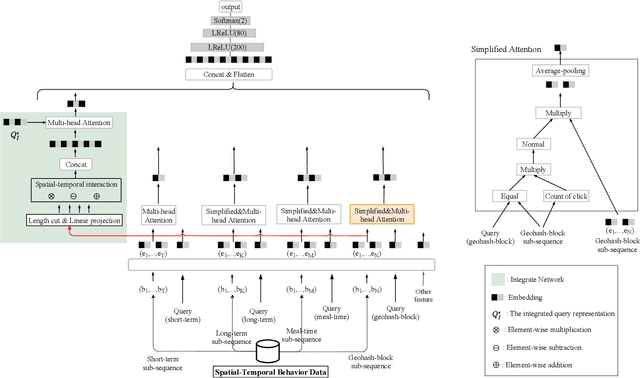

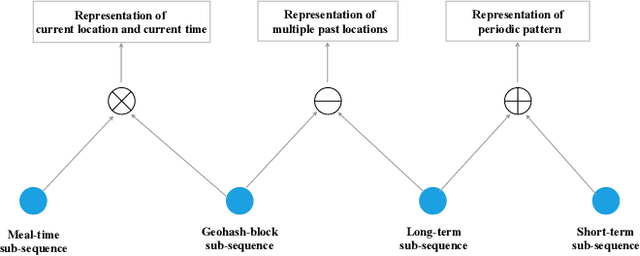

Spatial-temporal information has been proven to be of great significance for click-through rate prediction tasks in online Location-Based Services (LBS), especially in mainstream food ordering platforms such as DoorDash, Uber Eats, Meituan, and Ele.me. Modeling user spatial-temporal preferences with sequential behavior data has become a hot topic in recommendation systems and online advertising. However, most of existing methods either lack the representation of rich spatial-temporal information or only handle user behaviors with limited length, e.g. 100. In this paper, we tackle these problems by designing a new spatial-temporal modeling paradigm named Fragment and Integrate Network (FIN). FIN consists of two networks: (i) Fragment Network (FN) extracts Multiple Sub-Sequences (MSS) from lifelong sequential behavior data, and captures the specific spatial-temporal representation by modeling each MSS respectively. Here both a simplified attention and a complicated attention are adopted to balance the performance gain and resource consumption. (ii) Integrate Network (IN) builds a new integrated sequence by utilizing spatial-temporal interaction on MSS and captures the comprehensive spatial-temporal representation by modeling the integrated sequence with a complicated attention. Both public datasets and production datasets have demonstrated the accuracy and scalability of FIN. Since 2022, FIN has been fully deployed in the recommendation advertising system of Ele.me, one of the most popular online food ordering platforms in China, obtaining 5.7% improvement on Click-Through Rate (CTR) and 7.3% increase on Revenue Per Mille (RPM).