 Add to Chrome
 Add to Firefox
 Add to Edge
Q-CueGraph: Query-Conditioned Visual Evidence Graphs for Multimodal Reasoning
Aug 05, 2026
High-resolution pixels and crop or zoom tools give multimodal large language models the ability to inspect an image, but they do not provide a reliable task-conditioned policy for deciding where to inspect. Q-CueGraph makes this decision explicit. It maps a question and an image representation to budgeted, coordinate-level observations for a frozen reader. Text-rich images use a reusable OCR/layout graph; natural-image search instantiates query-conditioned visual nodes behind the same selection, composition, and budgeting interface. Optional utility refinement learns which candidate crops the frozen reader can use from training-answer correctness, without region-box supervision. With a frozen Qwen2.5-VL-7B reader, Q-CueGraph reaches 0.833 accuracy on V*Bench versus 0.696 for full-image inference from a 19% image-area budget, and reaches 92% of full-image ANLS on InfographicVQA from about half the image area. Across six benchmarks, explicit observation is most valuable when evidence is localizable, the question discriminates its location, and resolution limits full-image reading.

Make Tracking Easy: Neural Motion Retargeting for Humanoid Whole-body Control
Mar 23, 2026Humanoid robots require diverse motor skills to integrate into complex environments, but bridging the kinematic and dynamic embodiment gap from human data remains a major bottleneck. We demonstrate through Hessian analysis that traditional optimization-based retargeting is inherently non-convex and prone to local optima, leading to physical artifacts like joint jumps and self-penetration. To address this, we reformulate the targeting problem as learning data distribution rather than optimizing optimal solutions, where we propose NMR, a Neural Motion Retargeting framework that transforms static geometric mapping into a dynamics-aware learned process. We first propose Clustered-Expert Physics Refinement (CEPR), a hierarchical data pipeline that leverages VAE-based motion clustering to group heterogeneous movements into latent motifs. This strategy significantly reduces the computational overhead of massively parallel reinforcement learning experts, which project and repair noisy human demonstrations onto the robot's feasible motion manifold. The resulting high-fidelity data supervises a non-autoregressive CNN-Transformer architecture that reasons over global temporal context to suppress reconstruction noise and bypass geometric traps. Experiments on the Unitree G1 humanoid across diverse dynamic tasks (e.g., martial arts, dancing) show that NMR eliminates joint jumps and significantly reduces self-collisions compared to state-of-the-art baselines. Furthermore, NMR-generated references accelerate the convergence of downstream whole-body control policies, establishing a scalable path for bridging the human-robot embodiment gap.
Co-Driven Recognition of Semantic Consistency via the Fusion of Transformer and HowNet Sememes Knowledge
Feb 21, 2023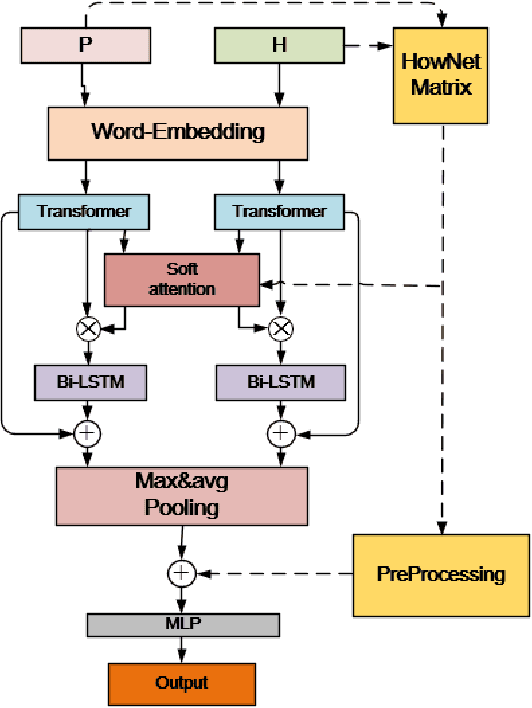
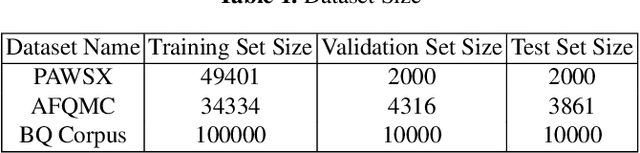
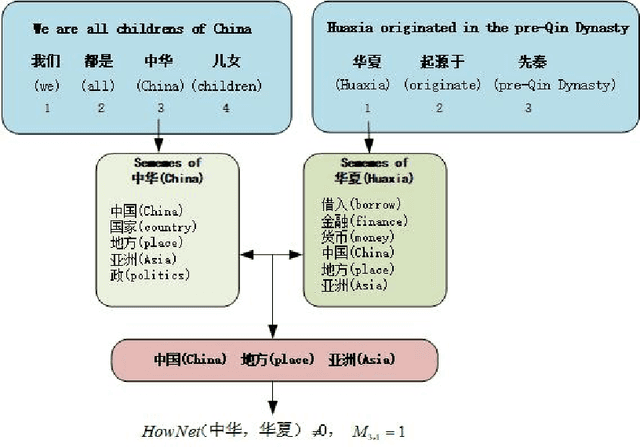
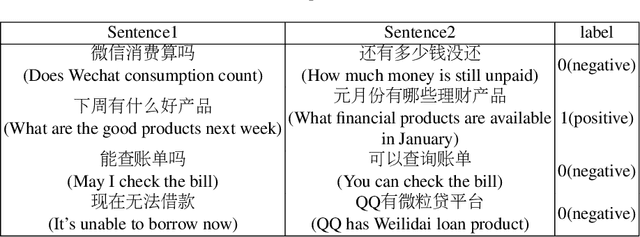
Semantic consistency recognition aims to detect and judge whether the semantics of two text sentences are consistent with each other. However, the existing methods usually encounter the challenges of synonyms, polysemy and difficulty to understand long text. To solve the above problems, this paper proposes a co-driven semantic consistency recognition method based on the fusion of Transformer and HowNet sememes knowledge. Multi-level encoding of internal sentence structures via data-driven is carried out firstly by Transformer, sememes knowledge base HowNet is introduced for knowledge-driven to model the semantic knowledge association among sentence pairs. Then, interactive attention calculation is carried out utilizing soft-attention and fusion the knowledge with sememes matrix. Finally, bidirectional long short-term memory network (BiLSTM) is exploited to encode the conceptual semantic information and infer the semantic consistency. Experiments are conducted on two financial text matching datasets (BQ, AFQMC) and a cross-lingual adversarial dataset (PAWSX) for paraphrase identification. Compared with lightweight models including DSSM, MwAN, DRCN, and pre-training models such as ERNIE etc., the proposed model can not only improve the accuracy of semantic consistency recognition effectively (by 2.19%, 5.57% and 6.51% compared with the DSSM, MWAN and DRCN models on the BQ dataset), but also reduce the number of model parameters (to about 16M). In addition, driven by the HowNet sememes knowledge, the proposed method is promising to adapt to scenarios with long text.