 Add to Chrome
 Add to Firefox
 Add to Edge
AS-FedBridge: Pseudo-Spike Bridge Distillation for Heterogeneous ANN-SNN Federated Learning
Aug 04, 2026
Federated learning enables collaborative model training across distributed edge devices while strictly preserving data privacy. To facilitate practical deployment on resource-constrained edge devices, Spiking Neural Networks (SNNs) have emerged as a promising alternative to traditional Artificial Neural Networks (ANNs) due to their sparse computing mechanisms and high energy efficiency. However, jointly training ANNs and SNNs exposes a challenge of representational misalignment, which is intrinsically caused by differences in information representation, specifically the semantic gap between continuous real-valued activations in ANNs and discrete spatio-temporal spikes in SNNs. To overcome this barrier, we propose AS-FedBridge, a novel federated learning framework tailored for mixed ANN-SNN clients. AS-FedBridge features a lightweight Bridge equipped with a Pseudo-Spike Interface, which effectively projects continuous signals into a spike-compatible space to facilitate ANN-SNN alignment. Given the absence of existing mixed ANN-SNN federated frameworks, we establish a comprehensive benchmark to evaluate against multiple advanced heterogeneous FL methods. Our empirical analysis demonstrates a positive correlation between the degree of ANN-SNN alignment and the collaborative FL performance. Across four datasets, AS-FedBridge consistently demonstrates advanced accuracy while mitigating extreme scale, architecture, and client heterogeneity challenge. Furthermore, our framework enables a highly controllable trade-off between model performance and resource efficiency. AS-FedBridge accomplishes these robust performance gains while introducing only marginal computational overhead, establishing a robust and practical foundation for mixed ANN-SNN federated learning systems.

Early and Prediagnostic Detection of Pancreatic Cancer from Computed Tomography
Jan 29, 2026Pancreatic ductal adenocarcinoma (PDAC), one of the deadliest solid malignancies, is often detected at a late and inoperable stage. Retrospective reviews of prediagnostic CT scans, when conducted by expert radiologists aware that the patient later developed PDAC, frequently reveal lesions that were previously overlooked. To help detecting these lesions earlier, we developed an automated system named ePAI (early Pancreatic cancer detection with Artificial Intelligence). It was trained on data from 1,598 patients from a single medical center. In the internal test involving 1,009 patients, ePAI achieved an area under the receiver operating characteristic curve (AUC) of 0.939-0.999, a sensitivity of 95.3%, and a specificity of 98.7% for detecting small PDAC less than 2 cm in diameter, precisely localizing PDAC as small as 2 mm. In an external test involving 7,158 patients across 6 centers, ePAI achieved an AUC of 0.918-0.945, a sensitivity of 91.5%, and a specificity of 88.0%, precisely localizing PDAC as small as 5 mm. Importantly, ePAI detected PDACs on prediagnostic CT scans obtained 3 to 36 months before clinical diagnosis that had originally been overlooked by radiologists. It successfully detected and localized PDACs in 75 of 159 patients, with a median lead time of 347 days before clinical diagnosis. Our multi-reader study showed that ePAI significantly outperformed 30 board-certified radiologists by 50.3% (P < 0.05) in sensitivity while maintaining a comparable specificity of 95.4% in detecting PDACs early and prediagnostic. These findings suggest its potential of ePAI as an assistive tool to improve early detection of pancreatic cancer.
Quantum Speedup in Adaptive Boosting of Binary Classification
Feb 03, 2019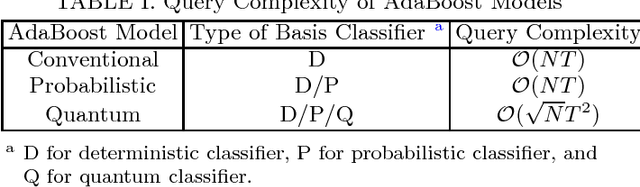
In classical machine learning, a set of weak classifiers can be adaptively combined to form a strong classifier for improving the overall performance, a technique called adaptive boosting (or AdaBoost). However, constructing the strong classifier for a large data set is typically resource consuming. Here we propose a quantum extension of AdaBoost, demonstrating a quantum algorithm that can output the optimal strong classifier with a quadratic speedup in the number of queries of the weak classifiers. Our results also include a generalization of the standard AdaBoost to the cases where the output of each classifier may be probabilistic even for the same input. We prove that the update rules and the query complexity of the non-deterministic classifiers are the same as those of deterministic classifiers, which may be of independent interest to the classical machine-learning community. Furthermore, the AdaBoost algorithm can also be applied to data encoded in the form of quantum states; we show how the training set can be simplified by using the tools of t-design. Our approach describes a model of quantum machine learning where quantum speedup is achieved in finding the optimal classifier, which can then be applied for classical machine-learning applications.