 Add to Chrome
 Add to Firefox
 Add to Edge
NaviDriveVLM: Decoupling High-Level Reasoning and Motion Planning for Autonomous Driving
Mar 09, 2026
Vision-language models (VLMs) have emerged as a promising direction for end-to-end autonomous driving (AD) by jointly modeling visual observations, driving context, and language-based reasoning. However, existing VLM-based systems face a trade-off between high-level reasoning and motion planning: large models offer strong semantic understanding but are costly to adapt for precise control, whereas small VLM models can be fine-tuned efficiently but often exhibit weaker reasoning. We propose NaviDriveVLM, a decoupled framework that separates reasoning from action generation using a large-scale Navigator and a lightweight trainable Driver. This design preserves reasoning ability, reduces training cost, and provides an explicit interpretable intermediate representation for downstream planning. Experiments on the nuScenes benchmark show that NaviDriveVLM outperforms large VLM baselines in end-to-end motion planning.

Toward Unified Multimodal Representation Learning for Autonomous Driving
Mar 09, 2026Contrastive Language-Image Pre-training (CLIP) has shown impressive performance in aligning visual and textual representations. Recent studies have extended this paradigm to 3D vision to improve scene understanding for autonomous driving. A common strategy is to employ pairwise cosine similarity between modalities to guide the training of a 3D encoder. However, considering the similarity between individual modality pairs rather than all modalities jointly fails to ensure consistent and unified alignment across the entire multimodal space. In this paper, we propose a Contrastive Tensor Pre-training (CTP) framework that simultaneously aligns multiple modalities in a unified embedding space to enhance end-to-end autonomous driving. Compared with pairwise cosine similarity alignment, our method extends the 2D similarity matrix into a multimodal similarity tensor. Furthermore, we introduce a tensor loss to enable joint contrastive learning across all modalities. For experimental validation of our framework, we construct a text-image-point cloud triplet dataset derived from existing autonomous driving datasets. The results show that our proposed unified multimodal alignment framework achieves favorable performance for both scenarios: (i) aligning a 3D encoder with pretrained CLIP encoders, and (ii) pretraining all encoders from scratch.
Model-Free and Learning-Free Proprioceptive Humanoid Movement Control
Feb 28, 2023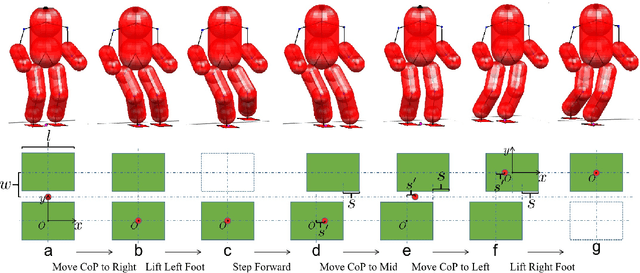
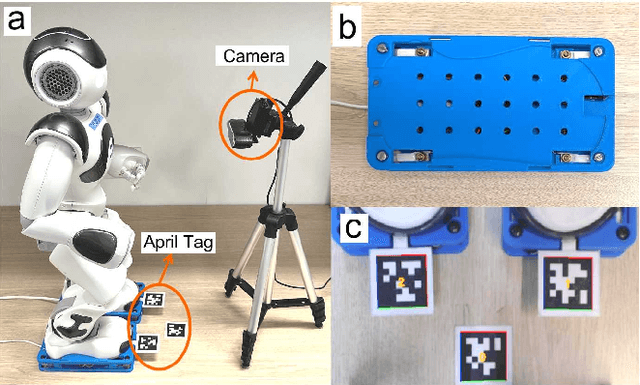
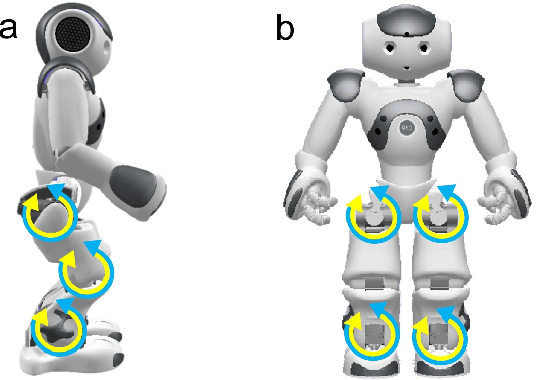
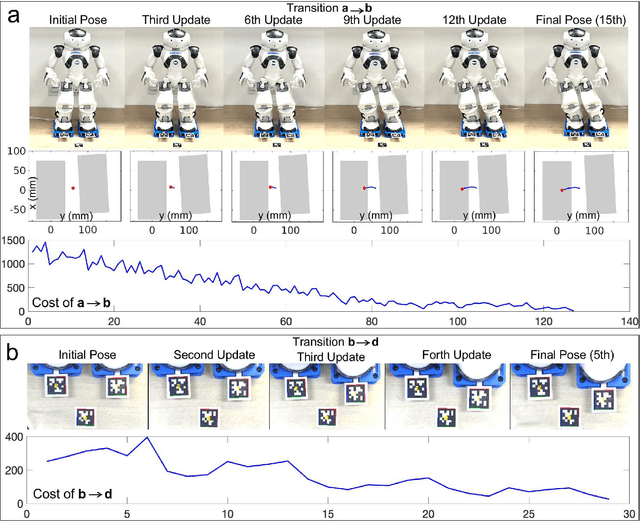
This paper presents a novel model-free method for humanoid-robot quasi-static movement control. Traditional model-based methods often require precise robot model parameters. Additionally, existing learning-based frameworks often train the policy in simulation environments, thereby indirectly relying on a model. In contrast, we propose a proprioceptive framework based only on sensory outputs. It does not require prior knowledge of a robot's kinematic model or inertial parameters. Our method consists of three steps: 1. Planning different pairs of center of pressure (CoP) and foot position objectives within a single cycle. 2. Searching around the current configuration by slightly moving the robot's leg joints back and forth while recording the sensor measurements of its CoP and foot positions. 3. Updating the robot motion with an optimization algorithm until all objectives are achieved. We demonstrate our approach on a NAO humanoid robot platform. Experiment results show that it can successfully generate stable robot motions.