 Add to Chrome
 Add to Firefox
 Add to Edge
A Recursive Decomposition Framework for Causal Structure Learning in the Presence of Latent Variables
May 11, 2026
Constraint-based causal discovery is widely used for learning causal structures, but heavy reliance on conditional independence (CI) testing makes it computationally expensive in high-dimensional settings. To mitigate this limitation, many divide-and-conquer frameworks have been proposed, but most assume causal sufficiency, i.e., no latent variables. In this paper, we show that divide-and-conquer strategies can be theoretically generalized beyond causal sufficiency to settings with latent variables. Specifically, we propose a recursive decomposition framework, termed DiCoLa, that enables divide-and-conquer causal discovery in the presence of latent variables. It recursively decomposes the global learning task into smaller subproblems and integrates their solutions through a principled reconstruction step to recover the global structure. We theoretically establish the soundness and completeness of the proposed framework. Extensive experiments on synthetic data demonstrate that our approach significantly improves computational efficiency across a range of causal discovery algorithms, while experiments on a real-world dataset further illustrate its practical effectiveness.

Testability of Instrumental Variables in Additive Nonlinear, Non-Constant Effects Models
Nov 19, 2024

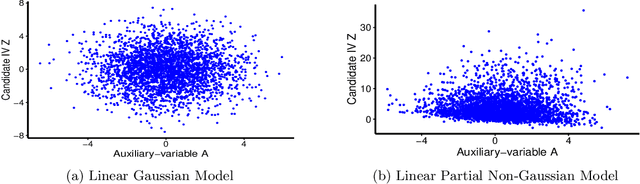

We address the issue of the testability of instrumental variables derived from observational data. Most existing testable implications are centered on scenarios where the treatment is a discrete variable, e.g., instrumental inequality (Pearl, 1995), or where the effect is assumed to be constant, e.g., instrumental variables condition based on the principle of independent mechanisms (Burauel, 2023). However, treatments can often be continuous variables, such as drug dosages or nutritional content levels, and non-constant effects may occur in many real-world scenarios. In this paper, we consider an additive nonlinear, non-constant effects model with unmeasured confounders, in which treatments can be either discrete or continuous, and propose an Auxiliary-based Independence Test (AIT) condition to test whether a variable is a valid instrument. We first show that if the candidate instrument is valid, then the AIT condition holds. Moreover, we illustrate the implications of the AIT condition and demonstrate that, in certain conditions, AIT conditions are necessary and sufficient to detect all invalid IVs. We also extend the AIT condition to include covariates and introduce a practical testing algorithm. Experimental results on both synthetic and three different real-world datasets show the effectiveness of our proposed condition.