 Add to Chrome
 Add to Firefox
 Add to Edge
MOTOR-Bench: A Real-world Dataset and Multi-agent Framework for Zero-shot Human Mental State Understanding
May 10, 2026
Understanding human mental states from natural behavior is crucial for intelligent systems in the real world. However, most current research focuses on predicting isolated mental state labels, lacking structured annotations of complex interpersonal interactions. To support structured analysis, we introduce MOTOR-Bench, a carefully-designed benchmark with a real-world dataset MOTOR-dataset, containing 1,440 multimodal video clips in collaborative learning scenarios, reflecting key real-world data challenges including natural class imbalance, visual noise, and domain-specific language. Each sample is labeled by educational experts based on self-regulated learning theory. We further evaluate several state-of-the-art multimodal large language models and multi-agent systems in a zero-shot setting on our MOTOR-Bench. However, their performance on this task remains limited, suggesting that existing methods still struggle with structured reasoning from observable behavior to deeper mental states. To address this challenge, we propose a reasoning multi-agent framework, named MOTOR-MAS. It coordinates multiple agents through a structured agent coordination mechanism to infer explicit behaviors, internal cognitions, and psychological emotions. Experimental results show that our MOTOR-MAS outperforms the best single-model benchmark by 15.93 points in Macro-F1 scores for the three labels of behavior, cognition, and emotion, and outperforms the general multi-agent benchmark by 10.2 points in internal cognition prediction.

HABD: a houma alliance book ancient handwritten character recognition database
Aug 26, 2024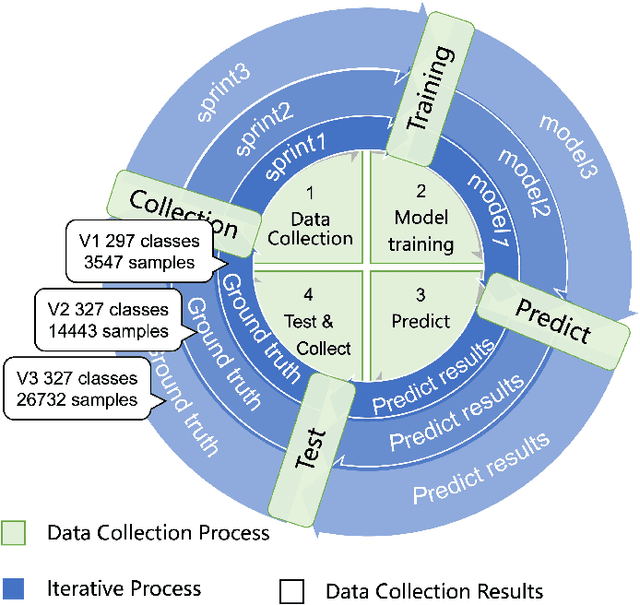
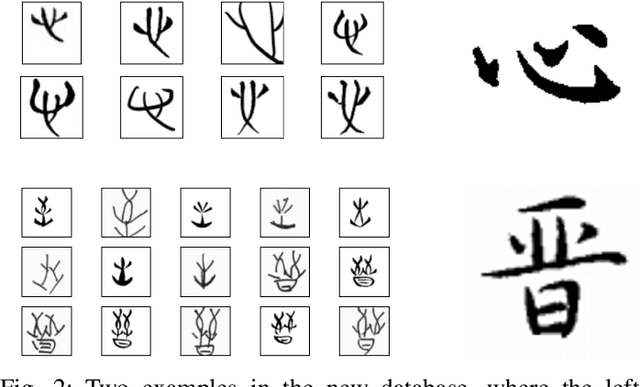
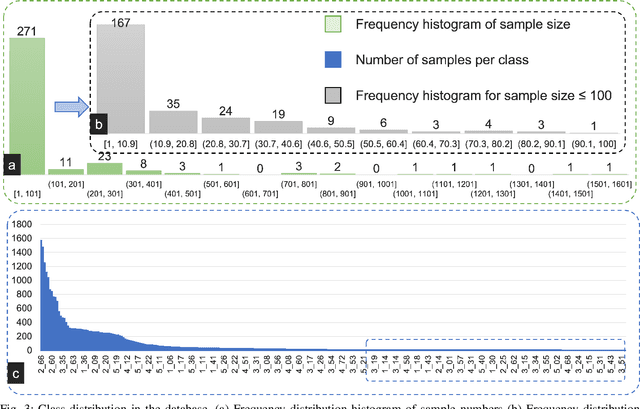
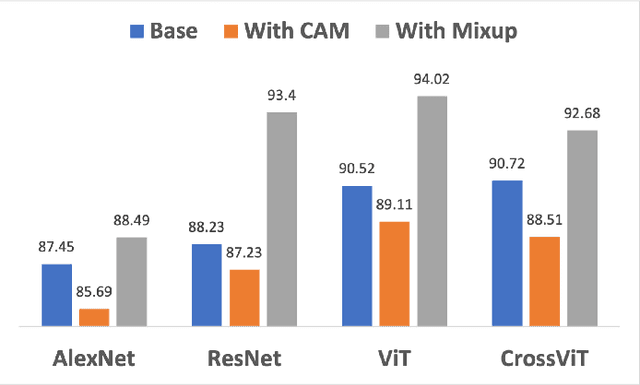
The Houma Alliance Book, one of history's earliest calligraphic examples, was unearthed in the 1970s. These artifacts were meticulously organized, reproduced, and copied by the Shanxi Provincial Institute of Cultural Relics. However, because of their ancient origins and severe ink erosion, identifying characters in the Houma Alliance Book is challenging, necessitating the use of digital technology. In this paper, we propose a new ancient handwritten character recognition database for the Houma alliance book, along with a novel benchmark based on deep learning architectures. More specifically, a collection of 26,732 characters samples from the Houma Alliance Book were gathered, encompassing 327 different types of ancient characters through iterative annotation. Furthermore, benchmark algorithms were proposed by combining four deep neural network classifiers with two data augmentation methods. This research provides valuable resources and technical support for further studies on the Houma Alliance Book and other ancient characters. This contributes to our understanding of ancient culture and history, as well as the preservation and inheritance of humanity's cultural heritage.
A new database of Houma Alliance Book ancient handwritten characters and its baseline algorithm
Jul 17, 2022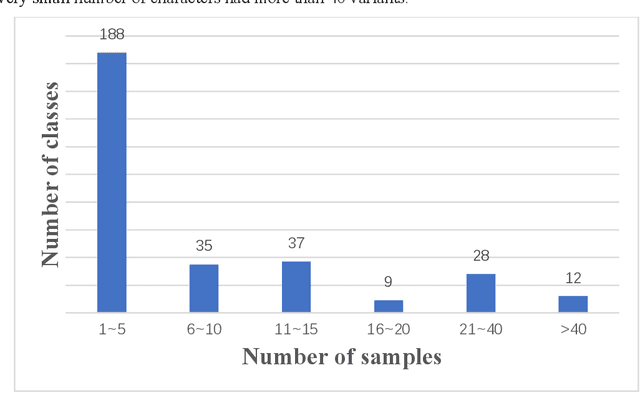
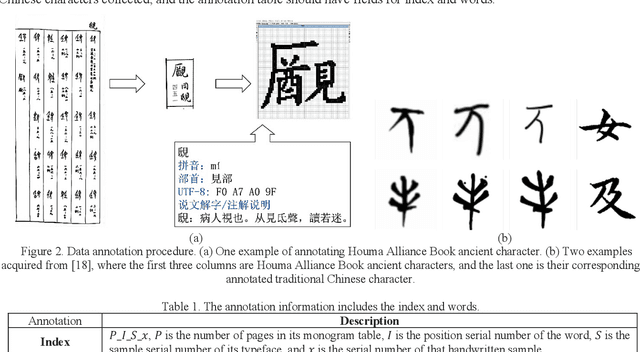
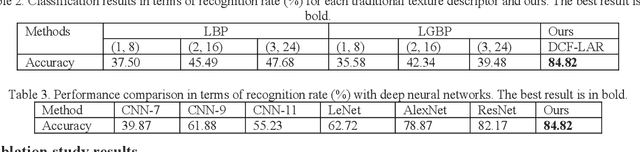
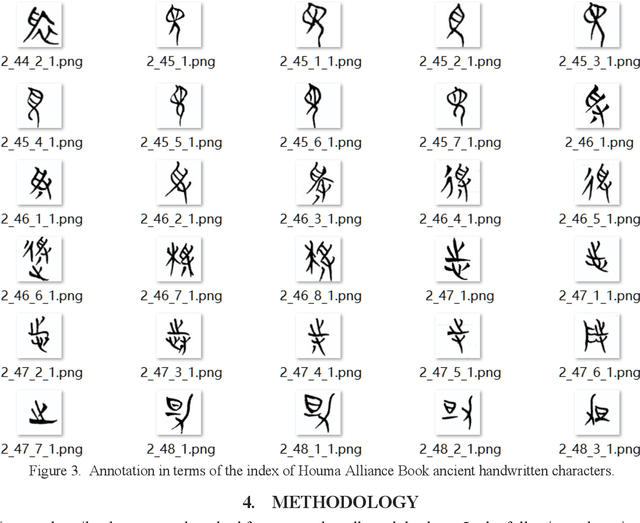
The Houma Alliance Book is one of the national treasures of the Museum in Shanxi Museum Town in China. It has great historical significance in researching ancient history. To date, the research on the Houma Alliance Book has been staying in the identification of paper documents, which is inefficient to identify and difficult to display, study and publicize. Therefore, the digitization of the recognized ancient characters of Houma League can effectively improve the efficiency of recognizing ancient characters and provide more reliable technical support and text data. This paper proposes a new database of Houma Alliance Book ancient handwritten characters and a multi-modal fusion method to recognize ancient handwritten characters. In the database, 297 classes and 3,547 samples of Houma Alliance ancient handwritten characters are collected from the original book collection and by human imitative writing. Furthermore, the decision-level classifier fusion strategy is applied to fuse three well-known deep neural network architectures for ancient handwritten character recognition. Experiments are performed on our new database. The experimental results first provide the baseline result of the new database to the research community and then demonstrate the efficiency of our proposed method.