 Add to Chrome
 Add to Firefox
 Add to Edge
MOTOR-Bench: A Real-world Dataset and Multi-agent Framework for Zero-shot Human Mental State Understanding
May 10, 2026
Understanding human mental states from natural behavior is crucial for intelligent systems in the real world. However, most current research focuses on predicting isolated mental state labels, lacking structured annotations of complex interpersonal interactions. To support structured analysis, we introduce MOTOR-Bench, a carefully-designed benchmark with a real-world dataset MOTOR-dataset, containing 1,440 multimodal video clips in collaborative learning scenarios, reflecting key real-world data challenges including natural class imbalance, visual noise, and domain-specific language. Each sample is labeled by educational experts based on self-regulated learning theory. We further evaluate several state-of-the-art multimodal large language models and multi-agent systems in a zero-shot setting on our MOTOR-Bench. However, their performance on this task remains limited, suggesting that existing methods still struggle with structured reasoning from observable behavior to deeper mental states. To address this challenge, we propose a reasoning multi-agent framework, named MOTOR-MAS. It coordinates multiple agents through a structured agent coordination mechanism to infer explicit behaviors, internal cognitions, and psychological emotions. Experimental results show that our MOTOR-MAS outperforms the best single-model benchmark by 15.93 points in Macro-F1 scores for the three labels of behavior, cognition, and emotion, and outperforms the general multi-agent benchmark by 10.2 points in internal cognition prediction.

Transition Network Analysis: A Novel Framework for Modeling, Visualizing, and Identifying the Temporal Patterns of Learners and Learning Processes
Nov 23, 2024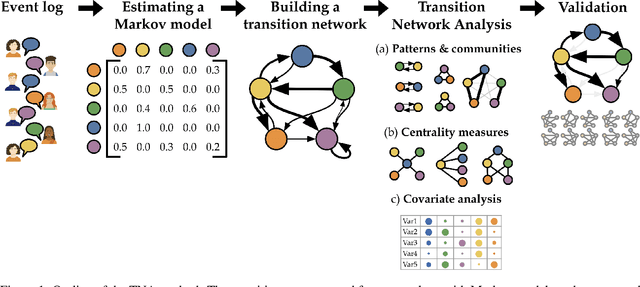

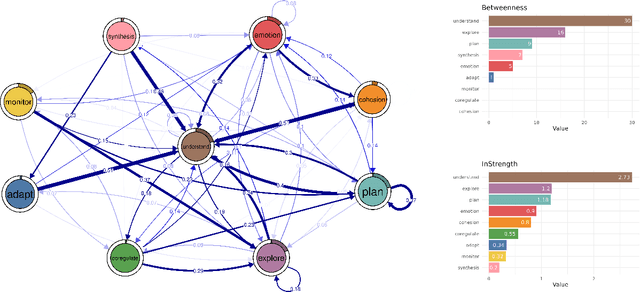
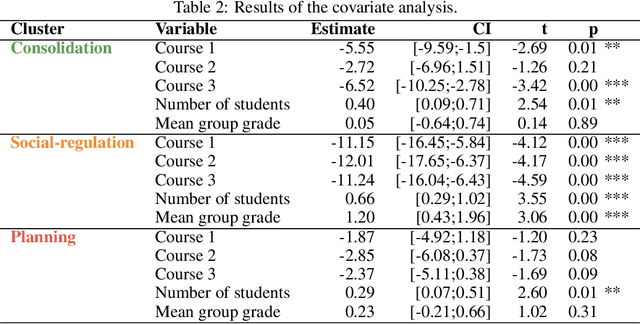
This paper proposes a novel analytical framework: Transition Network Analysis (TNA), an approach that integrates Stochastic Process Mining and probabilistic graph representation to model, visualize, and identify transition patterns in the learning process data. Combining the relational and temporal aspects into a single lens offers capabilities beyond either framework, including centralities to capture important learning events, community finding to identify patterns of behavior, and clustering to reveal temporal patterns. This paper introduces the theoretical and mathematical foundations of TNA. To demonstrate the functionalities of TNA, we present a case study with students (n=191) engaged in small-group collaboration to map patterns of group dynamics using the theories of co-regulation and socially-shared regulated learning. The analysis revealed that TNA could reveal the regulatory processes and identify important events, temporal patterns and clusters. Bootstrap validation established the significant transitions and eliminated spurious transitions. In doing so, we showcase TNA's utility to capture learning dynamics and provide a robust framework for investigating the temporal evolution of learning processes. Future directions include advancing estimation methods, expanding reliability assessment, exploring longitudinal TNA, and comparing TNA networks using permutation tests.