 Add to Chrome
 Add to Firefox
 Add to Edge
ERF-GS: Reconstructing Fast Motion from Disjoint Event-RGB Viewpoints
Aug 09, 2026
Deep learning-driven representations such as neural radiance fields (NeRFs) and 3D Gaussian splatting (3DGS) have revolutionized the field of dynamic 3D scene reconstruction with improved visual precision and scalability. However, the reconstruction of fast-moving objects remains a challenge; existing methods based on conventional frame-based videos often struggle in scenarios such as sports events and animal videography. We propose an event-RGB fusion Gaussian splatting (ERF-GS) framework that integrates event information into both optimization and densification stages of the Gaussian splatting pipeline, taking advantage of novel event sensors with high frame-rate. Unlike many other event-assisted scene reconstruction methods, ERF-GS was developed using realistic simulation settings and realizes event-based learning detached from RGB inputs. This design enables its application beyond straightforward synthetic data into the realm of natural video with complex layout, low frame rates and severe motion blur. Our experiments show that ERF-GS outperforms both the 4DGS baseline and the concurrent E-D3DGS on different variants of the Neu3D and Nvidia datasets which include blurry RGB frames and disjoint RGB-event viewpoints. Our code is available at https://github.com/andrewbxy/ERF-GS.

PhyGaP: Physically-Grounded Gaussians with Polarization Cues
Mar 14, 2026Recent advances in 3D Gaussian Splatting (3DGS) have demonstrated great success in modeling reflective 3D objects and their interaction with the environment via deferred rendering (DR). However, existing methods often struggle with correctly reconstructing physical attributes such as albedo and reflectance, and therefore they do not support high-fidelity relighting. Observing that this limitation stems from the lack of shape and material information in RGB images, we present PhyGaP, a physically-grounded 3DGS method that leverages polarization cues to facilitate precise reflection decomposition and visually consistent relighting of reconstructed objects. Specifically, we design a polarimetric deferred rendering (PolarDR) process to model polarization by reflection, and a self-occlusion-aware environment map building technique (GridMap) to resolve indirect lighting of non-convex objects. We validate on multiple synthetic and real-world scenes, including those featuring only partial polarization cues, that PhyGaP not only excels in reconstructing the appearance and surface normal of reflective 3D objects (~2 dB in PSNR and 45.7% in Cosine Distance better than existing RGB-based methods on average), but also achieves state-of-the-art inverse rendering and relighting capability. Our code will be released soon.
EventTracer: Fast Path Tracing-based Event Stream Rendering
Aug 25, 2025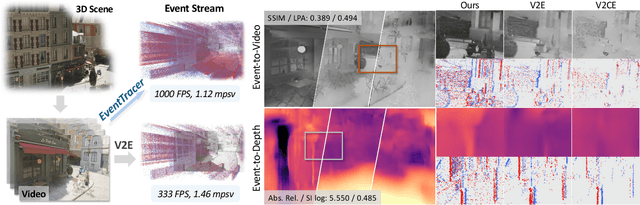

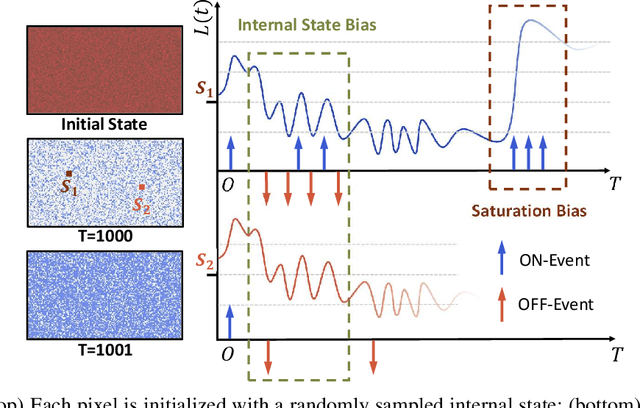
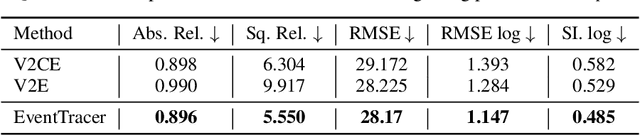
Simulating event streams from 3D scenes has become a common practice in event-based vision research, as it meets the demand for large-scale, high temporal frequency data without setting up expensive hardware devices or undertaking extensive data collections. Yet existing methods in this direction typically work with noiseless RGB frames that are costly to render, and therefore they can only achieve a temporal resolution equivalent to 100-300 FPS, far lower than that of real-world event data. In this work, we propose EventTracer, a path tracing-based rendering pipeline that simulates high-fidelity event sequences from complex 3D scenes in an efficient and physics-aware manner. Specifically, we speed up the rendering process via low sample-per-pixel (SPP) path tracing, and train a lightweight event spiking network to denoise the resulting RGB videos into realistic event sequences. To capture the physical properties of event streams, the network is equipped with a bipolar leaky integrate-and-fired (BiLIF) spiking unit and trained with a bidirectional earth mover distance (EMD) loss. Our EventTracer pipeline runs at a speed of about 4 minutes per second of 720p video, and it inherits the merit of accurate spatiotemporal modeling from its path tracing backbone. We show in two downstream tasks that EventTracer captures better scene details and demonstrates a greater similarity to real-world event data than other event simulators, which establishes it as a promising tool for creating large-scale event-RGB datasets at a low cost, narrowing the sim-to-real gap in event-based vision, and boosting various application scenarios such as robotics, autonomous driving, and VRAR.
Enhanced Velocity Field Modeling for Gaussian Video Reconstruction
Jul 31, 2025High-fidelity 3D video reconstruction is essential for enabling real-time rendering of dynamic scenes with realistic motion in virtual and augmented reality (VR/AR). The deformation field paradigm of 3D Gaussian splatting has achieved near-photorealistic results in video reconstruction due to the great representation capability of deep deformation networks. However, in videos with complex motion and significant scale variations, deformation networks often overfit to irregular Gaussian trajectories, leading to suboptimal visual quality. Moreover, the gradient-based densification strategy designed for static scene reconstruction proves inadequate to address the absence of dynamic content. In light of these challenges, we propose a flow-empowered velocity field modeling scheme tailored for Gaussian video reconstruction, dubbed FlowGaussian-VR. It consists of two core components: a velocity field rendering (VFR) pipeline which enables optical flow-based optimization, and a flow-assisted adaptive densification (FAD) strategy that adjusts the number and size of Gaussians in dynamic regions. We validate our model's effectiveness on multi-view dynamic reconstruction and novel view synthesis with multiple real-world datasets containing challenging motion scenarios, demonstrating not only notable visual improvements (over 2.5 dB gain in PSNR) and less blurry artifacts in dynamic textures, but also regularized and trackable per-Gaussian trajectories.