 Add to Chrome
 Add to Firefox
 Add to Edge
T-ADD: Enhancing DOA Estimation Robustness Against Adversarial Attacks
Dec 11, 2025
Deep learning has achieved remarkable success in direction-of-arrival (DOA) estimation. However, recent studies have shown that adversarial perturbations can severely compromise the performance of such models. To address this vulnerability, we propose Transformer-based Adversarial Defense for DOA estimation (T-ADD), a transformer-based defense method designed to counter adversarial attacks. To achieve a balance between robustness and estimation accuracy, we formulate the adversarial defense as a joint reconstruction task and introduce a tailored joint loss function. Experimental results demonstrate that, compared with three state-of-the-art adversarial defense methods, the proposed T-ADD significantly mitigates the adverse effects of widely used adversarial attacks, leading to notable improvements in the adversarial robustness of the DOA model.

Free energy model of emotional valence in dual-process perceptions
Oct 19, 2022
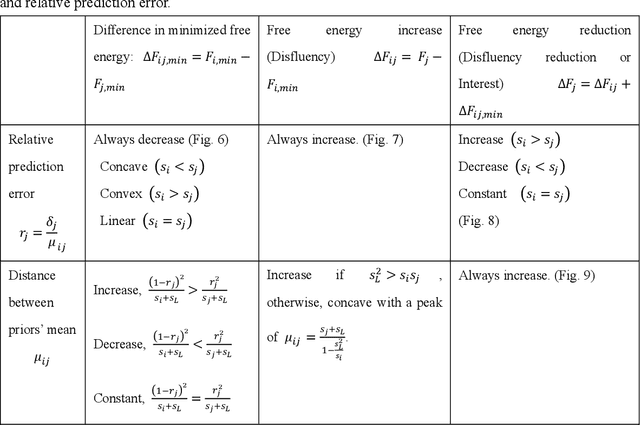
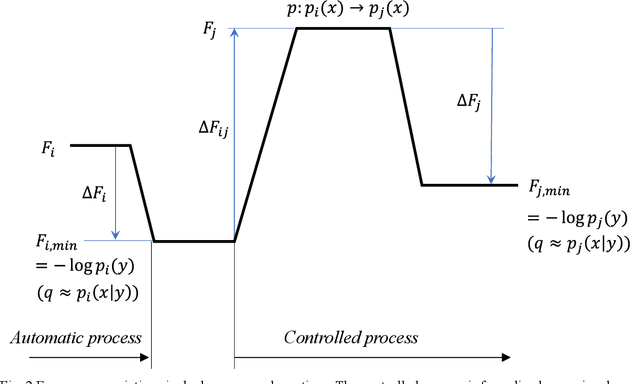

An appropriate level of arousal induces positive emotions, and a high arousal potential may provoke negative emotions. To explain the effect of arousal on emotional valence, we propose a novel mathematical framework of arousal potential variations in the dual process of human cognition: automatic and controlled process. Although models have been proposed to explain the emotions in the dual process, a suitable mathematical formulation is largely undiscovered. Our model associates free energy with arousal potential and its variations to explain emotional valence. Decreasing and increasing free energy consequently induces positive and negative emotions, respectively. We formalize a transition from the automatic to controlled process in the dual process as a change of Bayesian prior. We model emotion valence using free-energy increase (FI) when one tries to change one's Bayesian prior and its reduction (FR) when one succeeds to recognize the same stimuli with a changed prior and define three emotions: "interest," "confusion," and "boredom" using the variations. The mathematical analysis comparing between varied Gaussian model parameters suggests that: 1) prediction error (PR) increases FR when the first prior variance is greater than the second prior variance, 2) PR always increases FR, and 3) the distance between priors' means always increases FR. We discuss the association of the outcomes with emotions in the controlled process. The mathematical model provides a general framework for predicting and controlling emotional valence in the dual process that varies with viewpoint and stimuli, as well as for understanding the contradictions in the effects of arousal on the valence.