 Add to Chrome
 Add to Firefox
 Add to Edge
Free Energy-Based Modeling of Emotional Dynamics in Video Advertisements
Dec 22, 2025
Emotional responses during advertising video viewing are recognized as essential for understanding media effects because they have influenced attention, memory, and purchase intention. To establish a methodological basis for explainable emotion estimation without relying on external information such as physiological signals or subjective ratings, we have quantified "pleasantness," "surprise," and "habituation" solely from scene-level expression features of advertising videos, drawing on the free energy(FE) principle, which has provided a unified account of perception, learning, and behavior. In this framework, Kullback-Leibler divergence (KLD) has captured prediction error, Bayesian surprise (BS) has captured belief updates, and uncertainty (UN) has reflected prior ambiguity, and together they have formed the core components of FE. Using 1,059 15 s food video advertisements, the experiments have shown that KLD has reflected "pleasantness" associated with brand presentation, BS has captured "surprise" arising from informational complexity, and UN has reflected "surprise" driven by uncertainty in element types and spatial arrangements, as well as by the variability and quantity of presented elements. This study also identified three characteristic emotional patterns, namely uncertain stimulus, sustained high emotion, and momentary peak and decay, demonstrating the usefulness of the proposed method. Robustness across nine hyperparameter settings and generalization tests with six types of Japanese advertising videos (three genres and two durations) confirmed that these tendencies remained stable. This work can be extended by integrating a wider range of expression elements and validating the approach through subjective ratings, ultimately guiding the development of technologies that can support the creation of more engaging advertising videos.

Modeling arousal potential of epistemic emotions using Bayesian information gain: Inquiry cycle driven by free energy fluctuations
Dec 14, 2023Epistemic emotions, such as curiosity and interest, drive the inquiry process. This study proposes a novel formulation of epistemic emotions such as curiosity and interest using two types of information gain generated by the principle of free energy minimization: Kullback-Leibler divergence(KLD) from Bayesian posterior to prior, which represents free energy reduction in recognition, and Bayesian surprise (BS), which represents the expected information gain by Bayesian prior update. By applying a Gaussian generative model with an additional uniform likelihood, we found that KLD and BS form an upward-convex function of surprise (minimized free energy and prediction error), similar to Berlyne's arousal potential functions, or the Wundt curve. We consider that the alternate maximization of BS and KLD generates an ideal inquiry cycle to approach the optimal arousal level with fluctuations in surprise, and that curiosity and interest drive to facilitate the cyclic process. We exhaustively analyzed the effects of prediction uncertainty (prior variance) and observation uncertainty (likelihood variance) on the peaks of the information gain function as optimal surprises. The results show that greater prediction uncertainty, meaning an open-minded attitude, and less observational uncertainty, meaning precise observation with attention, are expected to provide greater information gains through a greater range of exploration. The proposed mathematical framework unifies the free energy principle of the brain and the arousal potential theory to explain the Wundt curve as an information gain function and suggests an ideal inquiry process driven by epistemic emotions.
Modeling the sense of presence of remote participants in hybrid communication and its application to the design of avatar robot behavior
May 02, 2023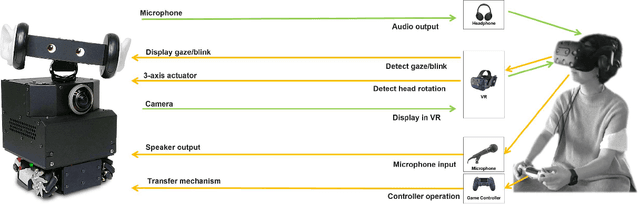
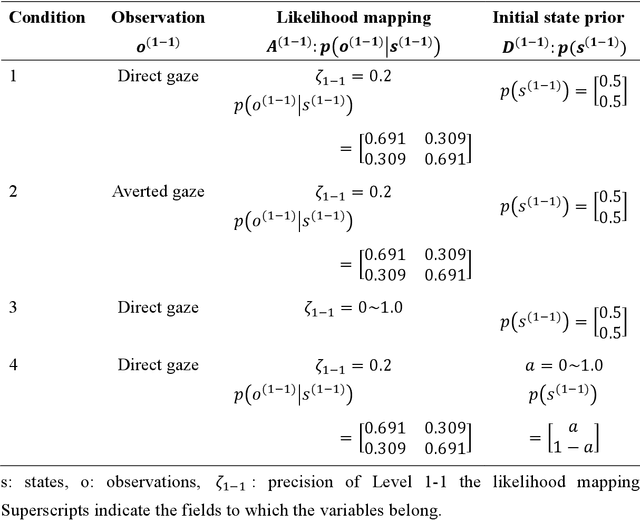
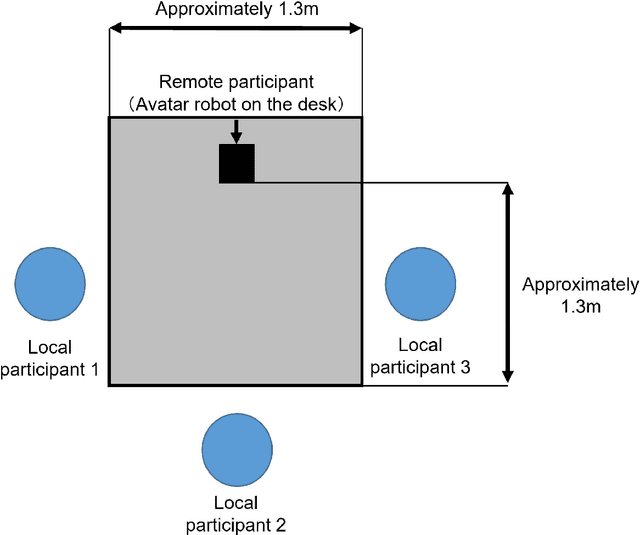
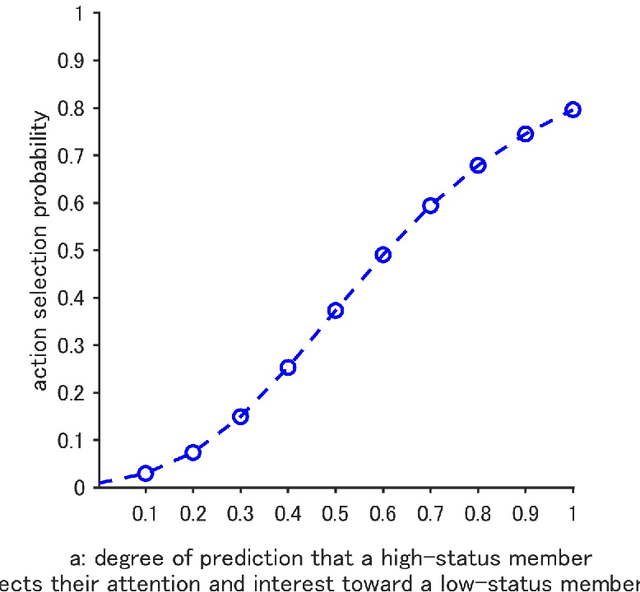
We formulated the sense of the presence of a remote participant in hybrid communication using a Bayesian framework. We also applied the knowledge gained from the simulation with the Bayesian model to the avatar robot's intervention behavior and encouraged the local participants to speak by intervening in the remote participant's behavior using an avatar robot. We then modeled the influence of the avatar robot's behavior on the local participants' statements using an active inference framework that included the presence of a remote participant as a latent variable. Based on the simulation results, we designed the gaze behavior of an avatar robot. Finally, we examined the effectiveness of the designed gaze behavior of the avatar robot. The gaze behavior expressed more of the remote participant's attention and interest in local participants, but local participants expressed fewer opinions in the meeting tasks. The results suggest that gaze behavior increased the presence of the remote participant and discouraged the local participant from speaking in the context of the experimental task. We believe that presence has a sufficiently large influence on whether participants want to express an opinion. It is worth investigating the influence of presence and its control methods using Bayesian models.
Free energy model of emotional valence in dual-process perceptions
Oct 19, 2022
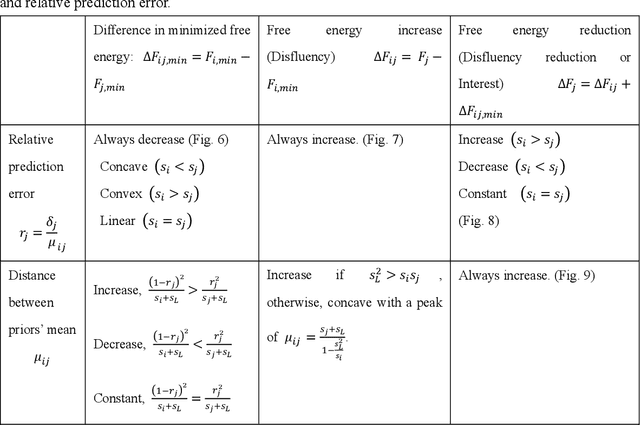
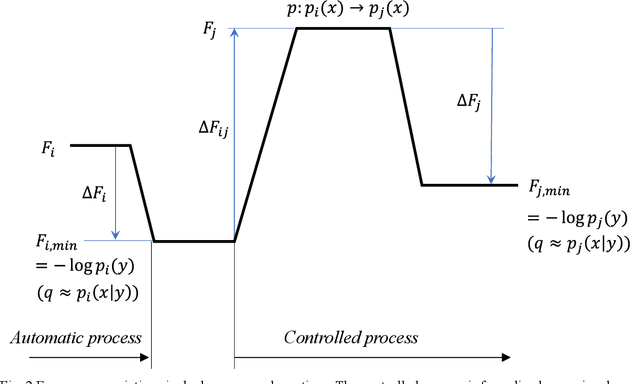

An appropriate level of arousal induces positive emotions, and a high arousal potential may provoke negative emotions. To explain the effect of arousal on emotional valence, we propose a novel mathematical framework of arousal potential variations in the dual process of human cognition: automatic and controlled process. Although models have been proposed to explain the emotions in the dual process, a suitable mathematical formulation is largely undiscovered. Our model associates free energy with arousal potential and its variations to explain emotional valence. Decreasing and increasing free energy consequently induces positive and negative emotions, respectively. We formalize a transition from the automatic to controlled process in the dual process as a change of Bayesian prior. We model emotion valence using free-energy increase (FI) when one tries to change one's Bayesian prior and its reduction (FR) when one succeeds to recognize the same stimuli with a changed prior and define three emotions: "interest," "confusion," and "boredom" using the variations. The mathematical analysis comparing between varied Gaussian model parameters suggests that: 1) prediction error (PR) increases FR when the first prior variance is greater than the second prior variance, 2) PR always increases FR, and 3) the distance between priors' means always increases FR. We discuss the association of the outcomes with emotions in the controlled process. The mathematical model provides a general framework for predicting and controlling emotional valence in the dual process that varies with viewpoint and stimuli, as well as for understanding the contradictions in the effects of arousal on the valence.
Intrinsic motivation in virtual assistant interaction for fostering spontaneous interactions
Oct 13, 2020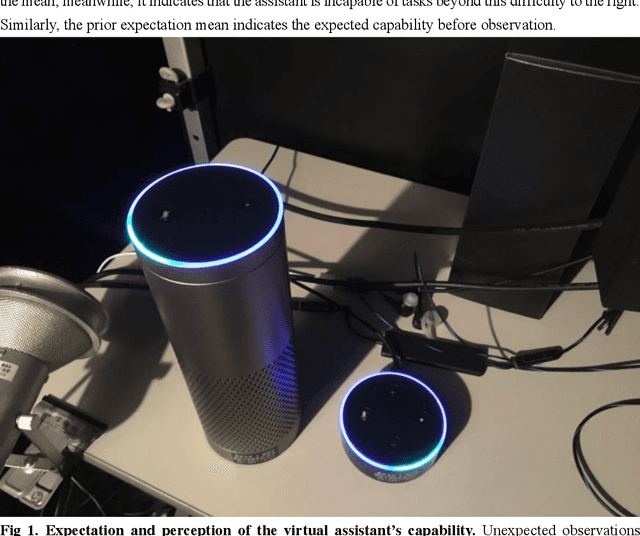
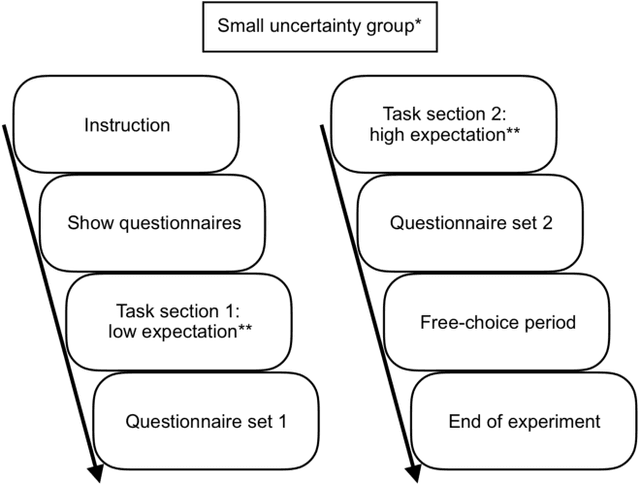
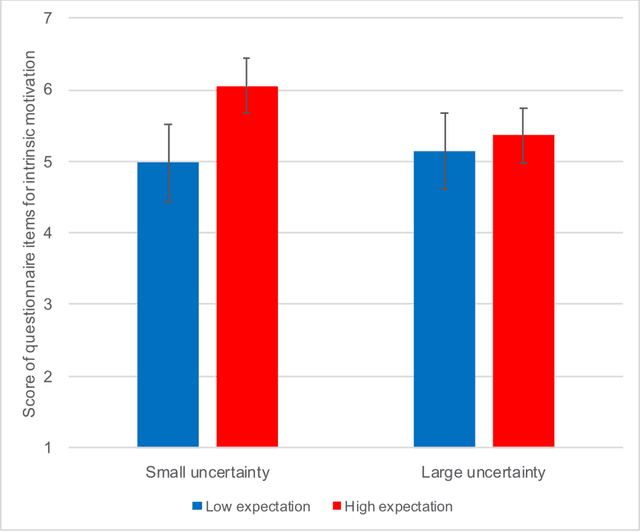
With the growing utility of today's conversational virtual assistants, the importance of user motivation in human-AI interaction is becoming more obvious. However, previous studies in this and related fields, such as human-computer interaction and human-robot interaction, scarcely discussed intrinsic motivation and its affecting factors. Those studies either treated motivation as an inseparable concept or focused on non-intrinsic motivation. The current study aims to cover intrinsic motivation by taking an affective-engineering approach. A novel motivation model is proposed, in which intrinsic motivation is affected by two factors that derive from user interactions with virtual assistants: expectation of capability and uncertainty. Experiments are conducted where these two factors are manipulated by making participants believe they are interacting with the smart speaker "Amazon Echo". Intrinsic motivation is measured both by using questionnaires and by covertly monitoring a five-minute free-choice period in the experimenter's absence, during which the participants could decide for themselves whether to interact with the virtual assistants. Results of the first experiment showed that high expectation engenders more intrinsically motivated interaction compared with low expectation. The results also suggested suppressive effects by uncertainty on intrinsic motivation, though we had not hypothesized before experiments. We then revised our hypothetical model of action selection accordingly and conducted a verification experiment of uncertainty's effects. Results of the verification experiment showed that reducing uncertainty encourages more interactions and causes the motivation behind these interactions to shift from non-intrinsic to intrinsic.
Information-Theoretic Free Energy as Emotion Potential: Emotional Valence as a Function of Complexity and Novelty
Mar 23, 2020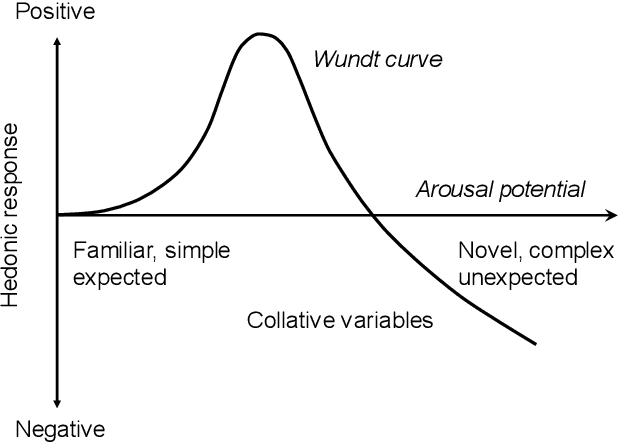
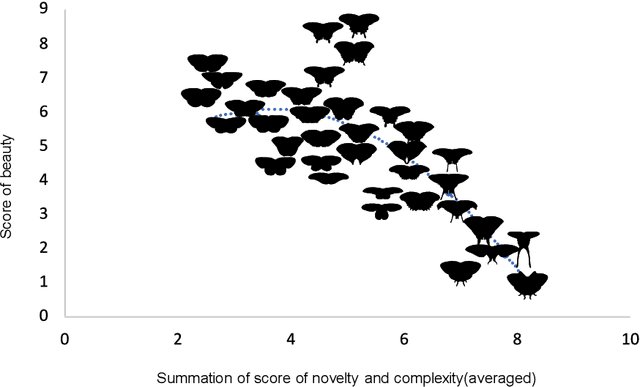
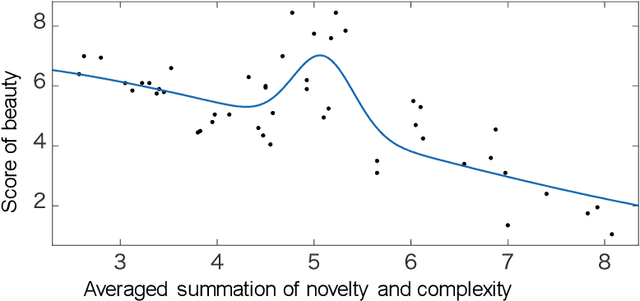
This study extends the mathematical model of emotion dimensions that we previously proposed (Yanagisawa, et al. 2019, Front Comput Neurosci) to consider perceived complexity as well as novelty, as a source of arousal potential. Berlyne's hedonic function of arousal potential (or the inverse U-shaped curve, the so-called Wundt curve) is assumed. We modeled the arousal potential as information contents to be processed in the brain after sensory stimuli are perceived (or recognized), which we termed sensory surprisal. We mathematically demonstrated that sensory surprisal represents free energy, and it is equivalent to a summation of information gain (or information from novelty) and perceived complexity (or information from complexity), which are the collative variables forming the arousal potential. We demonstrated empirical evidence with visual stimuli (profile shapes of butterfly) supporting the hypothesis that the summation of perceived novelty and complexity shapes the inverse U-shaped beauty function. We discussed the potential of free energy as a mathematical principle explaining emotion initiators.