 Add to Chrome
 Add to Firefox
 Add to Edge
T-ADD: Enhancing DOA Estimation Robustness Against Adversarial Attacks
Dec 11, 2025
Deep learning has achieved remarkable success in direction-of-arrival (DOA) estimation. However, recent studies have shown that adversarial perturbations can severely compromise the performance of such models. To address this vulnerability, we propose Transformer-based Adversarial Defense for DOA estimation (T-ADD), a transformer-based defense method designed to counter adversarial attacks. To achieve a balance between robustness and estimation accuracy, we formulate the adversarial defense as a joint reconstruction task and introduce a tailored joint loss function. Experimental results demonstrate that, compared with three state-of-the-art adversarial defense methods, the proposed T-ADD significantly mitigates the adverse effects of widely used adversarial attacks, leading to notable improvements in the adversarial robustness of the DOA model.

Deep Learning-Based Wideband Spectrum Sensing with Dual-Representation Inputs and Subband Shuffling Augmentation
Apr 10, 2025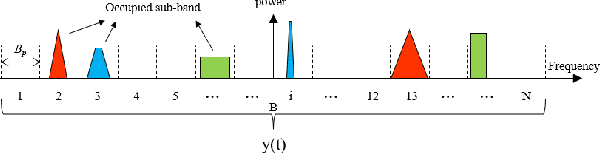
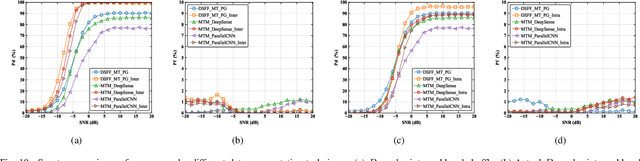
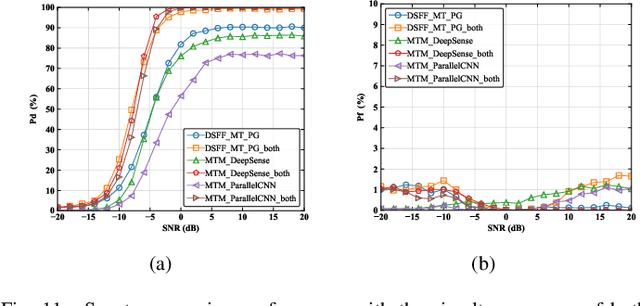
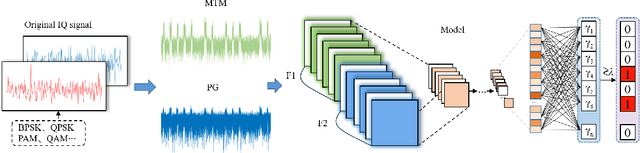
The widespread adoption of mobile communication technology has led to a severe shortage of spectrum resources, driving the development of cognitive radio technologies aimed at improving spectrum utilization, with spectrum sensing being the key enabler. This paper presents a novel deep learning-based wideband spectrum sensing framework that leverages multi-taper power spectral inputs to achieve high-precision and sample-efficient sensing. To enhance sensing accuracy, we incorporate a feature fusion strategy that combines multiple power spectrum representations. To tackle the challenge of limited sample sizes, we propose two data augmentation techniques designed to expand the training set and improve the network's detection probability. Comprehensive simulation results demonstrate that our method outperforms existing approaches, particularly in low signal-to-noise ratio conditions, achieving higher detection probabilities and lower false alarm rates. The method also exhibits strong robustness across various scenarios, highlighting its significant potential for practical applications in wireless communication systems.