 Add to Chrome
 Add to Firefox
 Add to Edge
OmniFaceRig: Fully Automatic Inner-Mouth-Aware Face Rigging Across Diverse 3D Character Topologies
Jun 06, 2026
Facial rigging - creating FACS-based blendshapes together with inner-mouth geometry (teeth, gums, and tongue) - remains a major bottleneck in 3D character production. Existing pipelines still require substantial designer effort, especially for manual landmark annotation, per-character template adjustment, and inner-mouth placement. We present OmniFaceRig, a fully automatic end-to-end pipeline that converts a static surface-only 3D character mesh, with no pre-modeled oral cavity, into an inner-mouth-aware FACS rig with up to 155 blendshapes, procedurally fitted teeth, gums, and tongue, and re-packed UV/texture. OmniFaceRig supports diverse topologies - humans, humanoids, long-muzzled animals (e.g., dogs, wolves, foxes), and short-muzzled animals (e.g., cats, bears, rabbits, tigers) - with no manual landmarks, no user-provided templates, and no per-asset setup. The pipeline combines hybrid VLM+CV riggability checking, multi-model face parsing, dense keypoint-driven template registration, procedural inner-mouth construction, and collision-aware blendshape transfer. For non-human characters, OmniFaceRig selects topology-specific face and inner-mouth templates and uses collision-aware inner-mouth fitting to reduce teeth-face intersections without exposing users to category-specific tuning. We also publicly release Omni-Bench, a freely available benchmark dataset of 1,000 biped 3D characters with FACS facial blendshapes and inner-mouth geometry, spanning humans, humanoids, cats, dogs, and other animals. Experiments show high final rigging success on screened Omni-Bench inputs, nearly complete face detection recall from the segmentation ensemble and reliable inner-mouth placement with low penetration. Together, OmniFaceRig provides an automatic path from static generated characters to animation-ready facial rigs across both human and non-human topologies.

Multiface: A Dataset for Neural Face Rendering
Jul 22, 2022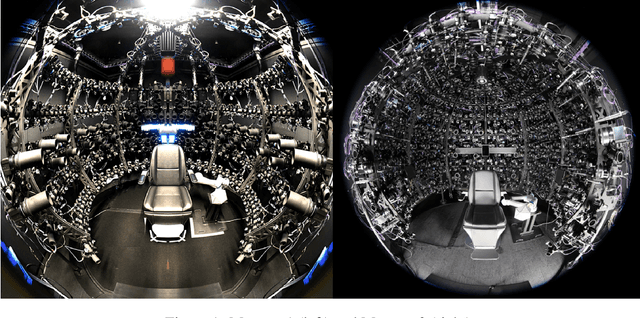
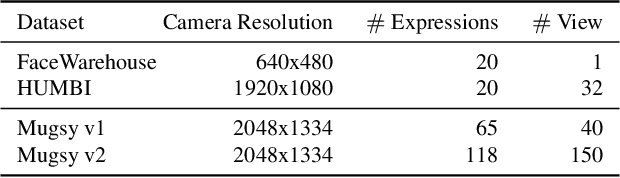
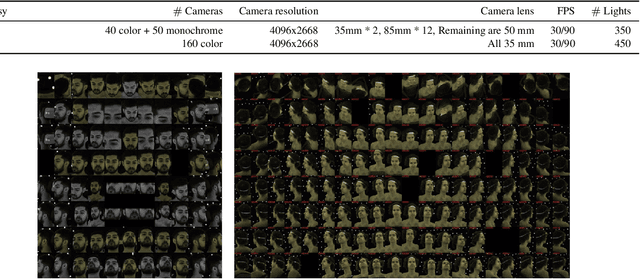
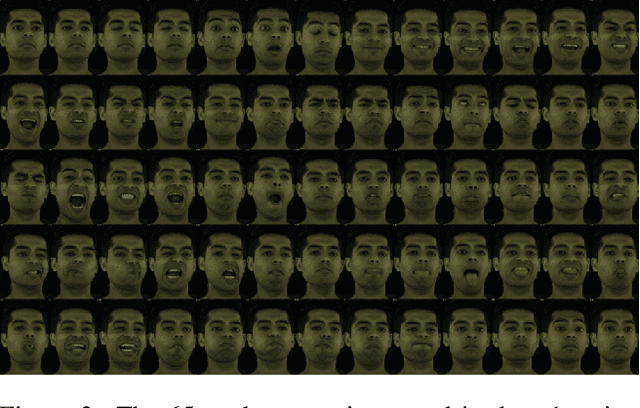
Photorealistic avatars of human faces have come a long way in recent years, yet research along this area is limited by a lack of publicly available, high-quality datasets covering both, dense multi-view camera captures, and rich facial expressions of the captured subjects. In this work, we present Multiface, a new multi-view, high-resolution human face dataset collected from 13 identities at Reality Labs Research for neural face rendering. We introduce Mugsy, a large scale multi-camera apparatus to capture high-resolution synchronized videos of a facial performance. The goal of Multiface is to close the gap in accessibility to high quality data in the academic community and to enable research in VR telepresence. Along with the release of the dataset, we conduct ablation studies on the influence of different model architectures toward the model's interpolation capacity of novel viewpoint and expressions. With a conditional VAE model serving as our baseline, we found that adding spatial bias, texture warp field, and residual connections improves performance on novel view synthesis. Our code and data is available at: https://github.com/facebookresearch/multiface