 Add to Chrome
 Add to Firefox
 Add to Edge
MoAKE: Toward Unified All-in-One Action Quality Assessment via Mixture of Action Knowledge Experts
Jul 22, 2026
Action Quality Assessment (AQA) aims to objectively evaluate performance quality from action videos. Most existing methods follow a ``one-by-one'' paradigm, training a separate model for each action type. This setting limits real-world deployment, as it requires prior action-type knowledge to select the corresponding model and suffers from poor generalization across diverse actions. To address these limitations, we study the challenging task of all-in-one AQA, which aims to assess heterogeneous actions within a single unified model. We propose a novel Mixture of Action Knowledge Experts (MoAKE) framework, designed to mitigate negative knowledge transfer caused by large semantic discrepancies among actions. MoAKE learns complementary experts that capture diverse action patterns within a shared semantic space and dynamically aggregates their knowledge to adapt the assessment to the input action. Each expert is tailored with segment-aware prototypes to handle varying temporal lengths, together with an Adaptive Intra- and Inter-Segment Relationship Modeling (AIISRM) module to model multi-granularity temporal dynamics. Furthermore, we establish comprehensive benchmarks for all-in-one as well as zero/few-shot AQA. Extensive experiments on three long-term datasets demonstrate that MoAKE significantly outperforms existing methods in the all-in-one setting, while also achieving consistent generalization on three short-term datasets under zero/few-shot evaluation. Code is available at https://github.com/XuHuangbiao/MoAKE.

$\mathbf{S^2LM}$: Towards Semantic Steganography via Large Language Models
Nov 07, 2025Although steganography has made significant advancements in recent years, it still struggles to embed semantically rich, sentence-level information into carriers. However, in the era of AIGC, the capacity of steganography is more critical than ever. In this work, we present Sentence-to-Image Steganography, an instance of Semantic Steganography, a novel task that enables the hiding of arbitrary sentence-level messages within a cover image. Furthermore, we establish a benchmark named Invisible Text (IVT), comprising a diverse set of sentence-level texts as secret messages for evaluation. Finally, we present $\mathbf{S^2LM}$: Semantic Steganographic Language Model, which utilizes large language models (LLMs) to embed high-level textual information, such as sentences or even paragraphs, into images. Unlike traditional bit-level counterparts, $\mathrm{S^2LM}$ enables the integration of semantically rich content through a newly designed pipeline in which the LLM is involved throughout the entire process. Both quantitative and qualitative experiments demonstrate that our method effectively unlocks new semantic steganographic capabilities for LLMs. The source code will be released soon.
Scene-aware SAR ship detection guided by unsupervised sea-land segmentation
Jun 15, 2025DL based Synthetic Aperture Radar (SAR) ship detection has tremendous advantages in numerous areas. However, it still faces some problems, such as the lack of prior knowledge, which seriously affects detection accuracy. In order to solve this problem, we propose a scene-aware SAR ship detection method based on unsupervised sea-land segmentation. This method follows a classical two-stage framework and is enhanced by two models: the unsupervised land and sea segmentation module (ULSM) and the land attention suppression module (LASM). ULSM and LASM can adaptively guide the network to reduce attention on land according to the type of scenes (inshore scene and offshore scene) and add prior knowledge (sea land segmentation information) to the network, thereby reducing the network's attention to land directly and enhancing offshore detection performance relatively. This increases the accuracy of ship detection and enhances the interpretability of the model. Specifically, in consideration of the lack of land sea segmentation labels in existing deep learning-based SAR ship detection datasets, ULSM uses an unsupervised approach to classify the input data scene into inshore and offshore types and performs sea-land segmentation for inshore scenes. LASM uses the sea-land segmentation information as prior knowledge to reduce the network's attention to land. We conducted our experiments using the publicly available SSDD dataset, which demonstrated the effectiveness of our network.
Sar Ship Detection based on Swin Transformer and Feature Enhancement Feature Pyramid Network
Sep 21, 2022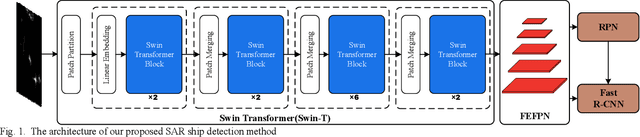
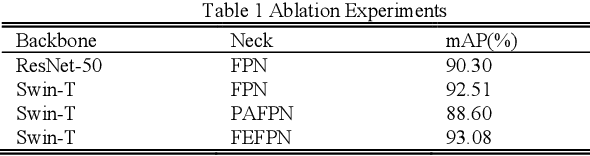
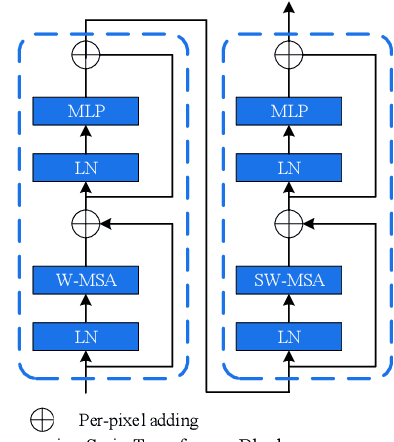
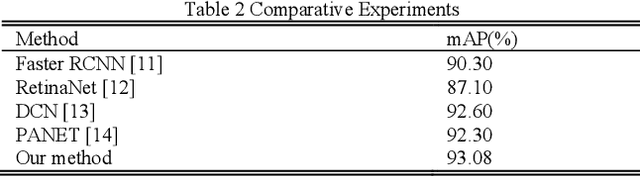
With the booming of Convolutional Neural Networks (CNNs), CNNs such as VGG-16 and ResNet-50 widely serve as backbone in SAR ship detection. However, CNN based backbone is hard to model long-range dependencies, and causes the lack of enough high-quality semantic information in feature maps of shallow layers, which leads to poor detection performance in complicated background and small-sized ships cases. To address these problems, we propose a SAR ship detection method based on Swin Transformer and Feature Enhancement Feature Pyramid Network (FEFPN). Swin Transformer serves as backbone to model long-range dependencies and generates hierarchical features maps. FEFPN is proposed to further improve the quality of feature maps by gradually enhancing the semantic information of feature maps at all levels, especially feature maps in shallow layers. Experiments conducted on SAR ship detection dataset (SSDD) reveal the advantage of our proposed methods.