 Add to Chrome
 Add to Firefox
 Add to Edge
NVIDIA OmniDreams: Real-Time Generative World Model for Closed-Loop Autonomous Vehicle Simulation
Jun 02, 2026
As autonomous vehicle capabilities advance, the safe evaluation of driving policies in long-tail scenarios remains a critical bottleneck. In closed-loop simulation, the driving policy model actively interacts with the environment, where its actions dynamically update the simulator state and directly influence the next set of generated sensor observations. While recent reconstruction-based neural simulators offer photorealism, they are fundamentally constrained by their initial captured data and struggle to generalize to highly dynamic or novel scenes. To overcome these limitations, we introduce OmniDreams, a foundation generative world model mid- and post-trained from the Cosmos diffusion model to autoregressively generate action-conditioned videos in real time. By leveraging the rich visual priors of Cosmos and mid- and post-training on 21k hours of driving scenarios, OmniDreams synthesizes complex, unobserved phenomena that are hard for traditional simulators to capture, such as extreme weather and unpredictable dynamic agent behaviors. Crucially, it autoregressively conditions its photorealistic sensor generation on past frames, the current simulator state, and immediate driving actions. Deployed in a closed-loop system with the Alpamayo 1 policy model and AlpaSim orchestrator, OmniDreams acts as a highly responsive, reactive environment, providing a scalable and comprehensive solution for training and evaluating next-generation autonomous driving policies. We additionally show preliminary results indicating that a world-action model (WAM) post-trained from OmniDreams achieves strong performance on the Physical AI Autonomous Vehicles NuRec dataset, surpassing the VLA-based Alpamayo 1.5 research policy model while using only 1/5 the total parameters. These results highlight the potential for a real-time world model like OmniDreams to also serve as a backbone for policy architectures.

DAVE Aquatic Virtual Environment: Toward a General Underwater Robotics Simulator
Sep 06, 2022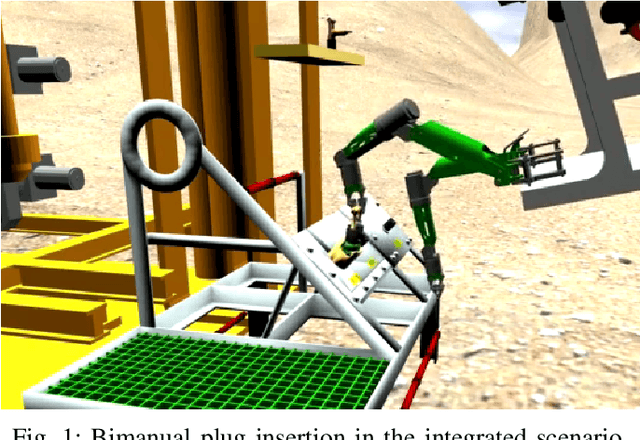
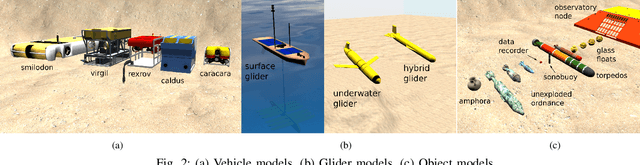
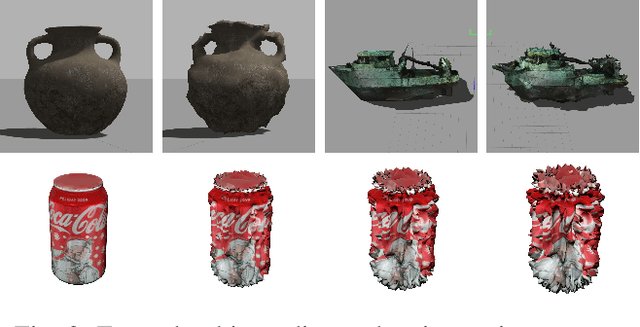
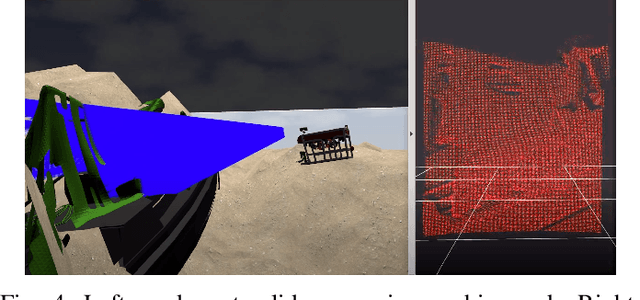
We present DAVE Aquatic Virtual Environment (DAVE), an open source simulation stack for underwater robots, sensors, and environments. Conventional robotics simulators are not designed to address unique challenges that come with the marine environment, including but not limited to environment conditions that vary spatially and temporally, impaired or challenging perception, and the unavailability of data in a generally unexplored environment. Given the variety of sensors and platforms, wheels are often reinvented for specific use cases that inevitably resist wider adoption. Building on existing simulators, we provide a framework to help speed up the development and evaluation of algorithms that would otherwise require expensive and time-consuming operations at sea. The framework includes basic building blocks (e.g., new vehicles, water-tracking Doppler Velocity Logger, physics-based multibeam sonar) as well as development tools (e.g., dynamic bathymetry spawning, ocean currents), which allows the user to focus on methodology rather than software infrastructure. We demonstrate usage through example scenarios, bathymetric data import, user interfaces for data inspection and motion planning for manipulation, and visualizations.