 Add to Chrome
 Add to Firefox
 Add to Edge
HipKittens: Fast and Furious AMD Kernels
Nov 11, 2025
AMD GPUs offer state-of-the-art compute and memory bandwidth; however, peak performance AMD kernels are written in raw assembly. To address the difficulty of mapping AI algorithms to hardware, recent work proposes C++ embedded and PyTorch-inspired domain-specific languages like ThunderKittens (TK) to simplify high performance AI kernel development on NVIDIA hardware. We explore the extent to which such primitives -- for explicit tile-based programming with optimized memory accesses and fine-grained asynchronous execution across workers -- are NVIDIA-specific or general. We provide the first detailed study of the programming primitives that lead to performant AMD AI kernels, and we encapsulate these insights in the HipKittens (HK) programming framework. We find that tile-based abstractions used in prior DSLs generalize to AMD GPUs, however we need to rethink the algorithms that instantiate these abstractions for AMD. We validate the HK primitives across CDNA3 and CDNA4 AMD platforms. In evaluations, HK kernels compete with AMD's hand-optimized assembly kernels for GEMMs and attention, and consistently outperform compiler baselines. Moreover, assembly is difficult to scale to the breadth of AI workloads; reflecting this, in some settings HK outperforms all available kernel baselines by $1.2-2.4\times$ (e.g., $d=64$ attention, GQA backwards, memory-bound kernels). These findings help pave the way for a single, tile-based software layer for high-performance AI kernels that translates across GPU vendors. HipKittens is released at: https://github.com/HazyResearch/HipKittens.

Improving Low-Resource Cross-lingual Document Retrieval by Reranking with Deep Bilingual Representations
Jun 08, 2019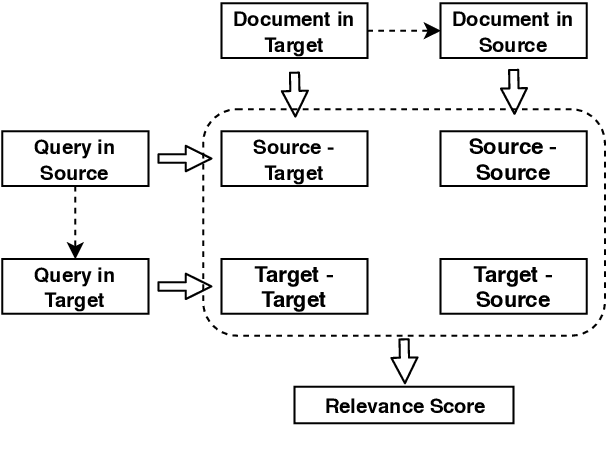
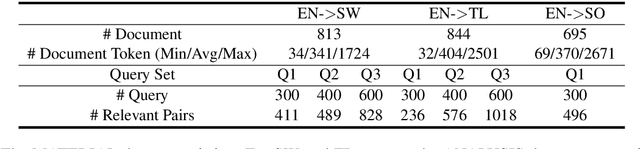

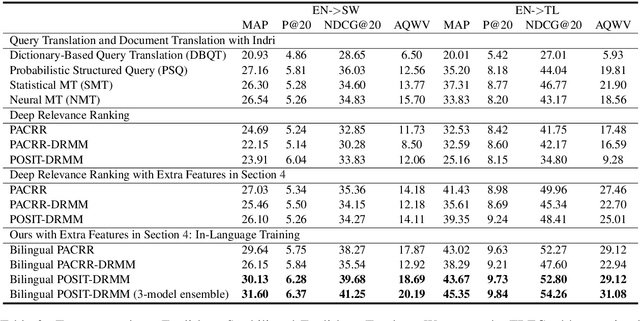
In this paper, we propose to boost low-resource cross-lingual document retrieval performance with deep bilingual query-document representations. We match queries and documents in both source and target languages with four components, each of which is implemented as a term interaction-based deep neural network with cross-lingual word embeddings as input. By including query likelihood scores as extra features, our model effectively learns to rerank the retrieved documents by using a small number of relevance labels for low-resource language pairs. Due to the shared cross-lingual word embedding space, the model can also be directly applied to another language pair without any training label. Experimental results on the MATERIAL dataset show that our model outperforms the competitive translation-based baselines on English-Swahili, English-Tagalog, and English-Somali cross-lingual information retrieval tasks.