 Add to Chrome
 Add to Firefox
 Add to Edge
CoEvo-Mem: Co-Evolving Retrieval Policy and Memory Bank for LLM Agents
Aug 03, 2026
As memories accumulate across tasks and sessions, the performance of long-term LLM agents depends jointly on query-specific retrieval and continual memory refinement. However, existing methods typically optimize either memory access, through iterative query refinement or adaptive retrieval policies, or memory evolution such as structural update. This separation overlooks a fundamental feedback loop: retrieval determines which memories receive usage signals, while updated memory bank reshape future retrieval. We propose \textbf{CoEvo-Mem}, a closed-loop framework for co-evolving the retrieval policy and memory bank. For each query, a frozen LLM generates route-specific query rewrites and a routing prior, which a lightweight residual router corrects online. The retrieved context serves as the coupling interface between the two learning processes: task outcomes assign credit to routing decisions, while trajectory-conditioned feedback updates memory values and graph relations. These updates alter how memories are ranked and selected for subsequent queries, thereby closing the feedback loop. To mitigate coupling induced non-stationarity, CoEvo-Mem alternates between updating the router with the memory bank fixed and evolving the memory bank with the retrieval policy fixed. Across seven diverse benchmarks, \textbf{CoEvo-Mem} achieves state-of-the-art performance, demonstrating the importance of retrieval-memory coevolution.

Matryoshka Gaussian Splatting
Mar 19, 2026The ability to render scenes at adjustable fidelity from a single model, known as level of detail (LoD), is crucial for practical deployment of 3D Gaussian Splatting (3DGS). Existing discrete LoD methods expose only a limited set of operating points, while concurrent continuous LoD approaches enable smoother scaling but often suffer noticeable quality degradation at full capacity, making LoD a costly design decision. We introduce Matryoshka Gaussian Splatting (MGS), a training framework that enables continuous LoD for standard 3DGS pipelines without sacrificing full-capacity rendering quality. MGS learns a single ordered set of Gaussians such that rendering any prefix, the first k splats, produces a coherent reconstruction whose fidelity improves smoothly with increasing budget. Our key idea is stochastic budget training: each iteration samples a random splat budget and optimises both the corresponding prefix and the full set. This strategy requires only two forward passes and introduces no architectural modifications. Experiments across four benchmarks and six baselines show that MGS matches the full-capacity performance of its backbone while enabling a continuous speed-quality trade-off from a single model. Extensive ablations on ordering strategies, training objectives, and model capacity further validate the designs.
ARF-Plus: Controlling Perceptual Factors in Artistic Radiance Fields for 3D Scene Stylization
Sep 06, 2023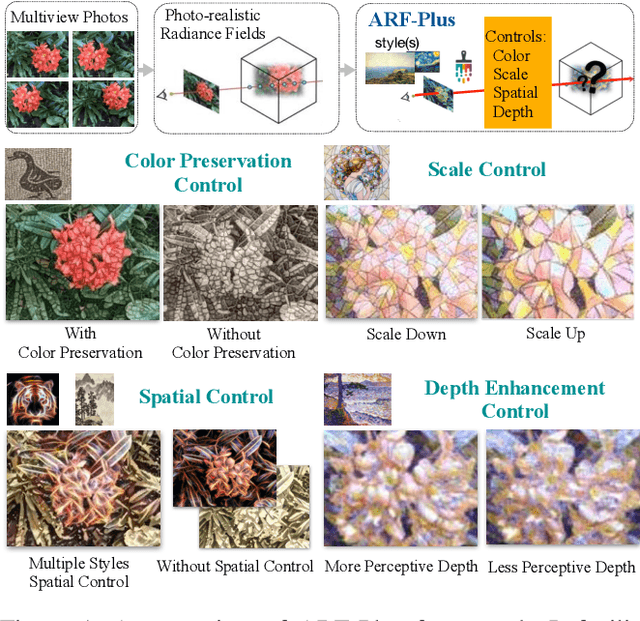
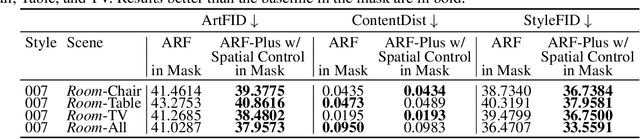
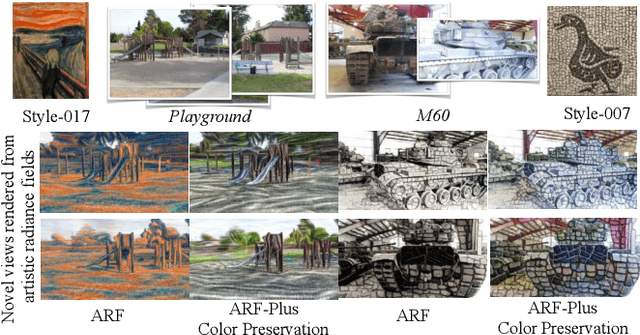
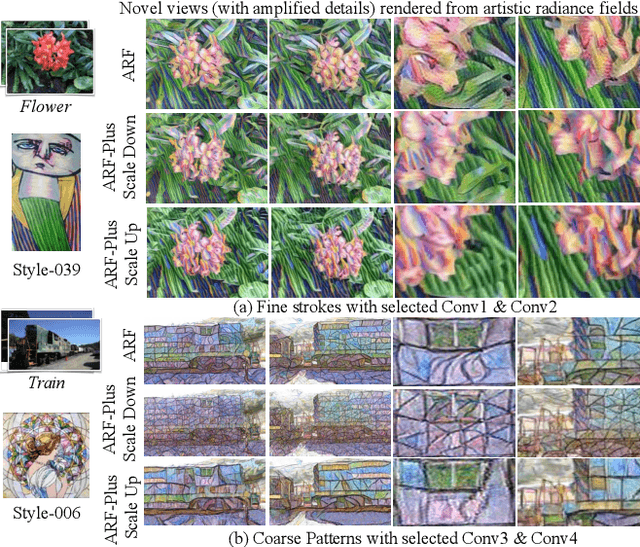
The radiance fields style transfer is an emerging field that has recently gained popularity as a means of 3D scene stylization, thanks to the outstanding performance of neural radiance fields in 3D reconstruction and view synthesis. We highlight a research gap in radiance fields style transfer, the lack of sufficient perceptual controllability, motivated by the existing concept in the 2D image style transfer. In this paper, we present ARF-Plus, a 3D neural style transfer framework offering manageable control over perceptual factors, to systematically explore the perceptual controllability in 3D scene stylization. Four distinct types of controls - color preservation control, (style pattern) scale control, spatial (selective stylization area) control, and depth enhancement control - are proposed and integrated into this framework. Results from real-world datasets, both quantitative and qualitative, show that the four types of controls in our ARF-Plus framework successfully accomplish their corresponding perceptual controls when stylizing 3D scenes. These techniques work well for individual style inputs as well as for the simultaneous application of multiple styles within a scene. This unlocks a realm of limitless possibilities, allowing customized modifications of stylization effects and flexible merging of the strengths of different styles, ultimately enabling the creation of novel and eye-catching stylistic effects on 3D scenes.