 Add to Chrome
 Add to Firefox
 Add to Edge
iFAN: Inference-Aware Learning for Plain Mask Transformers
Aug 07, 2026
Query-based mask transformers assemble segmentation outputs through pixel-wise competition among query predictions of the final layer, yet this inference process is not explicitly optimized during training. We identify two key mismatches: the query with the highest probability-mask score does not necessarily produce the most accurate mask, and final-layer decoding may discard superior predictions from intermediate layers. To address these issues, we propose Inference-Aware Learning (iFAN), a general training framework for plain mask transformers. iFAN introduces Adjusted Probability-Mask Ranking (APMR), which aligns query competition with predicted mask quality and suppresses high-confidence but inaccurate competitors. We further employ Cross-Layer Self-Distillation (CLSD) to transfer stronger intermediate predictions to the final layer. The ranking and distillation objectives are training-only, while inference retains efficient final-layer decoding. Experiments on COCO, ADE20K, and Cityscapes demonstrate consistent improvements across panoptic, instance, and semantic segmentation, as well as across different architectures, backbone scales, and input resolutions. Overall, iFAN improves performance by an average of 1.20 PQ, 1.30 AP, and 0.63 mIoU, with negligible additional parameters, FLOPs and inference latency.

Stop Replacing Noise with Noise: Two-Source Reliability Assessment for Label Correction and Sample Reweighting in Label-Noise Learning
Aug 04, 2026Refurbishment-based noisy-label learning mixes an observed label with a model-derived pseudo target, typically using one sample-wise cleanliness score to control both branches. This creates a hidden coupling: reducing trust in the observed label automatically increases trust in the pseudo target. We show that this complementarity can replace one unreliable signal with another because a pseudo target learned from corrupted supervision may reproduce the noise it is meant to correct. Our representation diagnostics provide a consistent account of this mismatch: noisy supervision redirects deeper layers more strongly, whereas shallower relations remain comparatively stable and provide information beyond the loss posterior. We therefore propose TRACE, a Two-Source Reliability Assessment framework for Label Correction and Sample Reweighting. TRACE assesses the observed label using loss fit, shallow relation stability, and prediction agreement, while separately assessing the pseudo target using model confidence. Its source-specific scores control target correction and supervision strength without assuming complementary reliability. Across synthetic and real-world noisy benchmarks, TRACE improves representative refurbishment baselines and yields more reliable pseudo supervision.
Recompute or Reuse? Diagnosing and Mitigating Textual Shortcuts in VLM Self-Reflection
Aug 03, 2026Vision-language models (VLMs) are expected to revise their reasoning when visual evidence changes. Failures to do so are often attributed to insufficient visual attention or contextual inertia, leaving unclear what models reuse instead of recomputing from the current image. We show that evidence-bearing reasoning in a prior chain of thought (CoT) can form a textual shortcut that competes behaviorally with visual recomputation. Across 16 VLMs, a matched counterfactual analysis identifies evidence-bearing content as the most robust carrier of prior-CoT influence. Removing this evidence-bearing content shifts answer preference more than removing length-matched non-evidence context or the final-answer span, with prior control weakening progressively as more stale evidence is removed. Reordering this evidence also weakens prior control, showing that its organization modulates shortcut strength. Beyond the immediate answer, the shortcut can retain residual influence after answer correction: weakening current-image support shifts preference back toward the prior answer, while repeated prior answers and reused premises arise mainly when the shortcut remains active. To limit this influence, we introduce Fresh-State Attention Firewall (FSAF), a training-free intervention that isolates fresh computation from the prior CoT. Across five VLMs, FSAF raises visual update rate from 35.28% to 53.61% and reduces prior-answer rate from 39.22% to 3.67%. Reliable VLM self-reflection therefore requires more than looking again: fresh visual recomputation must be protected from stale textual reuse.
OrientSAM: Mitigating Camera-Centric Shortcut in Multimodal Spatial Reasoning via Orientation-Aware Spatial Alignment
Jul 20, 2026Multimodal large language models (MLLMs) still struggle with spatial reasoning that requires perspective transformation. In particular, they often rely on camera-centric cues rather than reasoning from the reference object's viewpoint, leading to systematic errors in non-camera reference settings. In this paper, we first analyze this failure mode and show that object orientation is a key factor underlying such camera-centric shortcut behavior. To address this issue, we propose OrientSAM, an orientation-aware spatial alignment framework for multimodal models. OrientSAM injects explicit orientation information into multimodal representations through orientation-aware tokens and Fourier-based angle encoding, and further adopts a curriculum learning strategy to progressively improve perspective-aware reasoning. In addition, we build a spatial data construction pipeline to generate orientation-aware spatial supervision from large-scale images. Experiments on Spatial-MM, ViewSpatial, and 3DSRBench show that OrientSAM consistently outperforms strong baselines, especially on non-camera-view, person-centric, and orientation-sensitive tasks. The results further demonstrate that explicit orientation modeling is important for mitigating camera-centric shortcut behavior and enabling more robust allocentric spatial reasoning in multimodal models.
Leveraging Dissimilarity Invariance as a Robust Anchor for Learning with Noisy Labels
Jul 20, 2026Deep learning models excel in visual recognition but suffer severe performance drops when training labels are corrupted by noise. Under label noise prior work cannot learn accurate similarities and thus misguide the learning process. In this paper, we uncover a complementary and novel phenomenon, Dissimilarity Invariance, whereby semantic dissimilarity between unrelated samples remains stable despite label noise. Leveraging this insight, we propose NegScale, a plug-and-play framework that shifts focus from fragile similarity to robust dissimilarity. NegScale integrates: (1) Structured Negative Orthogonality Penalty (SNOP), enforcing subspace orthogonality for unrelated samples; and (2) Dissimilarity-Calibrated Similarity Adjustment (DCSA), suppressing spurious similarity using dissimilarity anchors. We also give theoretical analysis that proves Dissimilarity Invariance and the effectiveness of NegScale. Empirical results demonstrate that NegScale consistently outperforms state-of-the-art baselines, establishing new benchmarks on CIFAR with synthetic noise and real-world datasets.
Combating Semantic Contamination in Learning with Label Noise
Dec 17, 2024
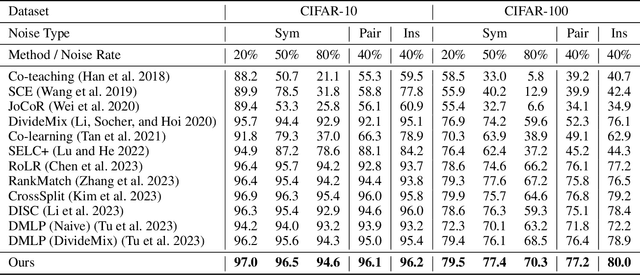
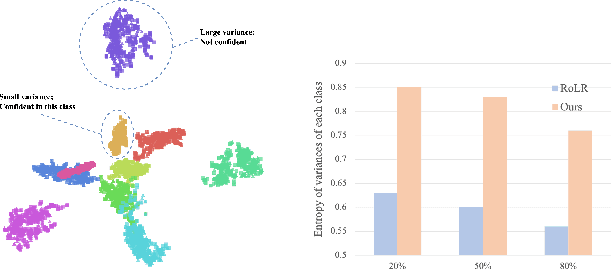
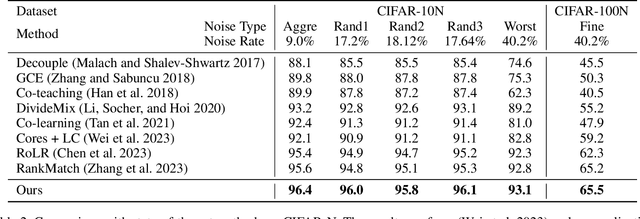
Noisy labels can negatively impact the performance of deep neural networks. One common solution is label refurbishment, which involves reconstructing noisy labels through predictions and distributions. However, these methods may introduce problematic semantic associations, a phenomenon that we identify as Semantic Contamination. Through an analysis of Robust LR, a representative label refurbishment method, we found that utilizing the logits of views for refurbishment does not adequately balance the semantic information of individual classes. Conversely, using the logits of models fails to maintain consistent semantic relationships across models, which explains why label refurbishment methods frequently encounter issues related to Semantic Contamination. To address this issue, we propose a novel method called Collaborative Cross Learning, which utilizes semi-supervised learning on refurbished labels to extract appropriate semantic associations from embeddings across views and models. Experimental results show that our method outperforms existing approaches on both synthetic and real-world noisy datasets, effectively mitigating the impact of label noise and Semantic Contamination.