 Add to Chrome
 Add to Firefox
 Add to Edge
ExMesh: EXplicit Mesh Reconstruction with Topology Adaptation
Jun 05, 2026
Reconstructing surface meshes from multi-view images has remained a core challenge in recent years. Most existing methods, whether implicit or explicit, depend on intermediate representations and post-processing steps like Marching Cubes or TSDF fusion, often resulting in artifacts and fragmented geometry. Directly optimizing explicit meshes is a promising approach. However, it presents two critical challenges. The first is how to adaptively refine mesh topology to capture detail without introducing degenerate faces. The second is how to maintain consistent UV coordinates for high-fidelity texturing as the mesh structure evolves. To overcome these, we propose ExMesh, a novel framework that directly optimizes explicit meshes by integrating differentiable optimization with discrete topology updates. Specifically, we introduce an adaptive vertex splitting and merging strategy, along with real-time UV maintenance, to enable coarse-to-fine optimization while preserving geometric integrity. To our knowledge, ExMesh is the first framework to seamlessly integrate discrete topology operations into a continuous differentiable optimization pipeline. Extensive experiments demonstrate that ExMesh achieves a balance among accuracy, computational efficiency, and mesh conciseness.

Articulation in Motion: Prior-free Part Mobility Analysis for Articulated Objects By Dynamic-Static Disentanglement
Mar 03, 2026Articulated objects are ubiquitous in daily life. Our goal is to achieve a high-quality reconstruction, segmentation of independent moving parts, and analysis of articulation. Recent methods analyse two different articulation states and perform per-point part segmentation, optimising per-part articulation using cross-state correspondences, given a priori knowledge of the number of parts. Such assumptions greatly limit their applications and performance. Their robustness is reduced when objects cannot be clearly visible in both states. To address these issues, in this paper, we present a new framework, Articulation in Motion (AiM). We infer part-level decomposition, articulation kinematics, and reconstruct an interactive 3D digital replica from a user-object interaction video and a start-state scan. We propose a dual-Gaussian scene representation that is learned from an initial 3DGS scan of the object and a video that shows the movement of separate parts. It uses motion cues to segment the object into parts and assign articulation joints. Subsequently, a robust, sequential RANSAC is employed to achieve part mobility analysis without any part-level structural priors, which clusters moving primitives into rigid parts and estimates kinematics while automatically determining the number of parts. The proposed approach separates the object into parts, each represented as a 3D Gaussian set, enabling high-quality rendering. Our approach yields higher quality part segmentation than previous methods, without prior knowledge. Extensive experimental analysis on both simple and complex objects validates the effectiveness and strong generalisation ability of our approach. Project page: https://haoai-1997.github.io/AiM/.
MeshSplat: Generalizable Sparse-View Surface Reconstruction via Gaussian Splatting
Aug 25, 2025Surface reconstruction has been widely studied in computer vision and graphics. However, existing surface reconstruction works struggle to recover accurate scene geometry when the input views are extremely sparse. To address this issue, we propose MeshSplat, a generalizable sparse-view surface reconstruction framework via Gaussian Splatting. Our key idea is to leverage 2DGS as a bridge, which connects novel view synthesis to learned geometric priors and then transfers these priors to achieve surface reconstruction. Specifically, we incorporate a feed-forward network to predict per-view pixel-aligned 2DGS, which enables the network to synthesize novel view images and thus eliminates the need for direct 3D ground-truth supervision. To improve the accuracy of 2DGS position and orientation prediction, we propose a Weighted Chamfer Distance Loss to regularize the depth maps, especially in overlapping areas of input views, and also a normal prediction network to align the orientation of 2DGS with normal vectors predicted by a monocular normal estimator. Extensive experiments validate the effectiveness of our proposed improvement, demonstrating that our method achieves state-of-the-art performance in generalizable sparse-view mesh reconstruction tasks. Project Page: https://hanzhichang.github.io/meshsplat_web
CUBE360: Learning Cubic Field Representation for Monocular 360 Depth Estimation for Virtual Reality
Oct 08, 2024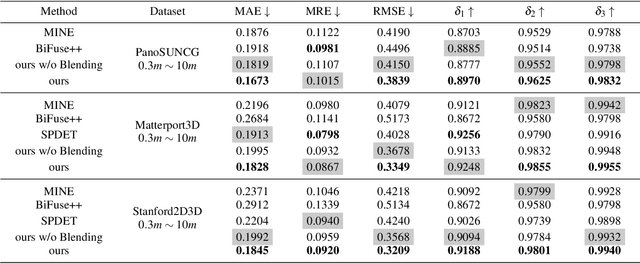
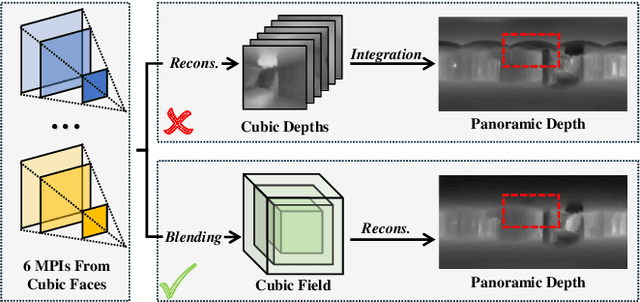
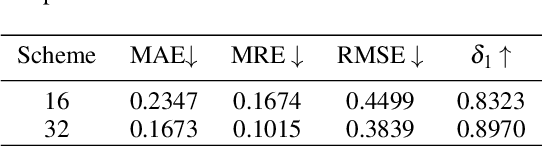
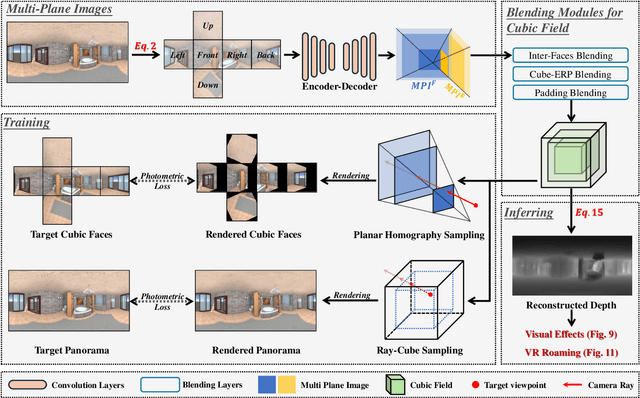
Panoramic images provide comprehensive scene information and are suitable for VR applications. Obtaining corresponding depth maps is essential for achieving immersive and interactive experiences. However, panoramic depth estimation presents significant challenges due to the severe distortion caused by equirectangular projection (ERP) and the limited availability of panoramic RGB-D datasets. Inspired by the recent success of neural rendering, we propose a novel method, named $\mathbf{CUBE360}$, that learns a cubic field composed of multiple MPIs from a single panoramic image for $\mathbf{continuous}$ depth estimation at any view direction. Our CUBE360 employs cubemap projection to transform an ERP image into six faces and extract the MPIs for each, thereby reducing the memory consumption required for MPI processing of high-resolution data. Additionally, this approach avoids the computational complexity of handling the uneven pixel distribution inherent to equirectangular projectio. An attention-based blending module is then employed to learn correlations among the MPIs of cubic faces, constructing a cubic field representation with color and density information at various depth levels. Furthermore, a novel sampling strategy is introduced for rendering novel views from the cubic field at both cubic and planar scales. The entire pipeline is trained using photometric loss calculated from rendered views within a self-supervised learning approach, enabling training on 360 videos without depth annotations. Experiments on both synthetic and real-world datasets demonstrate the superior performance of CUBE360 compared to prior SSL methods. We also highlight its effectiveness in downstream applications, such as VR roaming and visual effects, underscoring CUBE360's potential to enhance immersive experiences.