 Add to Chrome
 Add to Firefox
 Add to Edge
Deep Mixture of Experts Network for Resource Optimization in Aerial-Terrestrial CF-mMIMO Systems under URLLC
May 14, 2026
As a critical component of sixth-generation (6G) wireless networks, ultra-reliable and low-latency communication (URLLC) is expected to support real-time and reliable information exchange in low-altitude environments. However, achieving URLLC often incurs significant resource overhead, including increased bandwidth consumption, higher transmit power, and denser access point (AP) deployment, which pose significant challenges to both spectral efficiency (SE) and energy efficiency (EE). Besides, existing iterative optimization algorithms are computationally intensive and struggle to meet the latency requirements of URLLC. To address these challenges, we propose a hybrid aerial-terrestrial cell-free massive MIMO (CF-mMIMO) network to support diverse services, along with a channel prediction network and a deep mixture of experts (MoE) network for uplink optimization. First, we design a channel prediction network (CP-Net) to mitigate channel aging caused by high-mobility user equipment (UE). CP-Net employs three Transformer-based sub-networks for aged channel state information (CSI) prediction, while a channel quality-aware loss function is introduced to improve the prediction accuracy of weak links. Based on the predicted CSI, we develop a deep MoE network (MoE-Net) for power allocation comprising three expert models targeting different objectives. Then, we introduce a weighted gating network (WT-Net) to learn an efficient adaptive combination of expert outputs. The proposed framework better captures heterogeneous UE requirements and improves communication performance under URLLC constraints. Numerical results demonstrate the effectiveness of the proposed method.

Time-Frequency Analysis based Blind Modulation Classification for Multiple-Antenna Systems
Apr 01, 2020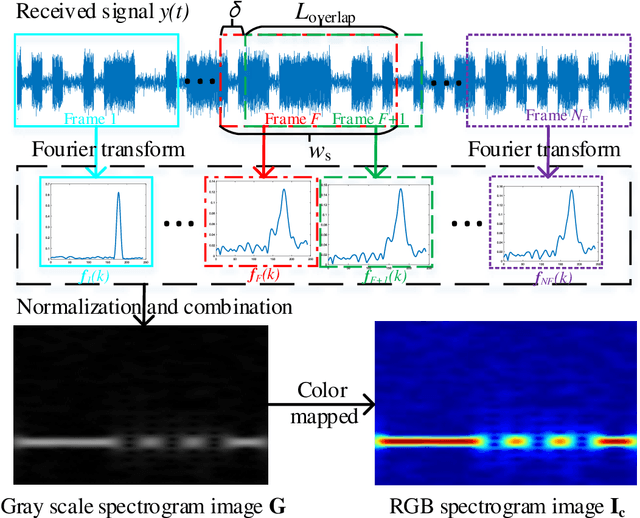
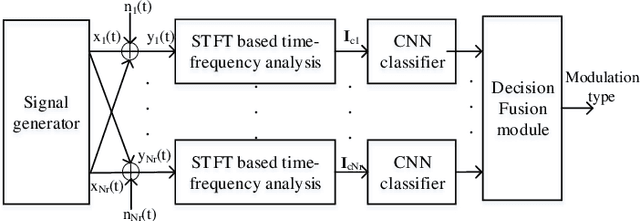
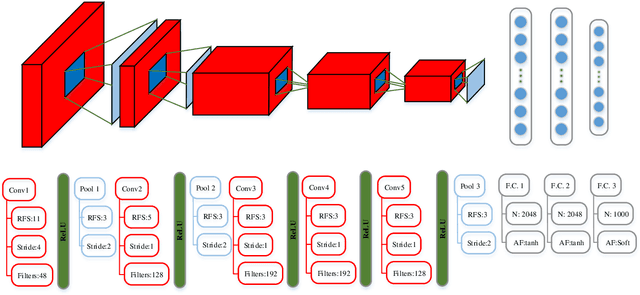
Blind modulation classification is an important step to implement cognitive radio networks. The multiple-input multiple-output (MIMO) technique is widely used in military and civil communication systems. Due to the lack of prior information about channel parameters and the overlapping of signals in the MIMO systems, the traditional likelihood-based and feature-based approaches cannot be applied in these scenarios directly. Hence, in this paper, to resolve the problem of blind modulation classification in MIMO systems, the time-frequency analysis method based on the windowed short-time Fourier transform is used to analyse the time-frequency characteristics of time-domain modulated signals. Then the extracted time-frequency characteristics are converted into RGB spectrogram images, and the convolutional neural network based on transfer learning is applied to classify the modulation types according to the RGB spectrogram images. Finally, a decision fusion module is used to fuse the classification results of all the receive antennas. Through simulations, we analyse the classification performance at different signal-to-noise ratios (SNRs), the results indicate that, for the single-input single-output (SISO) network, our proposed scheme can achieve 92.37% and 99.12% average classification accuracy at SNRs of -4 dB and 10 dB, respectively. For the MIMO network, our scheme achieves 80.42% and 87.92% average classification accuracy at -4 dB and 10 dB, respectively. This outperforms the existing classification methods based on baseband signals.