 Add to Chrome
 Add to Firefox
 Add to Edge
Your Privacy My Cloak: Backdoor Attacks on Differentially Private Federated Learning
Jun 15, 2026
Prior research suggests that differential privacy (DP) inherently enhances the robustness of federated learning (FL) against backdoor attacks. In this paper, we challenge this assumption. Through an empirical analysis of two baseline attack strategies, we uncover a fundamental tension in DP-FL: while bypassing DP allows state-of-the-art defenses to detect and filter malicious updates, complying with DP inadvertently masks their distinguishing statistical characteristics. Consequently, existing defenses become ineffective as DP reduces the raw backdoor signal. Building on this masking effect, we propose RING, a novel attack that explicitly exploits DP to conceal malicious contributions while maximizing attack impact. By collaboratively crafting adversarial perturbations, compromised clients reconstruct a strong backdoor signal during aggregation without triggering anomaly detection. RING operates as a perturbation layer that is agnostic to the underlying backdoor technique, making it broadly applicable and composable with existing attacks -- a property that significantly amplifies the threat it poses to DP-FL. Extensive evaluations across four image and text datasets under non-iid distributions show that RING achieves an average attack success rate of 90.3% against six state-of-the-art defenses under a moderate privacy budget, an improvement of up to 26.08x over baseline strategies. Finally, we evaluate potential countermeasures and find that mitigating this threat incurs significant utility trade-offs, exposing a fundamental security gap in the deployment of differentially private FL.

Monitoring-based Differential Privacy Mechanism Against Query-Flooding Parameter Duplication Attack
Nov 01, 2020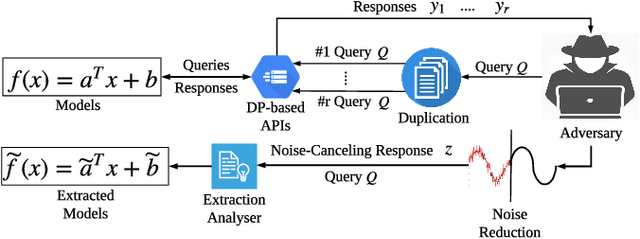
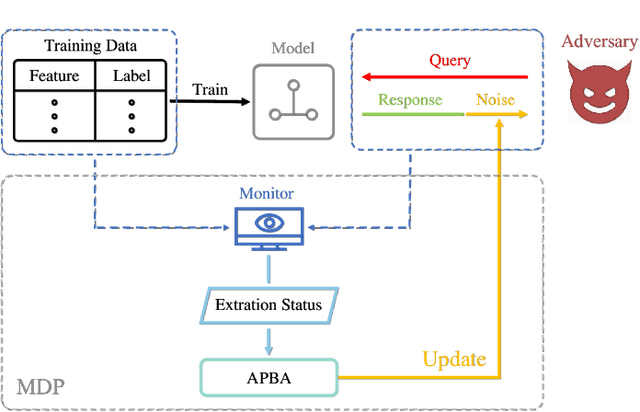
Public intelligent services enabled by machine learning algorithms are vulnerable to model extraction attacks that can steal confidential information of the learning models through public queries. Though there are some protection options such as differential privacy (DP) and monitoring, which are considered promising techniques to mitigate this attack, we still find that the vulnerability persists. In this paper, we propose an adaptive query-flooding parameter duplication (QPD) attack. The adversary can infer the model information with black-box access and no prior knowledge of any model parameters or training data via QPD. We also develop a defense strategy using DP called monitoring-based DP (MDP) against this new attack. In MDP, we first propose a novel real-time model extraction status assessment scheme called Monitor to evaluate the situation of the model. Then, we design a method to guide the differential privacy budget allocation called APBA adaptively. Finally, all DP-based defenses with MDP could dynamically adjust the amount of noise added in the model response according to the result from Monitor and effectively defends the QPD attack. Furthermore, we thoroughly evaluate and compare the QPD attack and MDP defense performance on real-world models with DP and monitoring protection.
Mitigating Query-Flooding Parameter Duplication Attack on Regression Models with High-Dimensional Gaussian Mechanism
Feb 06, 2020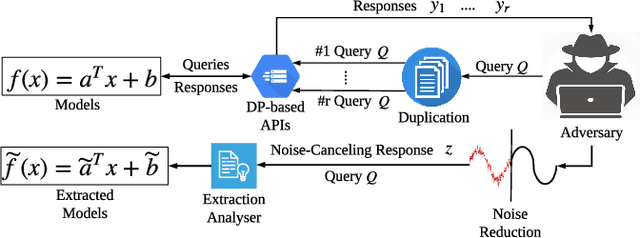
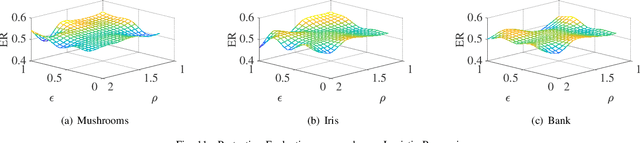
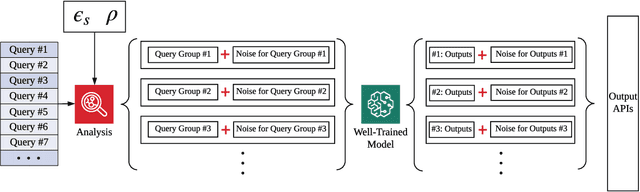
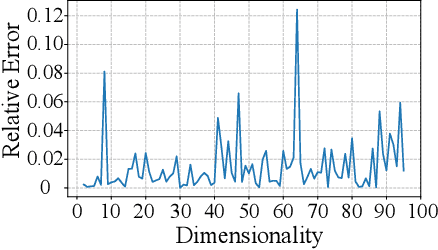
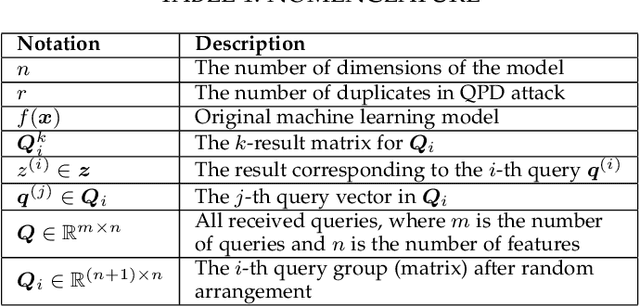
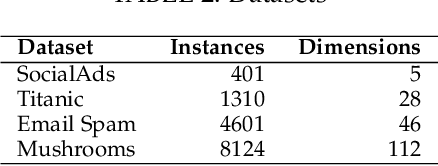
Public intelligent services enabled by machine learning algorithms are vulnerable to model extraction attacks that can steal confidential information of the learning models through public queries. Differential privacy (DP) has been considered a promising technique to mitigate this attack. However, we find that the vulnerability persists when regression models are being protected by current DP solutions. We show that the adversary can launch a query-flooding parameter duplication (QPD) attack to infer the model information by repeated queries. To defend against the QPD attack on logistic and linear regression models, we propose a novel High-Dimensional Gaussian (HDG) mechanism to prevent unauthorized information disclosure without interrupting the intended services. In contrast to prior work, the proposed HDG mechanism will dynamically generate the privacy budget and random noise for different queries and their results to enhance the obfuscation. Besides, for the first time, HDG enables an optimal privacy budget allocation that automatically determines the minimum amount of noise to be added per user-desired privacy level on each dimension. We comprehensively evaluate the performance of HDG using real-world datasets and shows that HDG effectively mitigates the QPD attack while satisfying the privacy requirements. We also prepare to open-source the relevant codes to the community for further research.