 Add to Chrome
 Add to Firefox
 Add to Edge
Rooted Absorbed Prefix Trajectory Balance with Submodular Replay for GFlowNet Training
Feb 28, 2026
Generative Flow Networks (GFlowNets) enable fine-tuning large language models to approximate reward-proportional posteriors, but they remain prone to mode collapse, manifesting as prefix collapse and length bias. We attribute this to two factors: (i) weak credit assignment to early prefixes, and (ii) biased replay that induces a shifted, non-representative training flow distribution. We propose Rooted absorbed prefix Trajectory Balance RapTB, an objective that anchors subtrajectory supervision at the root and propagates terminal rewards to intermediate prefixes via absorbed suffix-based backups, providing dense prefix-level learning signals. To mitigate replay-induced distribution shift, we further introduce SubM, a submodular replay refresh strategy that promotes both high reward and diversity. Empirically, on tasks such as molecule generation with LLM using SMILES strings, RapTB combined with SubM consistently improves optimization performance and molecular diversity while preserving high validity.

HilbertA: Hilbert Attention for Image Generation with Diffusion Models
Sep 30, 2025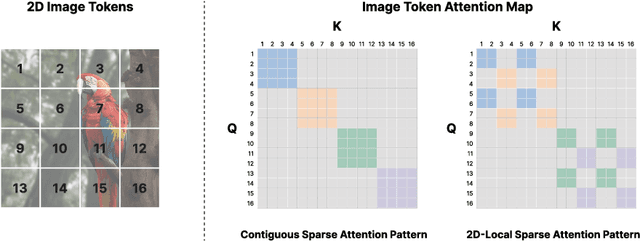
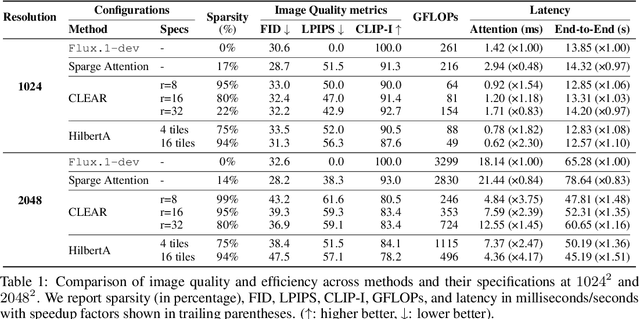
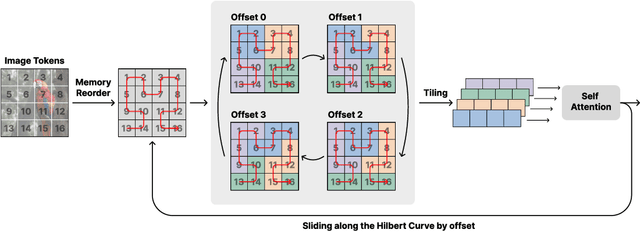
Designing sparse attention for diffusion transformers requires reconciling two-dimensional spatial locality with GPU efficiency, a trade-off that current methods struggle to achieve. Existing approaches enforce two-dimensional spatial locality but often incur uncoalesced memory access. We present HilbertA, a 2D-aware and GPU-efficient sparse attention mechanism. HilbertA reorders image tokens along Hilbert curves to achieve a contiguous memory layout while preserving spatial neighborhoods, and employs a sliding schedule across layers to enable long-range information propagation without repeated or uncoalesced memory access. To further enhance cross-tile communication and positional awareness, HilbertA introduces a small central shared region. Implemented in Triton, HilbertA delivers comparable image quality with significant acceleration over prior methods on Flux.1-dev, demonstrating the feasibility of hardware-aligned two-dimensional sparse attention for high-resolution image generation. HilbertA delivers attention speedups of $2.3\times$ when generating $1024\times 1024$ images, and up to $4.17\times$ at $2048\times 2048$, while achieving image quality comparable to or surpassing baselines.