 Add to Chrome
 Add to Firefox
 Add to Edge
Smoothing Dark Areas in Molecular Latent Diffusion
Jun 11, 2026
Latent diffusion is a promising framework for scalable 3D molecular generation, but it requires a latent space that remains smooth, valid, and navigable beyond posterior samples. Existing molecular VAEs, however, are typically learned through reconstruction-based objectives, which do not guarantee such a latent space. We show that this leads to dark areas: regions of latent space that are reachable during diffusion sampling but decode to disconnected or chemically invalid molecules. Unlike in image generation, molecular decoding requires strict structural and chemical precision, so even small latent perturbations can produce catastrophic failures. We therefore propose TopVAE, a topology-optimized VAE that reduces dark areas by making the decoder internalize structural and chemical constraints during training, eliminating the need for test-time chemical correction. TopVAE greatly improves off-posterior robustness, and when paired with a standard DiT, achieves $77\%$ lower FCD-3D on QM9, the highest V&C, $52\%$ lower FCD-3D on GEOM-Drugs, and $1.29{\times}$ more stable and connected molecules on zero-shot scaffold inpainting.

InfoFlow KV: Information-Flow-Aware KV Recomputation for Long Context
Mar 05, 2026Retrieval-augmented generation (RAG) for long-context question answering is bottlenecked by inference-time prefilling over large retrieved contexts. A common strategy is to precompute key-value (KV) caches for individual documents and selectively recompute a small subset of tokens to restore global causal dependencies, but existing methods rely on heuristics or representation discrepancies without modeling whether selected tokens can effectively influence generation. We cast selective KV recomputation as an information flow problem and show that a simple attention-norm signal from the query reliably identifies tokens that are both semantically relevant and structurally positioned to propagate information, when computed under an inference-consistent RoPE geometry. We therefore reconstruct global positional assignments for retrieved chunks and introduce an information-flow-guided chunk reordering strategy. Experiments on LLM and VLM benchmarks demonstrate consistent gains over prior methods under comparable efficiency budgets.
HilbertA: Hilbert Attention for Image Generation with Diffusion Models
Sep 30, 2025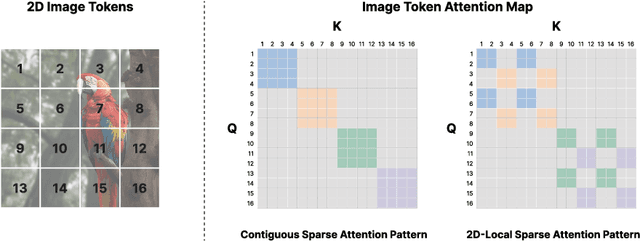
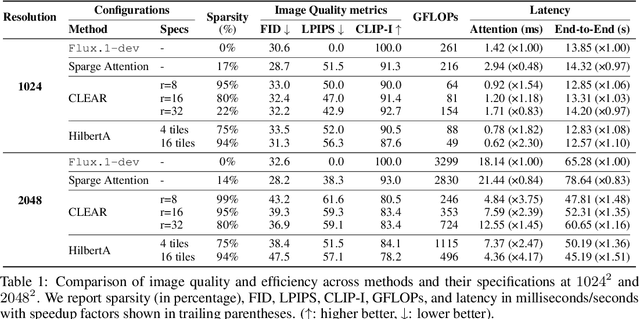
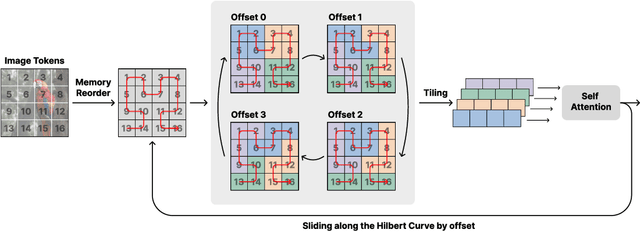
Designing sparse attention for diffusion transformers requires reconciling two-dimensional spatial locality with GPU efficiency, a trade-off that current methods struggle to achieve. Existing approaches enforce two-dimensional spatial locality but often incur uncoalesced memory access. We present HilbertA, a 2D-aware and GPU-efficient sparse attention mechanism. HilbertA reorders image tokens along Hilbert curves to achieve a contiguous memory layout while preserving spatial neighborhoods, and employs a sliding schedule across layers to enable long-range information propagation without repeated or uncoalesced memory access. To further enhance cross-tile communication and positional awareness, HilbertA introduces a small central shared region. Implemented in Triton, HilbertA delivers comparable image quality with significant acceleration over prior methods on Flux.1-dev, demonstrating the feasibility of hardware-aligned two-dimensional sparse attention for high-resolution image generation. HilbertA delivers attention speedups of $2.3\times$ when generating $1024\times 1024$ images, and up to $4.17\times$ at $2048\times 2048$, while achieving image quality comparable to or surpassing baselines.