 Add to Chrome
 Add to Firefox
 Add to Edge
SubdivAR: Autoregressive Next-Scale Prediction for Neural Mesh Subdivision
Jun 25, 2026
Mesh subdivision is a fundamental operation for converting coarse, editable meshes into high-resolution surfaces, with broad applications in digital asset creation. Classical rule-based schemes rely on fixed local refinement rules and often produce over-smoothed surfaces. Recent neural subdivision methods improve detail synthesis, but remain constrained by local modeling and exhibit limited generalizability. We present SubdivAR, a neural mesh subdivision framework based on our proposed Mesh Autoregressive Representation (MAR). MAR arranges meshes at different subdivision levels into an ordered scale sequence, reformulating subdivision as autoregressive next-scale prediction. To support this formulation, we introduce a Hybrid Topology-Aware Transformer that combines global semantic attention with topology-constrained local feature aggregation. SubdivAR adopts a next-scale coordinate prediction paradigm, regressing vertex offsets at each refinement stage to preserve subdivision topology while recovering fine-grained geometric details. To enable reliable learning, we construct FII-40K, a curated dataset of nearly 40,000 high-quality meshes with multi-level subdivision supervision. Experiments show that SubdivAR outperforms state-of-the-art baselines, reducing Hausdorff Distance and Chamfer Distance by 18.8% and 14.2%, respectively, and demonstrates strong robustness on complex open-surface geometries.

Large Language Model as Token Compressor and Decompressor
Mar 26, 2026In this paper, we establish the novel insight that an off-the-shelf LLM can function as an excellent token compressor and decompressor. To demonstrate, we design a self-expressive autoencoding learning framework fine-tunes a pretrained LLM to translate long texts into a compact internal language of discrete, variable-length latent codes, termed Z-tokens, and to reconstruct the original text exactly from them. The resulting representation is content-adaptive: semantically dense segments receive more Z-tokens, while redundant or predictable regions are aggressively compressed, via lightweight LoRA-based adapter heads. Empirically, our method achieves up to 18 times token reduction on Wikipedia, CNN/DailyMail, HotpotQA, and Qulac-style long-query datasets, while preserving reconstruction fidelity and downstream performance. This simple yet effective design supports applications including prompt compression and autoregressive generation directly in the Z-token space, offering a potential pathway toward token-efficient long-context reasoning.
Coupled Mamba: Enhanced Multi-modal Fusion with Coupled State Space Model
May 29, 2024

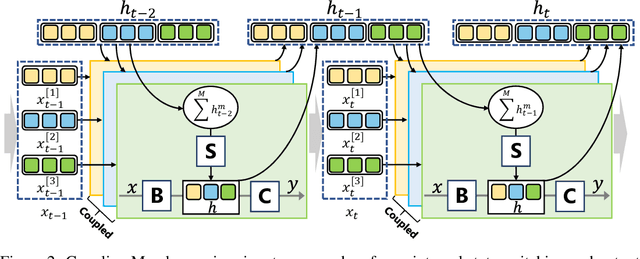
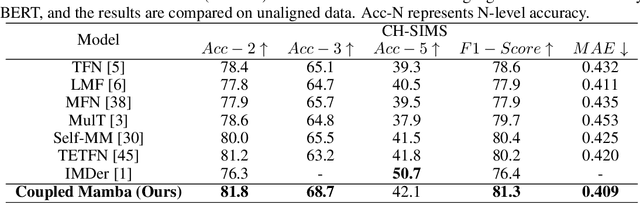
The essence of multi-modal fusion lies in exploiting the complementary information inherent in diverse modalities. However, prevalent fusion methods rely on traditional neural architectures and are inadequately equipped to capture the dynamics of interactions across modalities, particularly in presence of complex intra- and inter-modality correlations. Recent advancements in State Space Models (SSMs), notably exemplified by the Mamba model, have emerged as promising contenders. Particularly, its state evolving process implies stronger modality fusion paradigm, making multi-modal fusion on SSMs an appealing direction. However, fusing multiple modalities is challenging for SSMs due to its hardware-aware parallelism designs. To this end, this paper proposes the Coupled SSM model, for coupling state chains of multiple modalities while maintaining independence of intra-modality state processes. Specifically, in our coupled scheme, we devise an inter-modal hidden states transition scheme, in which the current state is dependent on the states of its own chain and that of the neighbouring chains at the previous time-step. To fully comply with the hardware-aware parallelism, we devise an expedite coupled state transition scheme and derive its corresponding global convolution kernel for parallelism. Extensive experiments on CMU-MOSEI, CH-SIMS, CH-SIMSV2 through multi-domain input verify the effectiveness of our model compared to current state-of-the-art methods, improved F1-Score by 0.4\%, 0.9\%, and 2.3\% on the three datasets respectively, 49\% faster inference and 83.7\% GPU memory save. The results demonstrate that Coupled Mamba model is capable of enhanced multi-modal fusion.