 Add to Chrome
 Add to Firefox
 Add to Edge
Athena-Brain Technical Report: An Efficient Robot Brain for General Intelligence and Embodied Interactio
Jul 21, 2026
Large language models (LLMs) have demonstrated remarkable capabilities in language understanding, reasoning, and world knowledge. As embodied agents become increasingly capable, there is a growing demand for compact models that can serve as an on-device brain, preserving the broad general intelligence of LLMs while enabling effective high-level interaction with embodied environments. Existing approaches, however, often prioritize either general-purpose intelligence or specialized embodied capabilities, making it challenging to satisfy both requirements within a single model. We present \textbf{Athena-Brain-8B}, an 8B LLM designed to serve as an on-device brain for embodied intelligence for embodied intelligence. Through a multi-stage post-training pipeline consisting of General Supervised Fine-Tuning, General Reinforcement Learning, Embodied Expert training, and Model Merge, Athena-Brain-8B maintains strong general capabilities while acquiring strong high-level embodied interaction capabilities and generating concise responses for efficient embodied interaction. Experimental results demonstrate the effectiveness of Athena across both general and embodied evaluations. Compared with the corresponding Qwen3-8B thinking model, Athena-Brain-8B achieves comparable performance on general language and reasoning benchmarks while generating substantially shorter responses. On in-domain embodied benchmarks, Athena-Brain-8B consistently outperforms models of similar scale and surpasses several substantially larger frontier models evaluated zero-shot, demonstrating that compact language models can effectively integrate strong general intelligence with embodied capabilities.

Engagement Process: Rethinking the Temporal Interface of Action and Observation
May 12, 2026Task completion in digital and physical environments increasingly involves complex temporal interaction, where actions and observations unfold over different time scales rather than align with fixed observation--action steps. To model such interactions, we propose \emph{Engagement Process} (EP), an interaction formalism that inherits the decision-theoretic structure of POMDPs while making time explicit in the action--observation interface. EP represents actions and observations as decoupled event streams along time, rather than updates paired at fixed decision steps. This interface captures single-agent timing issues such as deliberation latency, delayed feedback, and persistent actions, while supporting richer agent-side organization, multi-rate coordination, and compositional interaction among subsystems. Across toy, LLM-agent, and learning experiments, EP exposes temporal behaviors hidden by step-based interfaces and enables policies to adapt under explicit time costs.
Exploring Weaknesses in Function Call Models via Reinforcement Learning: An Adversarial Data Augmentation Approach
Jan 27, 2026Function call capabilities have become crucial for Large Language Models (LLMs), enabling them to interact more effectively with external tools and APIs. Existing methods for improving the function call capabilities of LLMs rely on data obtained either through manual annotation or automated generation by models, and use this data to finetune the LLMs. However, these methods often lack targeted design and are constrained by fixed patterns and data distributions, which limits their effectiveness in enhancing the generalization and robustness of function call LLMs. To address this limitation, we propose a novel adversarial data augmentation method that employs reinforcement learning to systematically identify and target the weaknesses of function call LLMs. Our training framework introduces a query model trained with reinforcement learning (RL) to generate adversarial queries that are specifically designed to challenge function call (FC) models. This approach adopts a zero sum game formulation, where the query model and the FC model engage in iterative alternating training. Overall, our method advances the development of more robust FC models and provides a systematic way to identify and correct weaknesses in the ability of LLMs to interact with external tools.
Enhancing the Robustness of QMIX against State-adversarial Attacks
Jul 03, 2023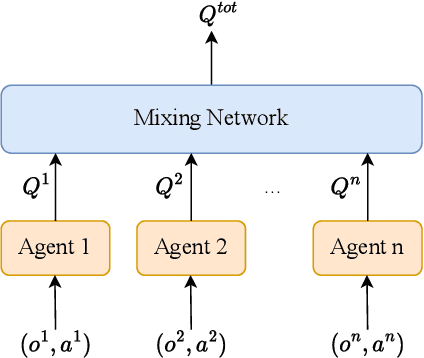
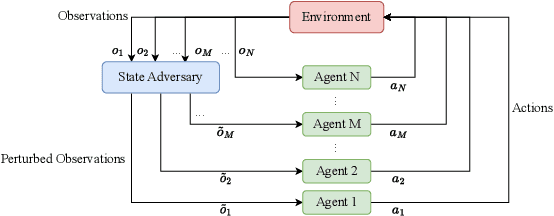
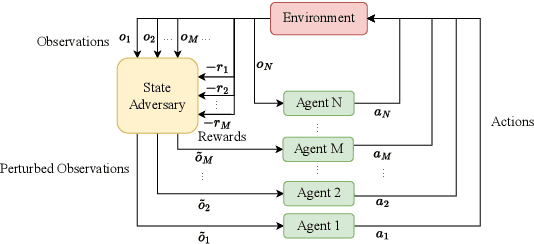
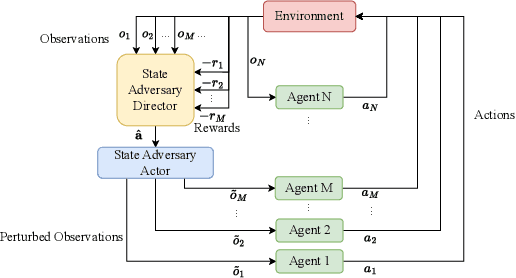
Deep reinforcement learning (DRL) performance is generally impacted by state-adversarial attacks, a perturbation applied to an agent's observation. Most recent research has concentrated on robust single-agent reinforcement learning (SARL) algorithms against state-adversarial attacks. Still, there has yet to be much work on robust multi-agent reinforcement learning. Using QMIX, one of the popular cooperative multi-agent reinforcement algorithms, as an example, we discuss four techniques to improve the robustness of SARL algorithms and extend them to multi-agent scenarios. To increase the robustness of multi-agent reinforcement learning (MARL) algorithms, we train models using a variety of attacks in this research. We then test the models taught using the other attacks by subjecting them to the corresponding attacks throughout the training phase. In this way, we organize and summarize techniques for enhancing robustness when used with MARL.