 Add to Chrome
 Add to Firefox
 Add to Edge
Fine-tuning is Not Enough: A Parallel Framework for Collaborative Imitation and Reinforcement Learning in End-to-end Autonomous Driving
Mar 14, 2026
End-to-end autonomous driving is typically built upon imitation learning (IL), yet its performance is constrained by the quality of human demonstrations. To overcome this limitation, recent methods incorporate reinforcement learning (RL) through sequential fine-tuning. However, such a paradigm remains suboptimal: sequential RL fine-tuning can introduce policy drift and often leads to a performance ceiling due to its dependence on the pretrained IL policy. To address these issues, we propose PaIR-Drive, a general Parallel framework for collaborative Imitation and Reinforcement learning in end-to-end autonomous driving. During training, PaIR-Drive separates IL and RL into two parallel branches with conflict-free training objectives, enabling fully collaborative optimization. This design eliminates the need to retrain RL when applying a new IL policy. During inference, RL leverages the IL policy to further optimize the final plan, allowing performance beyond prior knowledge of IL. Furthermore, we introduce a tree-structured trajectory neural sampler to group relative policy optimization (GRPO) in the RL branch, which enhances exploration capability. Extensive analysis on NAVSIMv1 and v2 benchmark demonstrates that PaIR-Drive achieves Competitive performance of 91.2 PDMS and 87.9 EPDMS, building upon Transfuser and DiffusionDrive IL baselines. PaIR-Drive consistently outperforms existing RL fine-tuning methods, and could even correct human experts' suboptimal behaviors. Qualitative results further confirm that PaIR-Drive can effectively explore and generate high-quality trajectories.

PortAgent: LLM-driven Vehicle Dispatching Agent for Port Terminals
Dec 16, 2025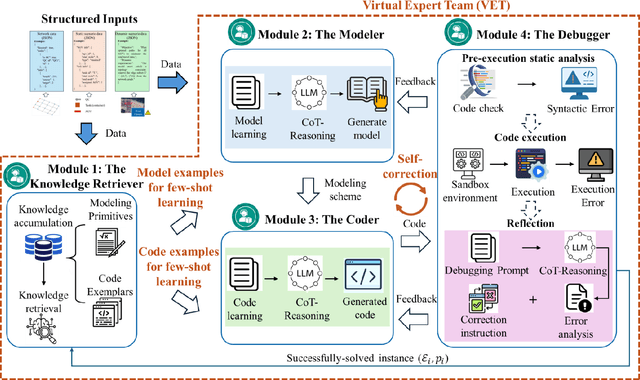
Vehicle Dispatching Systems (VDSs) are critical to the operational efficiency of Automated Container Terminals (ACTs). However, their widespread commercialization is hindered due to their low transferability across diverse terminals. This transferability challenge stems from three limitations: high reliance on port operational specialists, a high demand for terminal-specific data, and time-consuming manual deployment processes. Leveraging the emergence of Large Language Models (LLMs), this paper proposes PortAgent, an LLM-driven vehicle dispatching agent that fully automates the VDS transferring workflow. It bears three features: (1) no need for port operations specialists; (2) low need of data; and (3) fast deployment. Specifically, specialist dependency is eliminated by the Virtual Expert Team (VET). The VET collaborates with four virtual experts, including a Knowledge Retriever, Modeler, Coder, and Debugger, to emulate a human expert team for the VDS transferring workflow. These experts specialize in the domain of terminal VDS via a few-shot example learning approach. Through this approach, the experts are able to learn VDS-domain knowledge from a few VDS examples. These examples are retrieved via a Retrieval-Augmented Generation (RAG) mechanism, mitigating the high demand for terminal-specific data. Furthermore, an automatic VDS design workflow is established among these experts to avoid extra manual interventions. In this workflow, a self-correction loop inspired by the LLM Reflexion framework is created