 Add to Chrome
 Add to Firefox
 Add to Edge
WorldArena: A Unified Benchmark for Evaluating Perception and Functional Utility of Embodied World Models
Feb 09, 2026
While world models have emerged as a cornerstone of embodied intelligence by enabling agents to reason about environmental dynamics through action-conditioned prediction, their evaluation remains fragmented. Current evaluation of embodied world models has largely focused on perceptual fidelity (e.g., video generation quality), overlooking the functional utility of these models in downstream decision-making tasks. In this work, we introduce WorldArena, a unified benchmark designed to systematically evaluate embodied world models across both perceptual and functional dimensions. WorldArena assesses models through three dimensions: video perception quality, measured with 16 metrics across six sub-dimensions; embodied task functionality, which evaluates world models as data engines, policy evaluators, and action planners integrating with subjective human evaluation. Furthermore, we propose EWMScore, a holistic metric integrating multi-dimensional performance into a single interpretable index. Through extensive experiments on 14 representative models, we reveal a significant perception-functionality gap, showing that high visual quality does not necessarily translate into strong embodied task capability. WorldArena benchmark with the public leaderboard is released at https://worldarena.ai, providing a framework for tracking progress toward truly functional world models in embodied AI.

A Survey on Human-Centric LLMs
Nov 26, 2024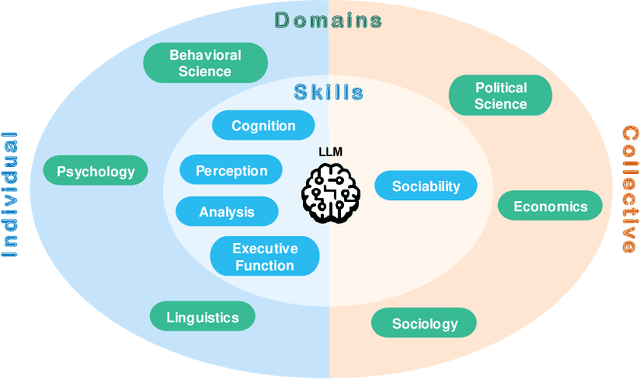
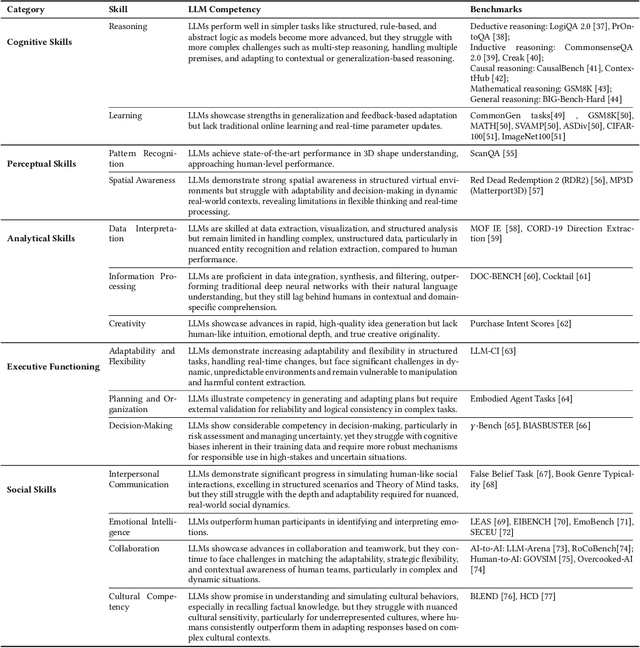
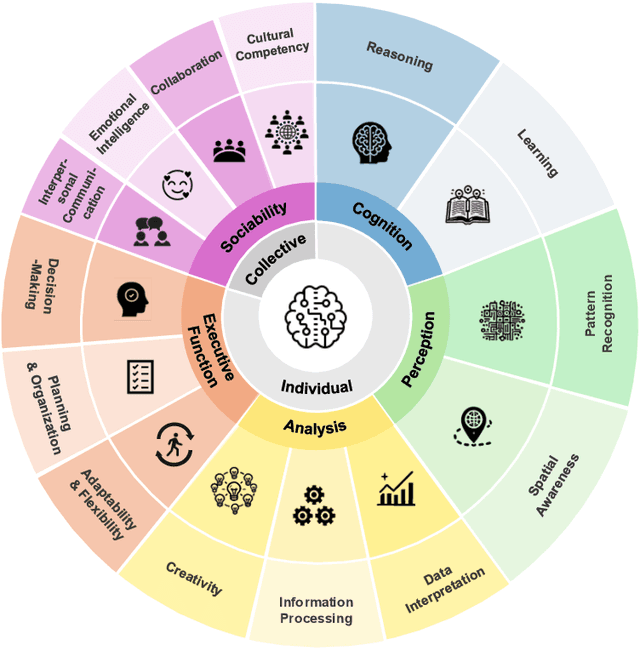
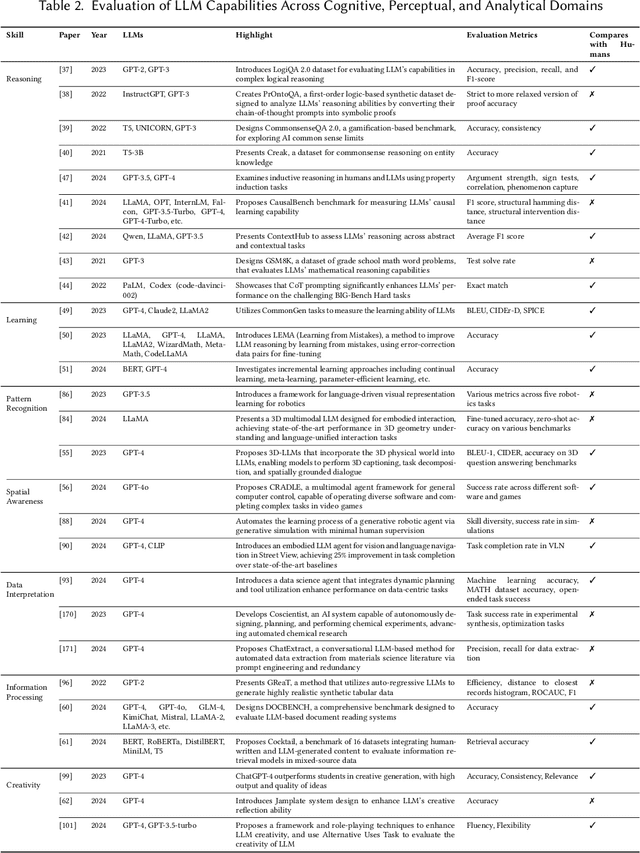
The rapid evolution of large language models (LLMs) and their capacity to simulate human cognition and behavior has given rise to LLM-based frameworks and tools that are evaluated and applied based on their ability to perform tasks traditionally performed by humans, namely those involving cognition, decision-making, and social interaction. This survey provides a comprehensive examination of such human-centric LLM capabilities, focusing on their performance in both individual tasks (where an LLM acts as a stand-in for a single human) and collective tasks (where multiple LLMs coordinate to mimic group dynamics). We first evaluate LLM competencies across key areas including reasoning, perception, and social cognition, comparing their abilities to human-like skills. Then, we explore real-world applications of LLMs in human-centric domains such as behavioral science, political science, and sociology, assessing their effectiveness in replicating human behaviors and interactions. Finally, we identify challenges and future research directions, such as improving LLM adaptability, emotional intelligence, and cultural sensitivity, while addressing inherent biases and enhancing frameworks for human-AI collaboration. This survey aims to provide a foundational understanding of LLMs from a human-centric perspective, offering insights into their current capabilities and potential for future development.