 Add to Chrome
 Add to Firefox
 Add to Edge
CoEvoP&R: Co-Evolving Placement Objectives with Routing Feedback via Large Language Models
Jul 19, 2026
Analytical placers rely on differentiable objective functions to guide placement, typically combining intermediate surrogate metrics such as half-perimeter wirelength (HPWL) and cell-density penalties. However, these placement-stage surrogates remain misaligned with downstream routed and timing quality. Prior work reduces this gap with human-designed terms or learned black-box surrogates, but the former requires expert retuning and the latter is difficult to explain, debug, or deploy in analytical placement flows. CoEvoP&R addresses these limitations with a large language model (LLM)-based framework that automatically evolves analytical placement objectives. At each generation, the prompt combines the restricted objective interface, baseline context, and archived prior candidates with routing-related feedback from placement, timing proxy, and routing tools. The LLM proposes readable differentiable objectives, which are embedded and validated in DREAMPlace, evaluated through a timing proxy and an actual router, and stored with their feedback to guide later generations. Across eight ChiP-Bench Nangate45 designs and three seeds, CoEvoP&R reduces post-route routed wirelength and congestion by 16.9% and 36.7%, with gains of 0.70 ns in worst negative slack and a 912 ns reduction in total negative slack magnitude over native DREAMPlace. Across eight ICCAD 2015 Superblue designs, it reduces post-route routed wirelength and congestion by 5.4% and 23.2%. Code is available at https://github.com/FCHXWH823/CoEvoP-R.git.

GUIDE: GenAI Units In Digital Design Education
Mar 18, 2026GenAI Units In Digital Design Education (GUIDE) is an open courseware repository with runnable Google Colab labs and other materials. We describe the repository's architecture and educational approach based on standardized teaching units comprising slides, short videos, runnable labs, and related papers. This organization enables consistency for both the students' learning experience and the reuse and grading by instructors. We demonstrate GUIDE in practice with three representative units: VeriThoughts for reasoning and formal-verification-backed RTL generation, enhanced LLM-aided testbench generation, and LLMPirate for IP Piracy. We also provide details for four example course instances (GUIDE4ChipDesign, Build your ASIC, GUIDE4HardwareSecurity, and Hardware Design) that assemble GUIDE units into full semester offerings, learning outcomes, and capstone projects, all based on proven materials. For example, the GUIDE4HardwareSecurity course includes a project on LLM-aided hardware Trojan insertion that has been successfully deployed in the classroom and in Cybersecurity Games and Conference (CSAW), a student competition and academic conference for cybersecurity. We also organized an NYU Cognichip Hackathon, engaging students across 24 international teams in AI-assisted RTL design workflows. The GUIDE repository is open for contributions and available at: https://github.com/FCHXWH823/LLM4ChipDesign.
TrojanGYM: A Detector-in-the-Loop LLM for Adaptive RTL Hardware Trojan Insertion
Jan 23, 2026Hardware Trojans (HTs) remain a critical threat because learning-based detectors often overfit to narrow trigger/payload patterns and small, stylized benchmarks. We introduce TrojanGYM, an agentic, LLM-driven framework that automatically curates HT insertions to expose detector blind spots while preserving design correctness. Given high-level HT specifications, a suite of cooperating LLM agents (instantiated with GPT-4, LLaMA-3.3-70B, and Gemini-2.5Pro) proposes and refines RTL modifications that realize diverse triggers and payloads without impacting normal functionality. TrojanGYM implements a feedback-driven benchmark generation loop co-designed with HT detectors, in which constraint-aware syntactic checking and GNN-based HT detectors provide feedback that iteratively refines HT specifications and insertion strategies to better surface detector blind spots. We further propose Robust-GNN4TJ, a new implementation of the GNN4TJ with improved graph extraction, training robustness, and prediction reliability, especially on LLM-generated HT designs. On the most challenging TrojanGYM-generated benchmarks, Robust-GNN4TJ raises HT detection rates from 0% to 60% relative to a prior GNN-based detector. We instantiate TrojanGYM on SRAM, AES-128, and UART designs at RTL level, and show that it systematically produces diverse, functionally correct HTs that reach up to 83.33% evasion rates against modern GNN-based detectors, revealing robustness gaps that are not apparent when these detectors are evaluated solely on existing TrustHub-style benchmarks. Post peer-review, we will release all codes and artifacts.
PrefixLLM: LLM-aided Prefix Circuit Design
Dec 03, 2024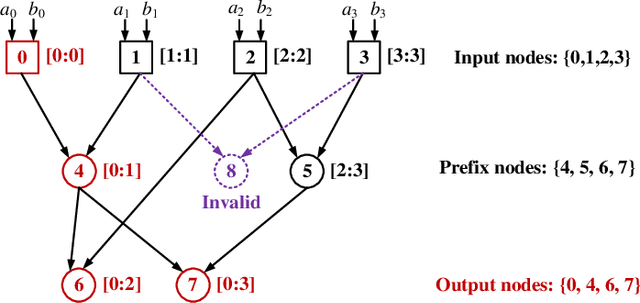
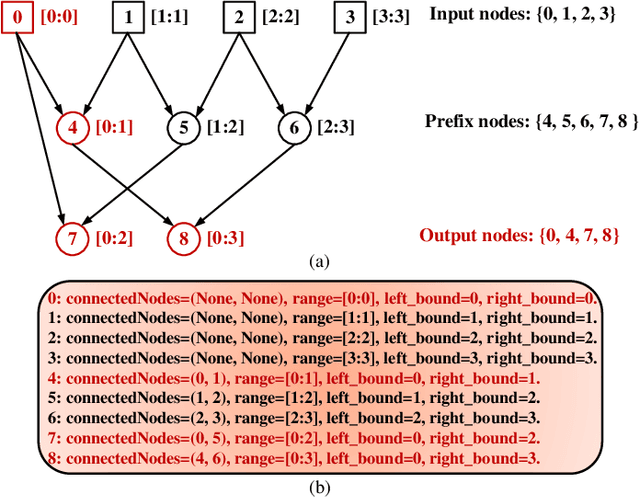
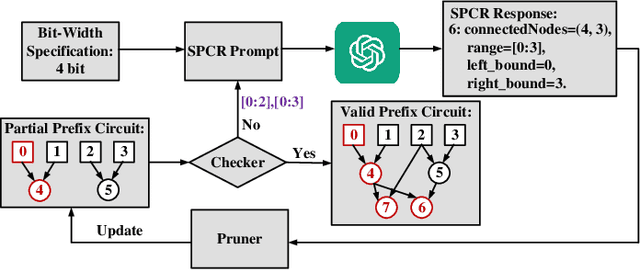
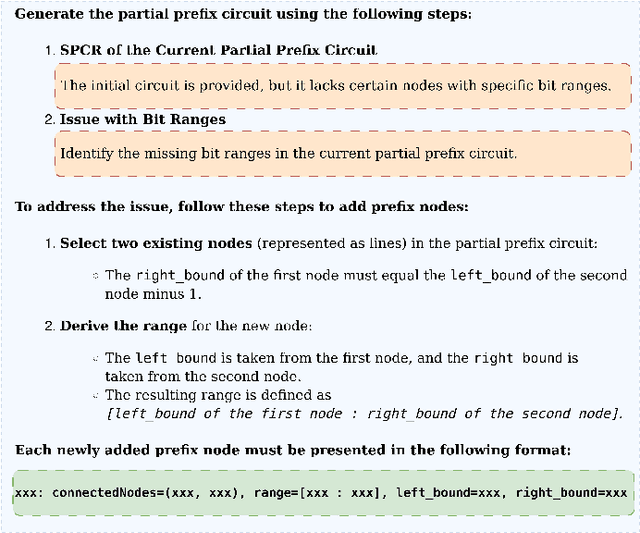
Prefix circuits are fundamental components in digital adders, widely used in digital systems due to their efficiency in calculating carry signals. Synthesizing prefix circuits with minimized area and delay is crucial for enhancing the performance of modern computing systems. Recently, large language models (LLMs) have demonstrated a surprising ability to perform text generation tasks. We propose PrefixLLM, that leverages LLMs for prefix circuit synthesis. PrefixLLM transforms the prefix circuit synthesis task into a structured text generation problem, termed the Structured Prefix Circuit Representation (SPCR), and introduces an iterative framework to automatically and accurately generate valid SPCRs. We further present a design space exploration (DSE) framework that uses LLMs to iteratively search for area and delay optimized prefix circuits. Compared to state-of-the-art, PrefixLLM can reduce the area by 3.70% under the same delay constraint. This work highlights the use of LLMs in the synthesis of arithmetic circuits, which can be transformed into the structured text generation.