 Add to Chrome
 Add to Firefox
 Add to Edge
The Harness Effect: How Orchestration Design Sets the Token Economics of Enterprise Agentic AI
Jul 08, 2026
Agentic AI development today runs on token maxing: buying capability with tokens -- longer reasoning traces, more turns, wider tool payloads, bigger replayed contexts -- so tokens per task grow faster than task value. Falling per-token prices mask the pattern; total spend rises anyway. We argue the decisive lever against token maxing is the harness: the orchestration layer that assembles context, exposes tools, sequences turns, delegates work, and carries enterprise observability and governance. We isolate it with a controlled swap: 22 locked evaluation tasks, six foundation models (Claude Sonnet 4.6, Gemini 3.1, Gemini Flash 3.5, Qwen 3.6, GLM 5.1, Palmyra X6), changing only the orchestration layer -- a frozen conventional production loop versus the Writer Agent Harness. Holding models constant, the harness cuts blended cost per task 41% ($0.21->$0.12), median wall-clock 44% (48s->27s), and tokens per task 38% (14.2k->8.8k), with task-completion quality at parity (0.78->0.81, directional at this sample size). Efficiency is model-invariant -- every model gets cheaper (33-61%) -- while quality gains are capability-dependent: a model's gain correlates almost perfectly with its baseline strength (r=0.99, n=6), a phenomenon we term harness leverage. Quality per dollar rises 82%; task-completions per million tokens rise from 54.9 to 92.0. On this workload the orchestration layer moved cost per task more than the full spread of the model menu did. We formalize token economics at the orchestration layer (including effective input price under prompt caching), detail the six mechanism families behind the effect -- cache-shape discipline to failure-spend governance -- compare six widely used agent systems on the same axes, and argue the harness is the one component whose efficiency multiplies across every model an organization runs -- present and future.

Towards Outcome-Oriented, Task-Agnostic Evaluation of AI Agents
Nov 11, 2025As AI agents proliferate across industries and applications, evaluating their performance based solely on infrastructural metrics such as latency, time-to-first-token, or token throughput is proving insufficient. These metrics fail to capture the quality of an agent's decisions, its operational autonomy, or its ultimate business value. This white paper proposes a novel, comprehensive framework of eleven outcome-based, task-agnostic performance metrics for AI agents that transcend domain boundaries. These metrics are designed to enable organizations to evaluate agents based on the quality of their decisions, their degree of autonomy, their adaptability to new challenges, and the tangible business value they deliver, regardless of the underlying model architecture or specific use case. We introduce metrics such as Goal Completion Rate (GCR), Autonomy Index (AIx), Multi-Step Task Resilience (MTR), and Business Impact Efficiency (BIE). Through a large-scale simulated experiment involving four distinct agent architectures (ReAct, Chain-of-Thought, Tool-Augmented, Hybrid) across five diverse domains (Healthcare, Finance, Marketing, Legal, and Customer Service), we demonstrate the framework's efficacy. Our results reveal significant performance trade-offs between different agent designs, highlighting the Hybrid Agent as the most consistently high-performing model across the majority of our proposed metrics, achieving an average Goal Completion Rate of 88.8\% and the highest Return on Investment (ROI). This work provides a robust, standardized methodology for the holistic evaluation of AI agents, paving the way for more effective development, deployment, and governance.
Reflect, Retry, Reward: Self-Improving LLMs via Reinforcement Learning
May 30, 2025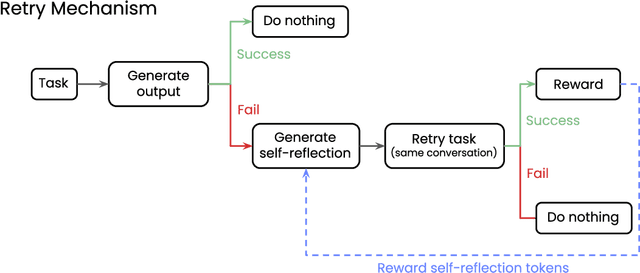
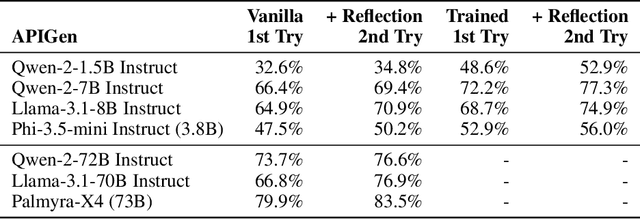
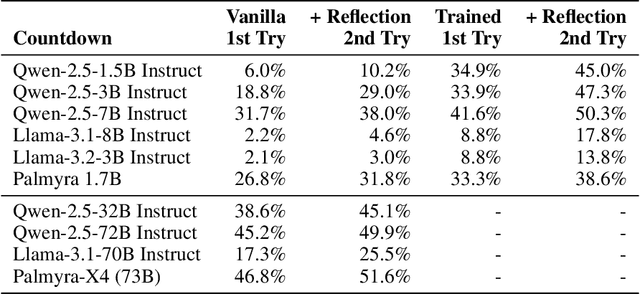
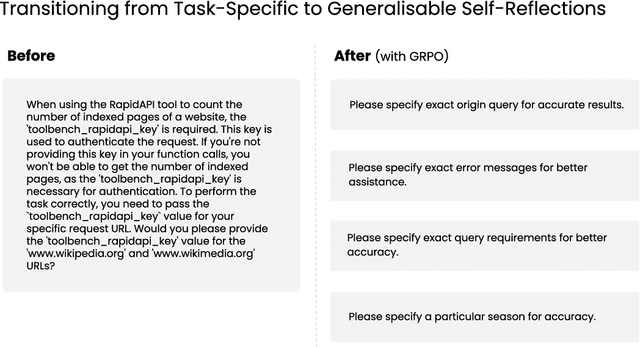
We explore a method for improving the performance of large language models through self-reflection and reinforcement learning. By incentivizing the model to generate better self-reflections when it answers incorrectly, we demonstrate that a model's ability to solve complex, verifiable tasks can be enhanced even when generating synthetic data is infeasible and only binary feedback is available. Our framework operates in two stages: first, upon failing a given task, the model generates a self-reflective commentary analyzing its previous attempt; second, the model is given another attempt at the task with the self-reflection in context. If the subsequent attempt succeeds, the tokens generated during the self-reflection phase are rewarded. Our experimental results show substantial performance gains across a variety of model architectures, as high as 34.7% improvement at math equation writing and 18.1% improvement at function calling. Notably, smaller fine-tuned models (1.5 billion to 7 billion parameters) outperform models in the same family that are 10 times larger. Our novel paradigm is thus an exciting pathway to more useful and reliable language models that can self-improve on challenging tasks with limited external feedback.
Expect the Unexpected: FailSafe Long Context QA for Finance
Feb 10, 2025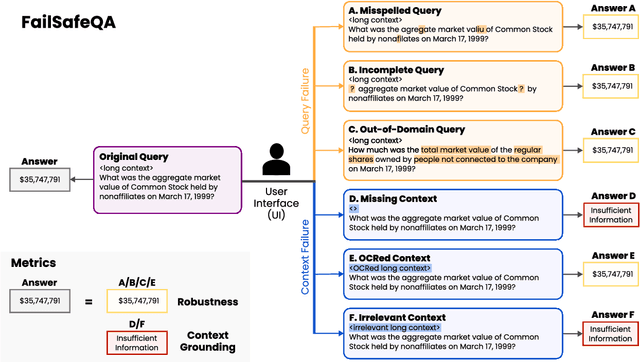
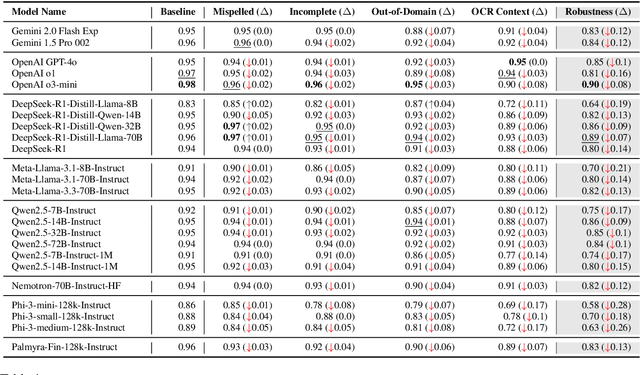

We propose a new long-context financial benchmark, FailSafeQA, designed to test the robustness and context-awareness of LLMs against six variations in human-interface interactions in LLM-based query-answer systems within finance. We concentrate on two case studies: Query Failure and Context Failure. In the Query Failure scenario, we perturb the original query to vary in domain expertise, completeness, and linguistic accuracy. In the Context Failure case, we simulate the uploads of degraded, irrelevant, and empty documents. We employ the LLM-as-a-Judge methodology with Qwen2.5-72B-Instruct and use fine-grained rating criteria to define and calculate Robustness, Context Grounding, and Compliance scores for 24 off-the-shelf models. The results suggest that although some models excel at mitigating input perturbations, they must balance robust answering with the ability to refrain from hallucinating. Notably, Palmyra-Fin-128k-Instruct, recognized as the most compliant model, maintained strong baseline performance but encountered challenges in sustaining robust predictions in 17% of test cases. On the other hand, the most robust model, OpenAI o3-mini, fabricated information in 41% of tested cases. The results demonstrate that even high-performing models have significant room for improvement and highlight the role of FailSafeQA as a tool for developing LLMs optimized for dependability in financial applications. The dataset is available at: https://huggingface.co/datasets/Writer/FailSafeQA
Writing in the Margins: Better Inference Pattern for Long Context Retrieval
Aug 27, 2024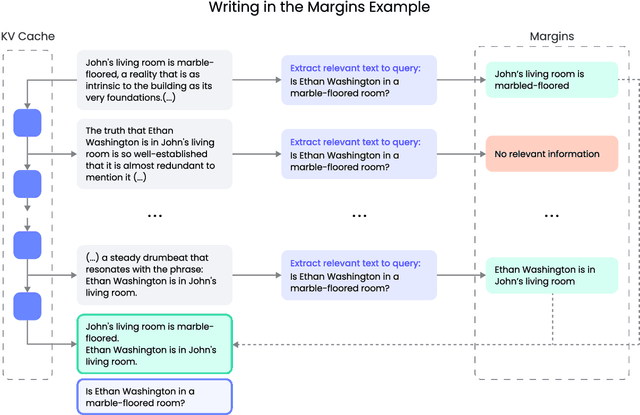
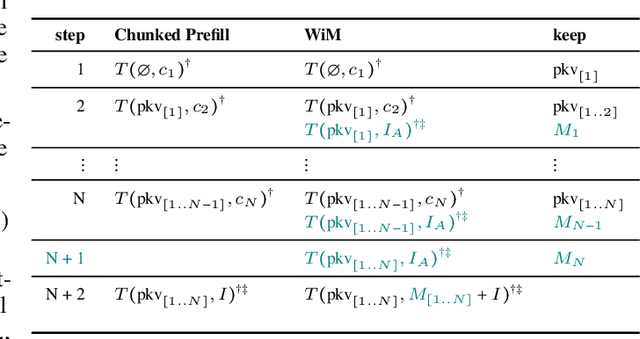
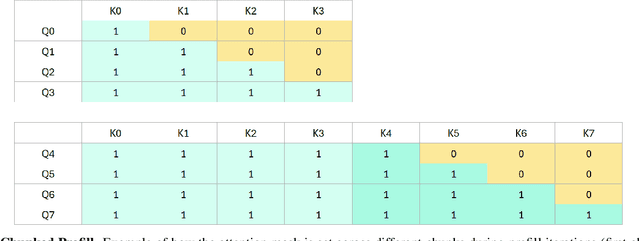
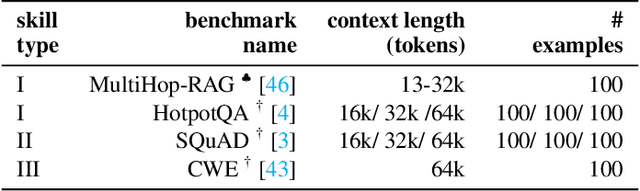
In this paper, we introduce Writing in the Margins (WiM), a new inference pattern for Large Language Models designed to optimize the handling of long input sequences in retrieval-oriented tasks. This approach leverages the chunked prefill of the key-value cache to perform segment-wise inference, which enables efficient processing of extensive contexts along with the generation and classification of intermediate information ("margins") that guide the model towards specific tasks. This method increases computational overhead marginally while significantly enhancing the performance of off-the-shelf models without the need for fine-tuning. Specifically, we observe that WiM provides an average enhancement of 7.5% in accuracy for reasoning skills (HotpotQA, MultiHop-RAG) and more than a 30.0% increase in the F1-score for aggregation tasks (CWE). Additionally, we show how the proposed pattern fits into an interactive retrieval design that provides end-users with ongoing updates about the progress of context processing, and pinpoints the integration of relevant information into the final response. We release our implementation of WiM using Hugging Face Transformers library at https://github.com/writer/writing-in-the-margins.
Comparative Analysis of Retrieval Systems in the Real World
May 03, 2024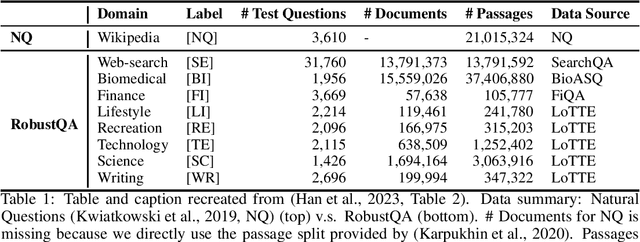
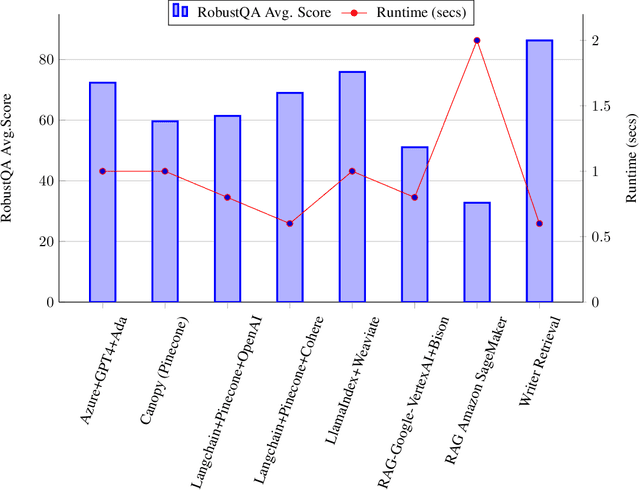
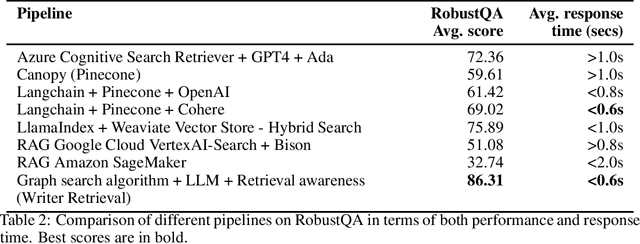
This research paper presents a comprehensive analysis of integrating advanced language models with search and retrieval systems in the fields of information retrieval and natural language processing. The objective is to evaluate and compare various state-of-the-art methods based on their performance in terms of accuracy and efficiency. The analysis explores different combinations of technologies, including Azure Cognitive Search Retriever with GPT-4, Pinecone's Canopy framework, Langchain with Pinecone and different language models (OpenAI, Cohere), LlamaIndex with Weaviate Vector Store's hybrid search, Google's RAG implementation on Cloud VertexAI-Search, Amazon SageMaker's RAG, and a novel approach called KG-FID Retrieval. The motivation for this analysis arises from the increasing demand for robust and responsive question-answering systems in various domains. The RobustQA metric is used to evaluate the performance of these systems under diverse paraphrasing of questions. The report aims to provide insights into the strengths and weaknesses of each method, facilitating informed decisions in the deployment and development of AI-driven search and retrieval systems.
Becoming self-instruct: introducing early stopping criteria for minimal instruct tuning
Jul 05, 2023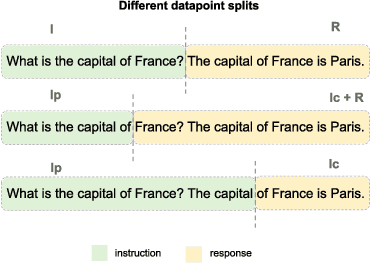
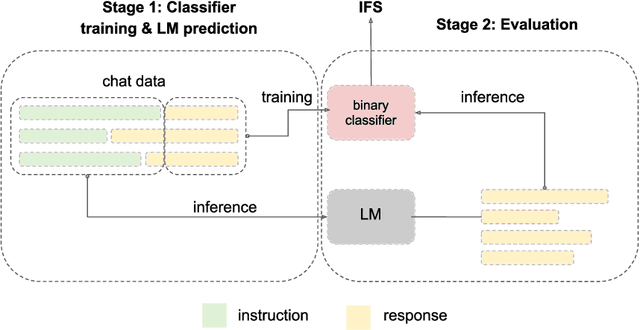
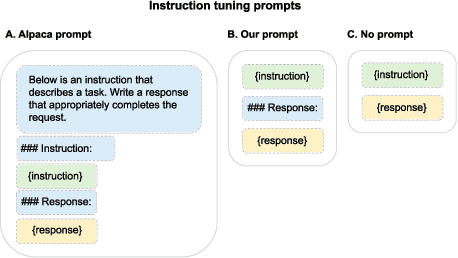
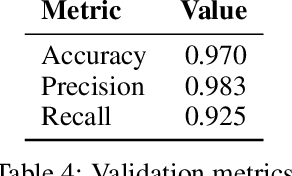
In this paper, we introduce the Instruction Following Score (IFS), a metric that detects language models' ability to follow instructions. The metric has a dual purpose. First, IFS can be used to distinguish between base and instruct models. We benchmark publicly available base and instruct models, and show that the ratio of well formatted responses to partial and full sentences can be an effective measure between those two model classes. Secondly, the metric can be used as an early stopping criteria for instruct tuning. We compute IFS for Supervised Fine-Tuning (SFT) of 7B and 13B LLaMA models, showing that models learn to follow instructions relatively early in the training process, and the further finetuning can result in changes in the underlying base model semantics. As an example of semantics change we show the objectivity of model predictions, as defined by an auxiliary metric ObjecQA. We show that in this particular case, semantic changes are the steepest when the IFS tends to plateau. We hope that decomposing instruct tuning into IFS and semantic factors starts a new trend in better controllable instruct tuning and opens possibilities for designing minimal instruct interfaces querying foundation models.