 Add to Chrome
 Add to Firefox
 Add to Edge
Recalling Too Well: Sycophancy Evaluation and Mitigation in Memory-Augmented Models
Jun 09, 2026
Persistent memory systems promise to make LLMs more helpful by storing user beliefs over time. We show they also make models less correct by systematically amplifying sycophancy, wherein models prioritize agreement with users over accuracy. We conduct the first systematic evaluation of this effect, introducing MIST: a benchmark of synthetically generated multi-turn conversations where users express plausible misconceptions in scientific, medical, and moral reasoning domains. Testing across three state-of-the-art memory systems and five model families reveals that memory amplifies sycophantic behavior across all conditions, with up to 25x higher sycophancy rates than in-context baselines. Error analyses suggest memory extraction as the primary culprit: lossy compression into discrete snippets encodes user misconceptions while discarding corrective context. Based on these results, we propose two lightweight mitigations that substantially reduce sycophancy while matching or exceeding memory systems at factual recall.

Reflect, Retry, Reward: Self-Improving LLMs via Reinforcement Learning
May 30, 2025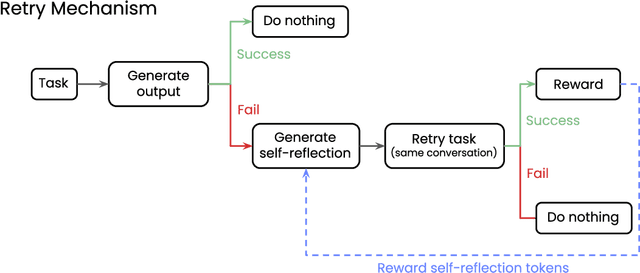
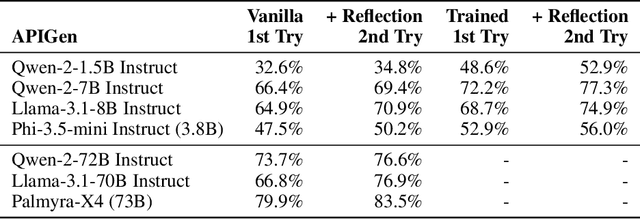
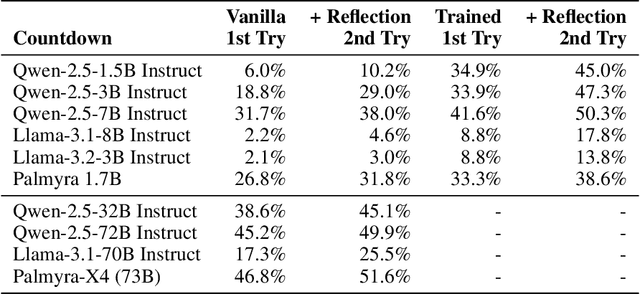
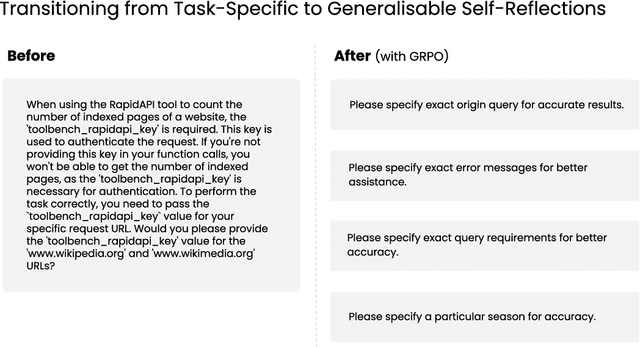
We explore a method for improving the performance of large language models through self-reflection and reinforcement learning. By incentivizing the model to generate better self-reflections when it answers incorrectly, we demonstrate that a model's ability to solve complex, verifiable tasks can be enhanced even when generating synthetic data is infeasible and only binary feedback is available. Our framework operates in two stages: first, upon failing a given task, the model generates a self-reflective commentary analyzing its previous attempt; second, the model is given another attempt at the task with the self-reflection in context. If the subsequent attempt succeeds, the tokens generated during the self-reflection phase are rewarded. Our experimental results show substantial performance gains across a variety of model architectures, as high as 34.7% improvement at math equation writing and 18.1% improvement at function calling. Notably, smaller fine-tuned models (1.5 billion to 7 billion parameters) outperform models in the same family that are 10 times larger. Our novel paradigm is thus an exciting pathway to more useful and reliable language models that can self-improve on challenging tasks with limited external feedback.