 Add to Chrome
 Add to Firefox
 Add to Edge
StairMaster: Learning to Conquer Risky Hollow Stairs for Agile Quadrupedal Robots
Jun 24, 2026
Climbing hollow stairs remains a challenging problem for quadruped robots due to the high risk of leg trapping, severe depth sparsity, and high-frequency depth-sensing noise. In this paper, we propose StairMaster, a novel three-stage reinforcement learning framework for stable locomotion on such extreme discontinuous terrains. Our architecture integrates a Cross-Attention mechanism to extract structural features from noisy depth data, alongside a Spatial-aware Recurrent Unit (SRU) that maintains robust spatio-temporal memory to mitigate perception blind spots. To bridge the sim-to-real gap in depth perception, we propose a high-fidelity sim-to-real depth sensor modeling pipeline that faithfully replicates real-world sensor artifacts. Additionally, we employ a 3D waypoint-guided active perception reward for proactive sensing, alongside hollow gap kinematic and stair edge penalties to ensure precise foothold placement. We successfully deployed StairMaster on a Unitree Go2 robot, demonstrating its ability to conquer hollow stairs with an unprecedented incline of up to 55$^\circ$ through zero-shot transfer. To the best of our knowledge, this is the first RL-based policy to achieve such steep hollow stair climbing in real-world environments. Project Website: https://sivan666666.github.io/StairMaster/.

Augmented smartphone bilirubinometer enabled by a mobile app that turns smartphone into multispectral imager
Mar 04, 2023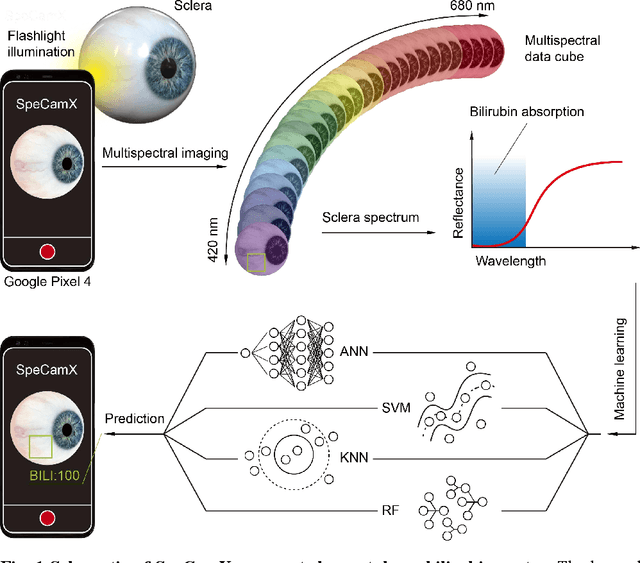
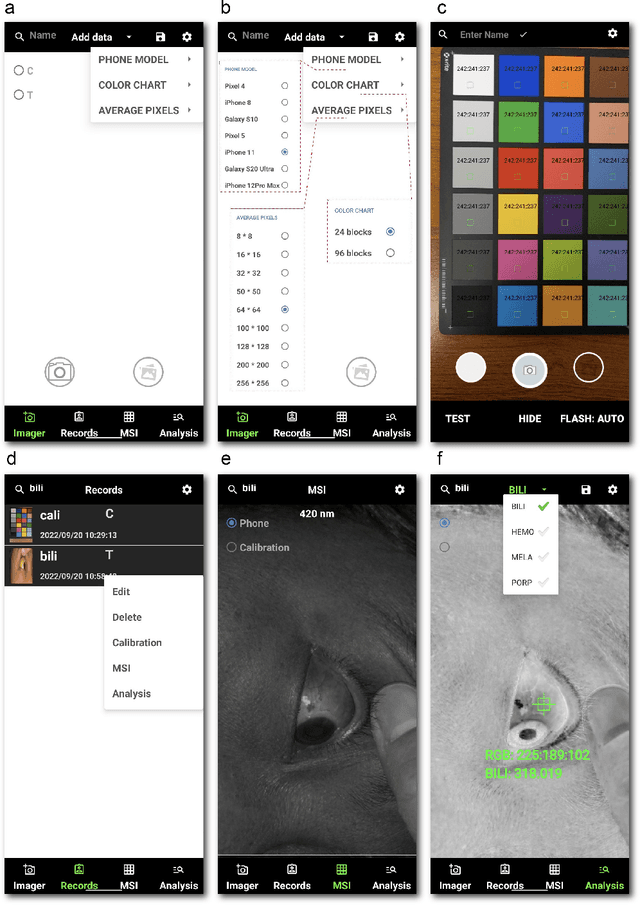
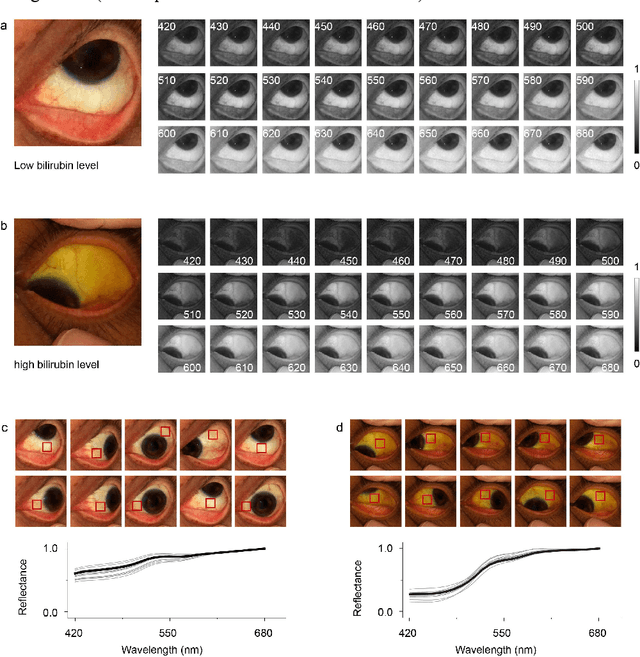
We present the development of SpeCamX, a mobile application that transforms any unmodified smartphone into a powerful multispectral imager capable of capturing multispectral information. Our application includes an augmented bilirubinometer, enabling accurate prediction of blood bilirubin levels (BBL). In a clinical study involving 320 patients with liver diseases, we used SpeCamX to image the bulbar conjunctiva region, and we employed a hybrid machine learning prediction model to predict BBL. We observed a high correlation with blood test results, demonstrating the efficacy of our approach. Furthermore, we compared our method, which uses spectrally augmented learning (SAL), with traditional learning based on RGB photographs (RGBL), and our results clearly indicate that SpeCamX outperforms RGBL in terms of prediction accuracy, efficiency, and stability. This study highlights the potential of SpeCamX to improve the prediction of bio-chromophores, and its ability to transform an ordinary smartphone into a powerful medical tool without the need for additional investments or expertise. This makes it suitable for widespread use, particularly in areas where medical resources are scarce.