 Add to Chrome
 Add to Firefox
 Add to Edge
Hierarchical Policy Learning via Spectral Decomposition
Jun 28, 2026
In this paper, we identify a semantic decomposition in robot action sequences, separating task-level motion intent from execution-level refinements. By analyzing actions in the spectral domain using the discrete cosine transform (DCT), we observe that low-frequency components capture global motion trajectories, while high-frequency components encode precise timing, alignment, and contact behaviors. Motivated by this structure, we propose Causal Spectral Policy (CSP), which models action generation as a causal coarse-to-fine process: coarse motion is predicted from observation and language, and fine corrections are generated conditionally on the realized trajectory. Across simulation and real-world evaluations, CSP consistently outperforms strong baselines on precision-sensitive manipulation tasks. Additionally, we propose human-inspired teleoperation noise injection as a data augmentation method, under which our approach demonstrates strong robustness to noisy demonstrations.

CLIMB: Language-Guided Continual Learning for Task Planning with Iterative Model Building
Oct 17, 2024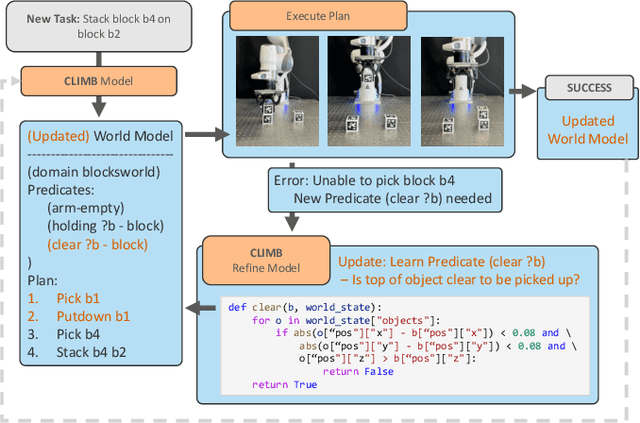
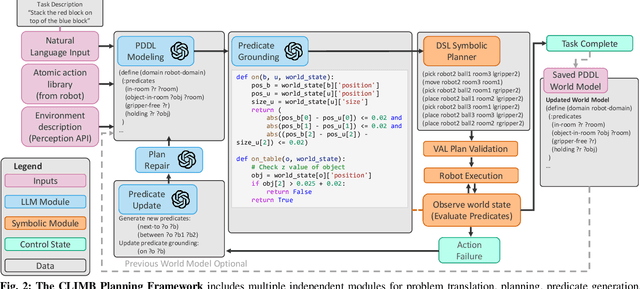
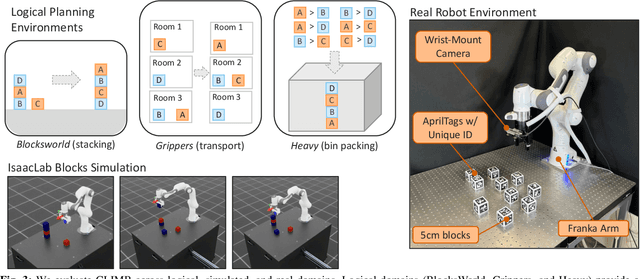
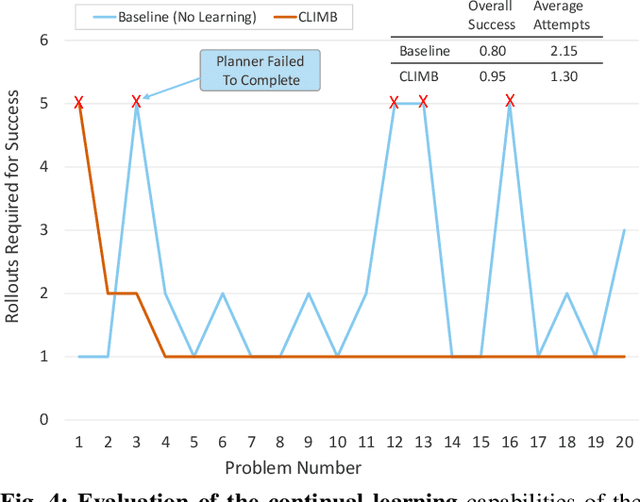
Intelligent and reliable task planning is a core capability for generalized robotics, requiring a descriptive domain representation that sufficiently models all object and state information for the scene. We present CLIMB, a continual learning framework for robot task planning that leverages foundation models and execution feedback to guide domain model construction. CLIMB can build a model from a natural language description, learn non-obvious predicates while solving tasks, and store that information for future problems. We demonstrate the ability of CLIMB to improve performance in common planning environments compared to baseline methods. We also develop the BlocksWorld++ domain, a simulated environment with an easily usable real counterpart, together with a curriculum of tasks with progressing difficulty for evaluating continual learning. Additional details and demonstrations for this system can be found at https://plan-with-climb.github.io/ .