 Add to Chrome
 Add to Firefox
 Add to Edge
Adynamical systems view of training generativemodels and the memorization phenomenon
May 19, 2026
Using recent works of one of the authors (VSB) on collapse in generative models and two time scale dynamics in stochastic gradient descent in high dimensions, we give a system theoretic explanation of the memorization phenomenon in generative models. This relies purely on the dynamic aspects of the training phase. Specifically, we use a result of Austin [2016] to motivate a stylized model for the loss function for stochastic gradient descent (SGD) wherein the loss function has a strong dependence on some variables and weak dependence on the rest in a precise sense. This naturally leads to two distinct time scales in the constant step size SGD that is commonly used in machine learning. This fact has been used to explain the double descent phenomenon in SGD in Borkar [2026]. In conjunction with a mathematical model for collapse phenomenon in SGD developed in Borkar [2025a], we analyze the constant step size SGD using the recent results of Azizian et al. [2024] in order to explain the phenomenon of memorization wherein a generative model that is concurrently being tuned yields the same or similar outputs for significant stretches of time. This gives a novel perspective on the aforementioned phenomena reported in machine learning literature and their interrelationships, using a dynamical systems viewpoint.

Regret and Sample Complexity of Online Q-Learning via Concentration of Stochastic Approximation with Time-Inhomogeneous Markov Chains
Feb 18, 2026We present the first high-probability regret bound for classical online Q-learning in infinite-horizon discounted Markov decision processes, without relying on optimism or bonus terms. We first analyze Boltzmann Q-learning with decaying temperature and show that its regret depends critically on the suboptimality gap of the MDP: for sufficiently large gaps, the regret is sublinear, while for small gaps it deteriorates and can approach linear growth. To address this limitation, we study a Smoothed $ε_n$-Greedy exploration scheme that combines $ε_n$-greedy and Boltzmann exploration, for which we prove a gap-robust regret bound of near-$\tilde{O}(N^{9/10})$. To analyze these algorithms, we develop a high-probability concentration bound for contractive Markovian stochastic approximation with iterate- and time-dependent transition dynamics. This bound may be of independent interest as the contraction factor in our bound is governed by the mixing time and is allowed to converge to one asymptotically.
An Actor-Critic Algorithm with Function Approximation for Risk Sensitive Cost Markov Decision Processes
Feb 17, 2025

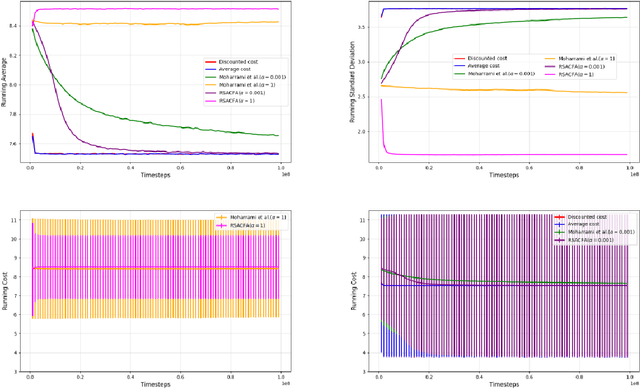

In this paper, we consider the risk-sensitive cost criterion with exponentiated costs for Markov decision processes and develop a model-free policy gradient algorithm in this setting. Unlike additive cost criteria such as average or discounted cost, the risk-sensitive cost criterion is less studied due to the complexity resulting from the multiplicative structure of the resulting Bellman equation. We develop an actor-critic algorithm with function approximation in this setting and provide its asymptotic convergence analysis. We also show the results of numerical experiments that demonstrate the superiority in performance of our algorithm over other recent algorithms in the literature.
Lagrangian Index Policy for Restless Bandits with Average Reward
Dec 17, 2024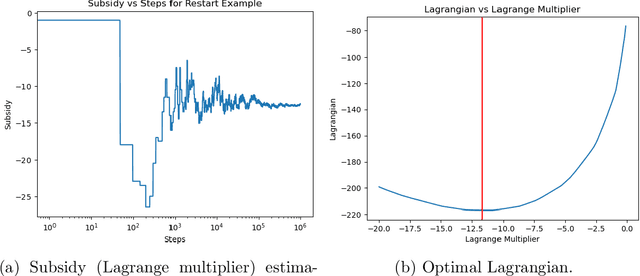
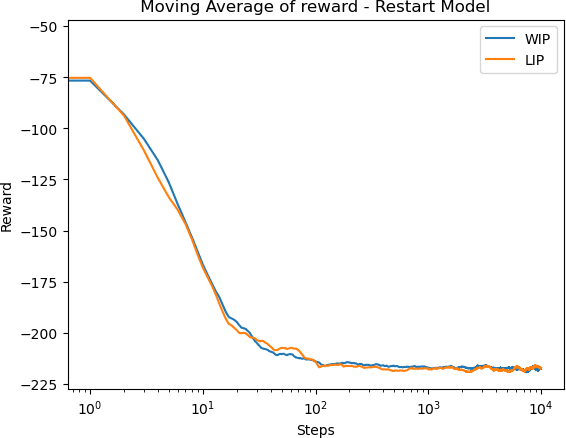
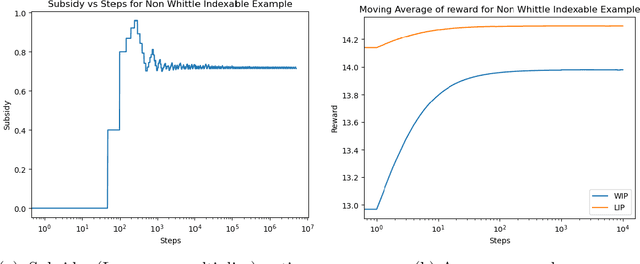
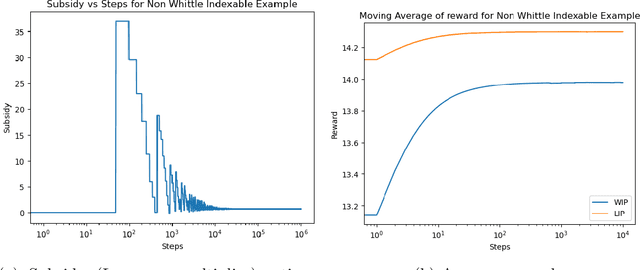
We study the Lagrangian Index Policy (LIP) for restless multi-armed bandits with long-run average reward. In particular, we compare the performance of LIP with the performance of the Whittle Index Policy (WIP), both heuristic policies known to be asymptotically optimal under certain natural conditions. Even though in most cases their performances are very similar, in the cases when WIP shows bad performance, LIP continues to perform very well. We then propose reinforcement learning algorithms, both tabular and NN-based, to obtain online learning schemes for LIP in the model-free setting. The proposed reinforcement learning schemes for LIP requires significantly less memory than the analogous scheme for WIP. We calculate analytically the Lagrangian index for the restart model, which describes the optimal web crawling and the minimization of the weighted age of information. We also give a new proof of asymptotic optimality in case of homogeneous bandits as the number of arms goes to infinity, based on exchangeability and de Finetti's theorem.
A Concentration Bound for TD with Function Approximation
Dec 16, 2023We derive a concentration bound of the type `for all $n \geq n_0$ for some $n_0$' for TD(0) with linear function approximation. We work with online TD learning with samples from a single sample path of the underlying Markov chain. This makes our analysis significantly different from offline TD learning or TD learning with access to independent samples from the stationary distribution of the Markov chain. We treat TD(0) as a contractive stochastic approximation algorithm, with both martingale and Markov noises. Markov noise is handled using the Poisson equation and the lack of almost sure guarantees on boundedness of iterates is handled using the concept of relaxed concentration inequalities.
Approximation of Convex Envelope Using Reinforcement Learning
Nov 24, 2023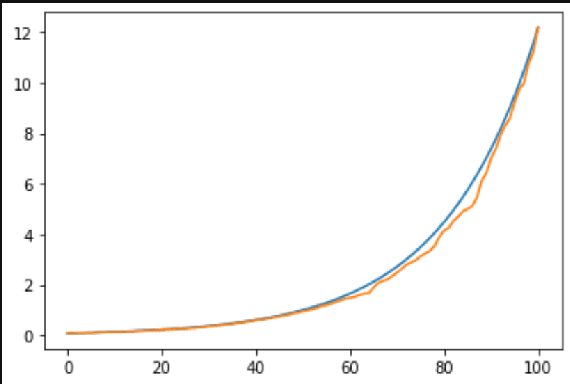
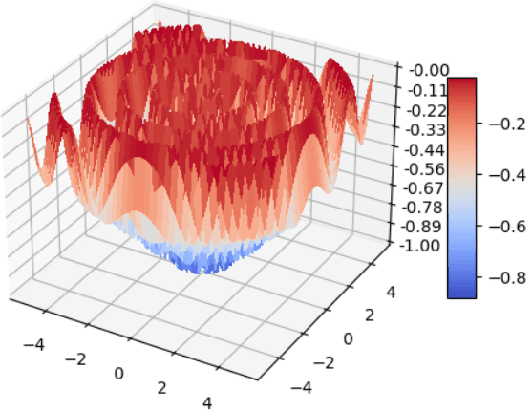
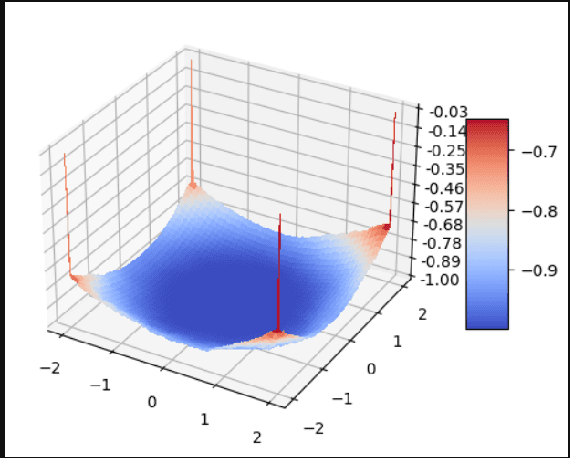
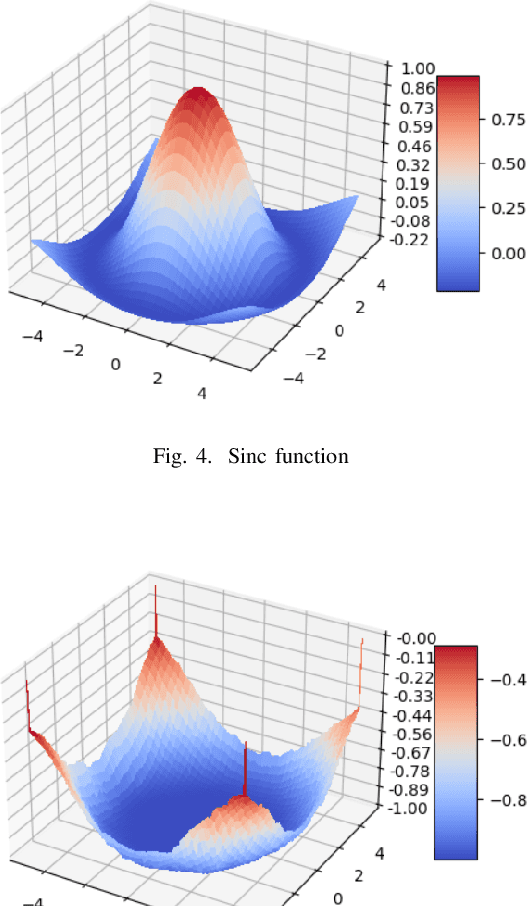
Oberman gave a stochastic control formulation of the problem of estimating the convex envelope of a non-convex function. Based on this, we develop a reinforcement learning scheme to approximate the convex envelope, using a variant of Q-learning for controlled optimal stopping. It shows very promising results on a standard library of test problems.
Decentralised Q-Learning for Multi-Agent Markov Decision Processes with a Satisfiability Criterion
Nov 21, 2023In this paper, we propose a reinforcement learning algorithm to solve a multi-agent Markov decision process (MMDP). The goal, inspired by Blackwell's Approachability Theorem, is to lower the time average cost of each agent to below a pre-specified agent-specific bound. For the MMDP, we assume the state dynamics to be controlled by the joint actions of agents, but the per-stage costs to only depend on the individual agent's actions. We combine the Q-learning algorithm for a weighted combination of the costs of each agent, obtained by a gossip algorithm with the Metropolis-Hastings or Multiplicative Weights formalisms to modulate the averaging matrix of the gossip. We use multiple timescales in our algorithm and prove that under mild conditions, it approximately achieves the desired bounds for each of the agents. We also demonstrate the empirical performance of this algorithm in the more general setting of MMDPs having jointly controlled per-stage costs.
Actor-Critic or Critic-Actor? A Tale of Two Time Scales
Oct 10, 2022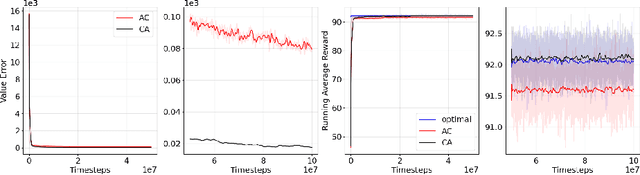
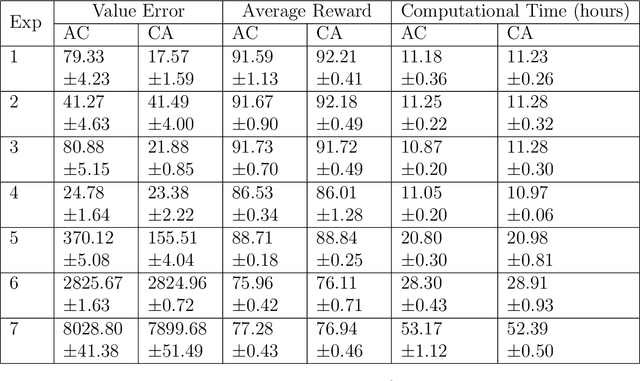
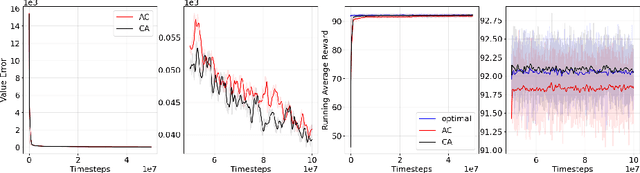
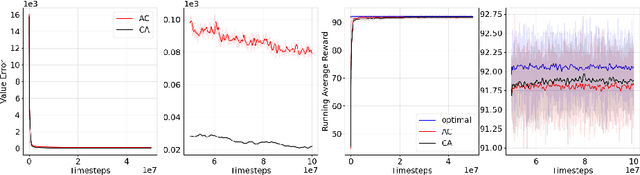
We revisit the standard formulation of tabular actor-critic algorithm as a two time-scale stochastic approximation with value function computed on a faster time-scale and policy computed on a slower time-scale. This emulates policy iteration. We begin by observing that reversal of the time scales will in fact emulate value iteration and is a legitimate algorithm. We compare the two empirically with and without function approximation (with both linear and nonlinear function approximators) and observe that our proposed critic-actor algorithm performs better empirically though with a marginal increase in the computational cost.
A Concentration Bound for LSPE($λ$)
Nov 04, 2021The popular LSPE($\lambda$) algorithm for policy evaluation is revisited to derive a concentration bound that gives high probability performance guarantees from some time on.
Concentration of Contractive Stochastic Approximation and Reinforcement Learning
Jun 27, 2021Using a martingale concentration inequality, concentration bounds `from time $n_0$ on' are derived for stochastic approximation algorithms with contractive maps and both martingale difference and Markov noises. These are applied to reinforcement learning algorithms, in particular to asynchronous Q-learning and TD(0).