 Add to Chrome
 Add to Firefox
 Add to Edge
Policy Gradient Methods for Non-Markovian Reinforcement Learning
May 11, 2026
We study policy gradient methods for reinforcement learning in non-Markovian decision processes (NMDPs), where observations and rewards depend on the entire interaction history. To handle this dependence, the agent maintains an internal state that is recursively updated to provide a compact summary of past observations and actions. In contrast to approaches that treat the agent state dynamics as fixed or learn it via predictive objectives, we propose a reward-centric formulation that jointly optimizes the agent state dynamics and the control policy to maximize the expected cumulative reward. To this end, we consider a class of Agent State-Markov (ASM) policies, comprising an agent state dynamics and a control policy that maps the agent state to actions. We establish a novel policy gradient theorem for ASM policies, extending the classical policy gradient results from the Markovian setting to episodic and infinite-horizon discounted NMDPs. Building on this gradient expression, we propose the Agent State-Markov Policy Gradient (ASMPG) algorithm, which leverages the recursive structure of the agent state dynamics for efficient optimization. We establish finite-time and almost sure convergence guarantees, and empirically demonstrate that, on a range of non-Markovian tasks, ASMPG outperforms baselines that learn state representations via predictive objectives.

Finite-time analysis of Multi-timescale Stochastic Optimization Algorithms
Mar 31, 2026We present a finite-time analysis of two smoothed functional stochastic approximation algorithms for simulation-based optimization. The first is a two time-scale gradient-based method, while the second is a three time-scale Newton-based algorithm that estimates both the gradient and the Hessian of the objective function $J$. Both algorithms involve zeroth order estimates for the gradient/Hessian. Although the asymptotic convergence of these algorithms has been established in prior work, finite-time guarantees of two-timescale stochastic optimization algorithms in zeroth order settings have not been provided previously. For our Newton algorithm, we derive mean-squared error bounds for the Hessian estimator and establish a finite-time bound on $\min\limits_{0 \le m \le T} \mathbb{E}\| \nabla J(θ(m)) \|^2$, showing convergence to first-order stationary points. The analysis explicitly characterizes the interaction between multiple time-scales and the propagation of estimation errors. We further identify step-size choices that balance dominant error terms and achieve near-optimal convergence rates. We also provide corresponding finite-time guarantees for the gradient algorithm under the same framework. The theoretical results are further validated through experiments on the Continuous Mountain Car environment.
High-Probability Bounds for SGD under the Polyak-Lojasiewicz Condition with Markovian Noise
Mar 15, 2026We present the first uniform-in-time high-probability bound for SGD under the PL condition, where the gradient noise contains both Markovian and martingale difference components. This significantly broadens the scope of finite-time guarantees, as the PL condition arises in many machine learning and deep learning models while Markovian noise naturally arises in decentralized optimization and online system identification problems. We further allow the magnitude of noise to grow with the function value, enabling the analysis of many practical sampling strategies. In addition to the high-probability guarantee, we establish a matching $1/k$ decay rate for the expected suboptimality. Our proof technique relies on the Poisson equation to handle the Markovian noise and a probabilistic induction argument to address the lack of almost-sure bounds on the objective. Finally, we demonstrate the applicability of our framework by analyzing three practical optimization problems: token-based decentralized linear regression, supervised learning with subsampling for privacy amplification, and online system identification.
Generalized Random Direction Newton Algorithms for Stochastic Optimization
Feb 23, 2026We present a family of generalized Hessian estimators of the objective using random direction stochastic approximation (RDSA) by utilizing only noisy function measurements. The form of each estimator and the order of the bias depend on the number of function measurements. In particular, we demonstrate that estimators with more function measurements exhibit lower-order estimation bias. We show the asymptotic unbiasedness of the estimators. We also perform asymptotic and non-asymptotic convergence analyses for stochastic Newton methods that incorporate our generalized Hessian estimators. Finally, we perform numerical experiments to validate our theoretical findings.
Convergence of Multiagent Learning Systems for Traffic control
Nov 10, 2025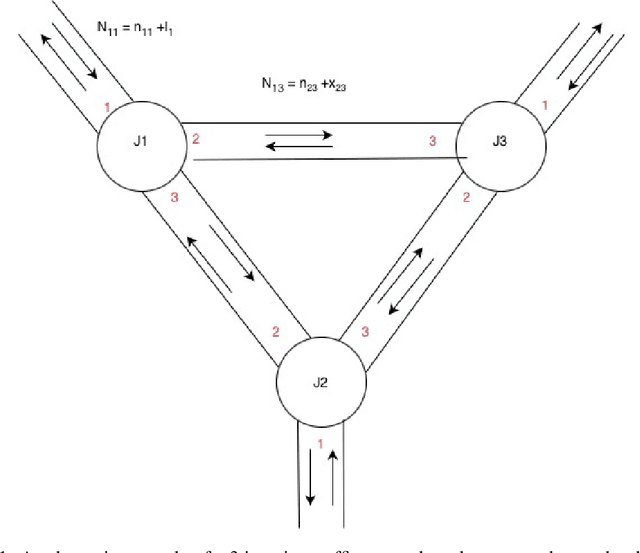

Rapid urbanization in cities like Bangalore has led to severe traffic congestion, making efficient Traffic Signal Control (TSC) essential. Multi-Agent Reinforcement Learning (MARL), often modeling each traffic signal as an independent agent using Q-learning, has emerged as a promising strategy to reduce average commuter delays. While prior work Prashant L A et. al has empirically demonstrated the effectiveness of this approach, a rigorous theoretical analysis of its stability and convergence properties in the context of traffic control has not been explored. This paper bridges that gap by focusing squarely on the theoretical basis of this multi-agent algorithm. We investigate the convergence problem inherent in using independent learners for the cooperative TSC task. Utilizing stochastic approximation methods, we formally analyze the learning dynamics. The primary contribution of this work is the proof that the specific multi-agent reinforcement learning algorithm for traffic control is proven to converge under the given conditions extending it from single agent convergence proofs for asynchronous value iteration.
Enabling Off-Policy Imitation Learning with Deep Actor Critic Stabilization
Nov 10, 2025Learning complex policies with Reinforcement Learning (RL) is often hindered by instability and slow convergence, a problem exacerbated by the difficulty of reward engineering. Imitation Learning (IL) from expert demonstrations bypasses this reliance on rewards. However, state-of-the-art IL methods, exemplified by Generative Adversarial Imitation Learning (GAIL)Ho et. al, suffer from severe sample inefficiency. This is a direct consequence of their foundational on-policy algorithms, such as TRPO Schulman et.al. In this work, we introduce an adversarial imitation learning algorithm that incorporates off-policy learning to improve sample efficiency. By combining an off-policy framework with auxiliary techniques specifically, double Q network based stabilization and value learning without reward function inference we demonstrate a reduction in the samples required to robustly match expert behavior.
An Actor-Critic Algorithm with Function Approximation for Risk Sensitive Cost Markov Decision Processes
Feb 17, 2025

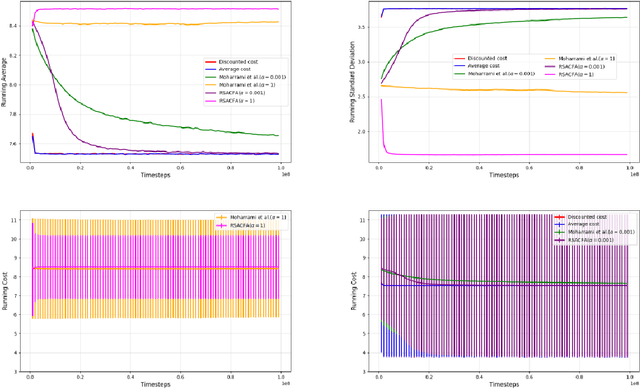

In this paper, we consider the risk-sensitive cost criterion with exponentiated costs for Markov decision processes and develop a model-free policy gradient algorithm in this setting. Unlike additive cost criteria such as average or discounted cost, the risk-sensitive cost criterion is less studied due to the complexity resulting from the multiplicative structure of the resulting Bellman equation. We develop an actor-critic algorithm with function approximation in this setting and provide its asymptotic convergence analysis. We also show the results of numerical experiments that demonstrate the superiority in performance of our algorithm over other recent algorithms in the literature.
Gradient-Weighted Feature Back-Projection: A Fast Alternative to Feature Distillation in 3D Gaussian Splatting
Nov 19, 2024We introduce a training-free method for feature field rendering in Gaussian splatting. Our approach back-projects 2D features into pre-trained 3D Gaussians, using a weighted sum based on each Gaussian's influence in the final rendering. While most training-based feature field rendering methods excel at 2D segmentation but perform poorly at 3D segmentation without post-processing, our method achieves high-quality results in both 2D and 3D segmentation. Experimental results demonstrate that our approach is fast, scalable, and offers performance comparable to training-based methods.
Gradient-Driven 3D Segmentation and Affordance Transfer in Gaussian Splatting Using 2D Masks
Sep 18, 20243D Gaussian Splatting has emerged as a powerful 3D scene representation technique, capturing fine details with high efficiency. In this paper, we introduce a novel voting-based method that extends 2D segmentation models to 3D Gaussian splats. Our approach leverages masked gradients, where gradients are filtered by input 2D masks, and these gradients are used as votes to achieve accurate segmentation. As a byproduct, we discovered that inference-time gradients can also be used to prune Gaussians, resulting in up to 21% compression. Additionally, we explore few-shot affordance transfer, allowing annotations from 2D images to be effectively transferred onto 3D Gaussian splats. The robust yet straightforward mathematical formulation underlying this approach makes it a highly effective tool for numerous downstream applications, such as augmented reality (AR), object editing, and robotics. The project code and additional resources are available at https://jojijoseph.github.io/3dgs-segmentation.
Critic-Actor for Average Reward MDPs with Function Approximation: A Finite-Time Analysis
Feb 02, 2024In recent years, there has been a lot of research work activity focused on carrying out asymptotic and non-asymptotic convergence analyses for two-timescale actor critic algorithms where the actor updates are performed on a timescale that is slower than that of the critic. In a recent work, the critic-actor algorithm has been presented for the infinite horizon discounted cost setting in the look-up table case where the timescales of the actor and the critic are reversed and asymptotic convergence analysis has been presented. In our work, we present the first critic-actor algorithm with function approximation and in the long-run average reward setting and present the first finite-time (non-asymptotic) analysis of such a scheme. We obtain optimal learning rates and prove that our algorithm achieves a sample complexity of $\mathcal{\tilde{O}}(\epsilon^{-2.08})$ for the mean squared error of the critic to be upper bounded by $\epsilon$ which is better than the one obtained for actor-critic in a similar setting. We also show the results of numerical experiments on three benchmark settings and observe that the critic-actor algorithm competes well with the actor-critic algorithm.