 Add to Chrome
 Add to Firefox
 Add to Edge
Deploying Semantic ID-based Generative Retrieval for Large-Scale Podcast Discovery at Spotify
Mar 18, 2026
Podcast listening is often grounded in a set of favorite shows, while listener intent can evolve over time. This combination of stable preferences and changing intent motivates recommendation approaches that support both familiarity and exploration. Traditional recommender systems typically emphasize long-term interaction patterns, and are less explicitly designed to incorporate rich contextual signals or flexible, intent-aware discovery objectives. In this setting, models that can jointly reason over semantics, context, and user state offer a promising direction. Large Language Models (LLMs) provide strong semantic reasoning and contextual conditioning for discovery-oriented recommendation, but deploying them in production introduces challenges in catalog grounding, user-level personalization, and latency-critical serving. We address these challenges with GLIDE, a production-scale generative recommender for podcast discovery at Spotify. GLIDE formulates recommendation as an instruction-following task over a discretized catalog using Semantic IDs, enabling grounded generation over a large inventory. The model conditions on recent listening history and lightweight user context, while injecting long-term user embeddings as soft prompts to capture stable preferences under strict inference constraints. We evaluate GLIDE using offline retrieval metrics, human judgments, and LLM-based evaluation, and validate its impact through large-scale online A/B testing. Across experiments involving millions of users, GLIDE increases non-habitual podcast streaming on Spotify home surface by up to 5.4% and new-show discovery by up to 14.3%, while meeting production cost and latency constraints.

A General-Purpose Multimodal Foundation Model for Dermatology
Oct 19, 2024
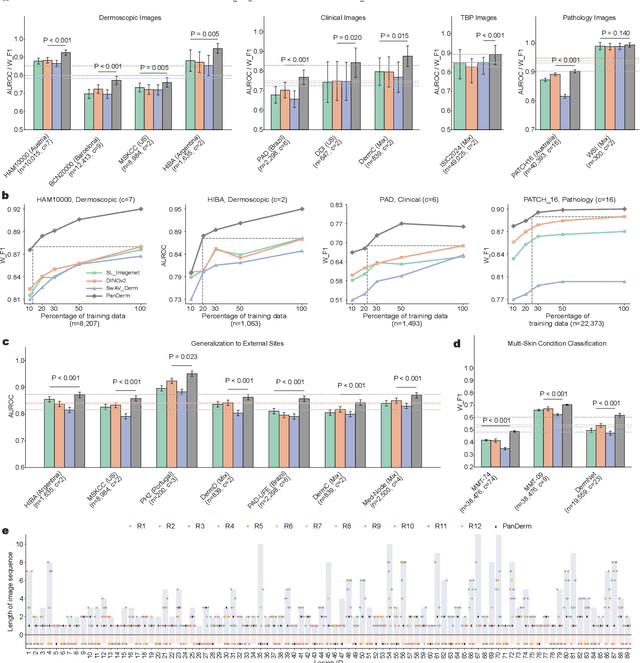
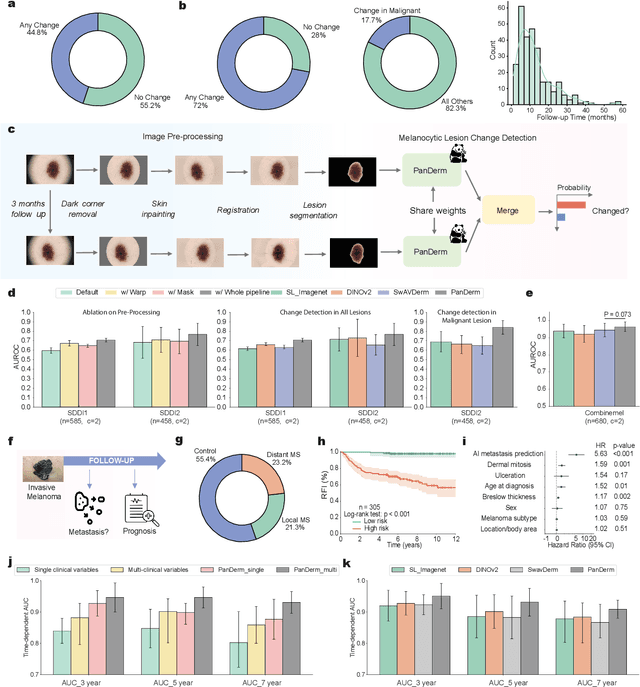

Diagnosing and treating skin diseases require advanced visual skills across multiple domains and the ability to synthesize information from various imaging modalities. Current deep learning models, while effective at specific tasks such as diagnosing skin cancer from dermoscopic images, fall short in addressing the complex, multimodal demands of clinical practice. Here, we introduce PanDerm, a multimodal dermatology foundation model pretrained through self-supervised learning on a dataset of over 2 million real-world images of skin diseases, sourced from 11 clinical institutions across 4 imaging modalities. We evaluated PanDerm on 28 diverse datasets covering a range of clinical tasks, including skin cancer screening, phenotype assessment and risk stratification, diagnosis of neoplastic and inflammatory skin diseases, skin lesion segmentation, change monitoring, and metastasis prediction and prognosis. PanDerm achieved state-of-the-art performance across all evaluated tasks, often outperforming existing models even when using only 5-10% of labeled data. PanDerm's clinical utility was demonstrated through reader studies in real-world clinical settings across multiple imaging modalities. It outperformed clinicians by 10.2% in early-stage melanoma detection accuracy and enhanced clinicians' multiclass skin cancer diagnostic accuracy by 11% in a collaborative human-AI setting. Additionally, PanDerm demonstrated robust performance across diverse demographic factors, including different body locations, age groups, genders, and skin tones. The strong results in benchmark evaluations and real-world clinical scenarios suggest that PanDerm could enhance the management of skin diseases and serve as a model for developing multimodal foundation models in other medical specialties, potentially accelerating the integration of AI support in healthcare.
FNetAR: Mixing Tokens with Autoregressive Fourier Transforms
Jul 22, 2021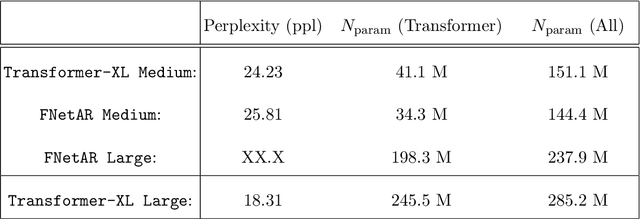
In this note we examine the autoregressive generalization of the FNet algorithm, in which self-attention layers from the standard Transformer architecture are substituted with a trivial sparse-uniformsampling procedure based on Fourier transforms. Using the Wikitext-103 benchmark, we demonstratethat FNetAR retains state-of-the-art performance (25.8 ppl) on the task of causal language modelingcompared to a Transformer-XL baseline (24.2 ppl) with only half the number self-attention layers,thus providing further evidence for the superfluity of deep neural networks with heavily compoundedattention mechanisms. The autoregressive Fourier transform could likely be used for parameterreduction on most Transformer-based time-series prediction models.