 Add to Chrome
 Add to Firefox
 Add to Edge
Security and Privacy in Retrieval-Augmented Generation: Architectures, Threats, Defenses, and Future Directions for Building Trustworthy Systems
Jun 24, 2026
Retrieval-Augmented Generation (RAG) has emerged as a dominant paradigm for enhancing large language models with external knowledge. By coupling retrieval mechanisms with generative models, RAG systems improve factual grounding and adaptability across domains. However, integrating retrieval pipelines introduces new security and privacy risks that extend beyond conventional language modeling threats. Sensitive information may be exposed through retrieval indices, query logs, context construction, or federated updates, while adversarial manipulation of knowledge bases can undermine trust in generated outputs. This survey provides a comprehensive examination of privacy and security challenges across RAG systems deployed in centralized, on-device (Micro-RAG), federated, and hybrid paradigms. We present a unified taxonomy of threat surfaces spanning the retrieval, context construction, and generation stages and systematically analyze attack classes, including membership inference, index inference, poisoning, gradient leakage, and collusion. We further review architectural, algorithmic, and cryptographic defenses, highlighting privacy-utility trade-offs and deployment considerations. Finally, we outline open research challenges toward building trustworthy, secure, and resilient RAG systems for real-world applications.

Beyond Reality: The Pivotal Role of Generative AI in the Metaverse
Jul 28, 2023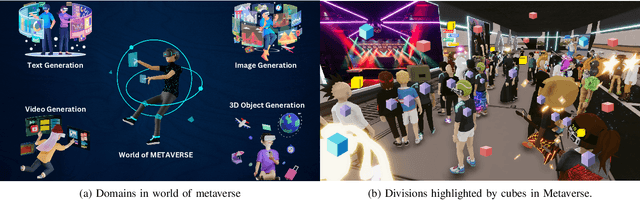
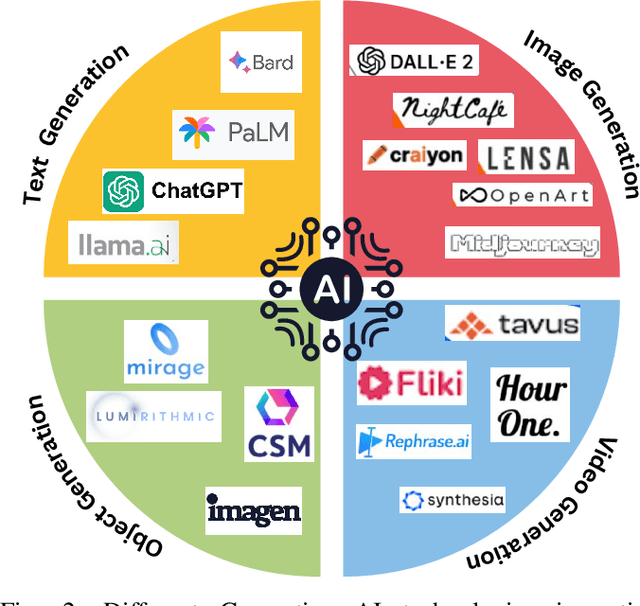
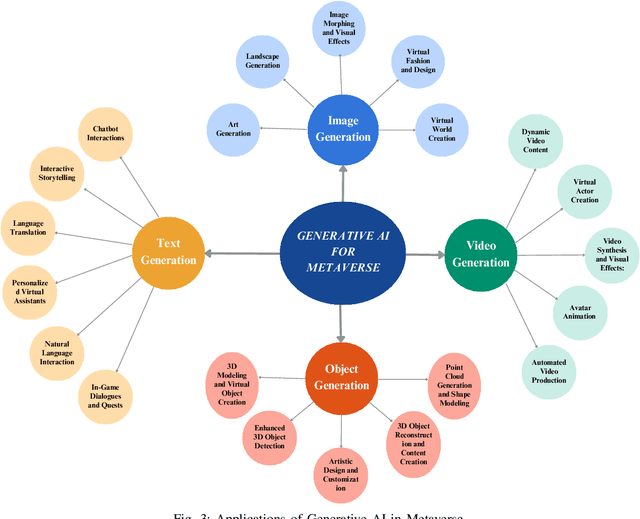
Imagine stepping into a virtual world that's as rich, dynamic, and interactive as our physical one. This is the promise of the Metaverse, and it's being brought to life by the transformative power of Generative Artificial Intelligence (AI). This paper offers a comprehensive exploration of how generative AI technologies are shaping the Metaverse, transforming it into a dynamic, immersive, and interactive virtual world. We delve into the applications of text generation models like ChatGPT and GPT-3, which are enhancing conversational interfaces with AI-generated characters. We explore the role of image generation models such as DALL-E and MidJourney in creating visually stunning and diverse content. We also examine the potential of 3D model generation technologies like Point-E and Lumirithmic in creating realistic virtual objects that enrich the Metaverse experience. But the journey doesn't stop there. We also address the challenges and ethical considerations of implementing these technologies in the Metaverse, offering insights into the balance between user control and AI automation. This paper is not just a study, but a guide to the future of the Metaverse, offering readers a roadmap to harnessing the power of generative AI in creating immersive virtual worlds.