 Add to Chrome
 Add to Firefox
 Add to Edge
Is GraphRAG Needed? From Basic RAG to Graph-/Agentic Solutions with Context Optimization
Jun 24, 2026
As advanced RAG variants like GraphRAG and Agentic RAG emerge, one leading question is when and how to use them. Here, we introduce a framework for different RAG scenarios evaluation and comparison on semi-structured knowledge bases, including regular RAG, GraphRAG, Modular RAG and Agentic RAG. We provide implementation for 9 standardized RAG scenarios, and conduct experiments for a comprehensive comparison. These scenarios are designed for real use cases regarding data and domain restrictions, spanning from simple document-based retrieval to advanced features such as hybrid text-graph retrieval, integration with computed or pre-defined domain knowledge graphs, agentic multi-step planning, and agent-graph integration. Besides, we present a novel context engineering method for GraphRAG and Agentic RAG, addressing the context/memory overflow issues, efficiently managing text and graph retrievals with new representations and agentic loop design, leading to 19%-53% reduction on token usage. Moreover, further analysis identifies a retrieval-generation gap where expanded retrieval does not proportionally improve generation quality, suggesting retrieval-oriented metrics overstate advanced retrieval benefits. This work provides data-driven insights on when and how to use them for building production-ready intelligent RAG systems.

Impression-Informed Multi-Behavior Recommender System: A Hierarchical Graph Attention Approach
Sep 07, 2023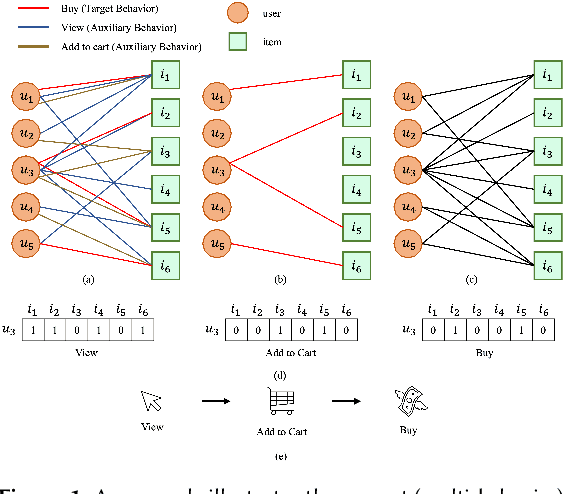

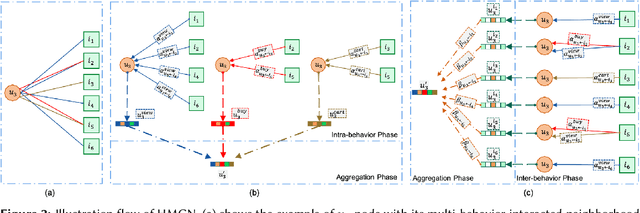
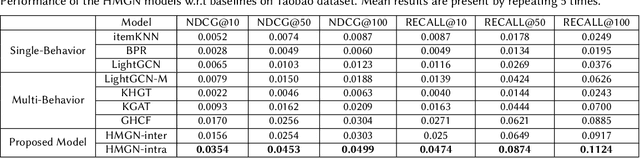
While recommender systems have significantly benefited from implicit feedback, they have often missed the nuances of multi-behavior interactions between users and items. Historically, these systems either amalgamated all behaviors, such as \textit{impression} (formerly \textit{view}), \textit{add-to-cart}, and \textit{buy}, under a singular 'interaction' label, or prioritized only the target behavior, often the \textit{buy} action, discarding valuable auxiliary signals. Although recent advancements tried addressing this simplification, they primarily gravitated towards optimizing the target behavior alone, battling with data scarcity. Additionally, they tended to bypass the nuanced hierarchy intrinsic to behaviors. To bridge these gaps, we introduce the \textbf{H}ierarchical \textbf{M}ulti-behavior \textbf{G}raph Attention \textbf{N}etwork (HMGN). This pioneering framework leverages attention mechanisms to discern information from both inter and intra-behaviors while employing a multi-task Hierarchical Bayesian Personalized Ranking (HBPR) for optimization. Recognizing the need for scalability, our approach integrates a specialized multi-behavior sub-graph sampling technique. Moreover, the adaptability of HMGN allows for the seamless inclusion of knowledge metadata and time-series data. Empirical results attest to our model's prowess, registering a notable performance boost of up to 64\% in NDCG@100 metrics over conventional graph neural network methods.