 Add to Chrome
 Add to Firefox
 Add to Edge
Effective Resistance Rewiring: A Simple Topological Correction for Over-Squashing
Mar 12, 2026
Graph Neural Networks struggle to capture long-range dependencies due to over-squashing, where information from exponentially growing neighborhoods must pass through a small number of structural bottlenecks. While recent rewiring methods attempt to alleviate this limitation, many rely on local criteria such as curvature, which can overlook global connectivity constraints that restrict information flow. We introduce Effective Resistance Rewiring (ERR), a simple topology correction strategy that uses effective resistance as a global signal to detect structural bottlenecks. ERR iteratively adds edges between node pairs with the largest resistance while removing edges with minimal resistance, strengthening weak communication pathways while controlling graph densification under a fixed edge budget. The procedure is parameter-free beyond the rewiring budget and relies on a single global measure aggregating all paths between node pairs. Beyond predictive performance with GCN models, we analyze how rewiring affects message propagation. By tracking cosine similarity between node embeddings across layers, we examine how the relationship between initial node features and learned representations evolves during message passing, comparing graphs with and without rewiring. This analysis helps determine whether improvements arise from better long-range communication rather than changes in embedding geometry. Experiments on homophilic and heterophilic graphs, including directed settings with DirGCN, reveal a trade-off between over-squashing and oversmoothing, where oversmoothing corresponds to the loss of representation diversity across layers. Resistance-guided rewiring improves connectivity and signal propagation but can accelerate representation mixing in deep models. Combining ERR with normalization techniques such as PairNorm stabilizes this trade-off and improves performance.

Active Learning-Guided Seq2Seq Variational Autoencoder for Multi-target Inhibitor Generation
Jun 18, 2025Simultaneously optimizing molecules against multiple therapeutic targets remains a profound challenge in drug discovery, particularly due to sparse rewards and conflicting design constraints. We propose a structured active learning (AL) paradigm integrating a sequence-to-sequence (Seq2Seq) variational autoencoder (VAE) into iterative loops designed to balance chemical diversity, molecular quality, and multi-target affinity. Our method alternates between expanding chemically feasible regions of latent space and progressively constraining molecules based on increasingly stringent multi-target docking thresholds. In a proof-of-concept study targeting three related coronavirus main proteases (SARS-CoV-2, SARS-CoV, MERS-CoV), our approach efficiently generated a structurally diverse set of pan-inhibitor candidates. We demonstrate that careful timing and strategic placement of chemical filters within this active learning pipeline markedly enhance exploration of beneficial chemical space, transforming the sparse-reward, multi-objective drug design problem into an accessible computational task. Our framework thus provides a generalizable roadmap for efficiently navigating complex polypharmacological landscapes.
ICML Topological Deep Learning Challenge 2024: Beyond the Graph Domain
Sep 08, 2024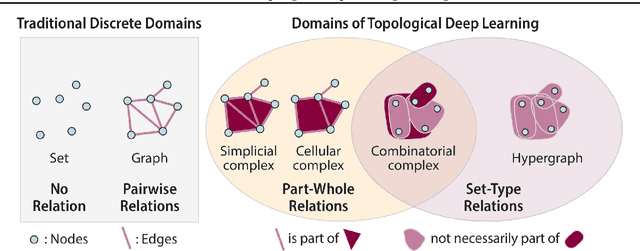
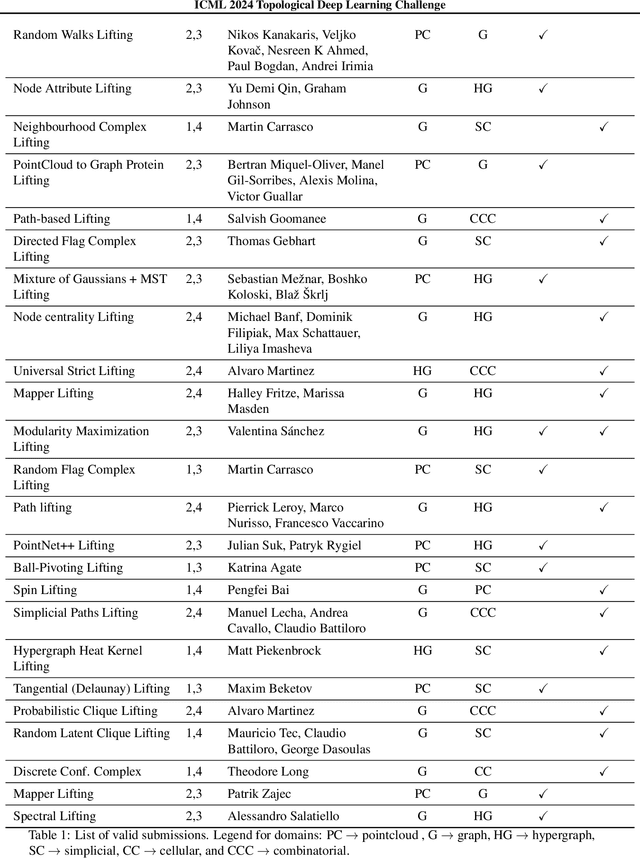
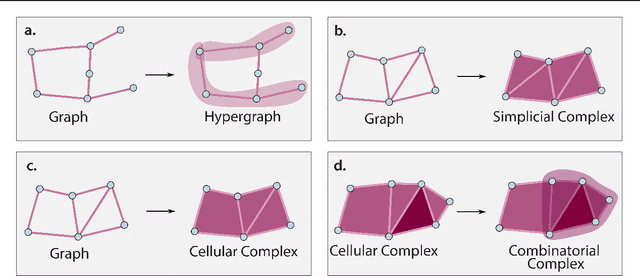
This paper describes the 2nd edition of the ICML Topological Deep Learning Challenge that was hosted within the ICML 2024 ELLIS Workshop on Geometry-grounded Representation Learning and Generative Modeling (GRaM). The challenge focused on the problem of representing data in different discrete topological domains in order to bridge the gap between Topological Deep Learning (TDL) and other types of structured datasets (e.g. point clouds, graphs). Specifically, participants were asked to design and implement topological liftings, i.e. mappings between different data structures and topological domains --like hypergraphs, or simplicial/cell/combinatorial complexes. The challenge received 52 submissions satisfying all the requirements. This paper introduces the main scope of the challenge, and summarizes the main results and findings.
Scoreformer: A Surrogate Model For Large-Scale Prediction of Docking Scores
Jun 13, 2024In this study, we present ScoreFormer, a novel graph transformer model designed to accurately predict molecular docking scores, thereby optimizing high-throughput virtual screening (HTVS) in drug discovery. The architecture integrates Principal Neighborhood Aggregation (PNA) and Learnable Random Walk Positional Encodings (LRWPE), enhancing the model's ability to understand complex molecular structures and their relationship with their respective docking scores. This approach significantly surpasses traditional HTVS methods and recent Graph Neural Network (GNN) models in both recovery and efficiency due to a wider coverage of the chemical space and enhanced performance. Our results demonstrate that ScoreFormer achieves competitive performance in docking score prediction and offers a substantial 1.65-fold reduction in inference time compared to existing models. We evaluated ScoreFormer across multiple datasets under various conditions, confirming its robustness and reliability in identifying potential drug candidates rapidly.
Optimizing Drug Design by Merging Generative AI With Active Learning Frameworks
May 04, 2023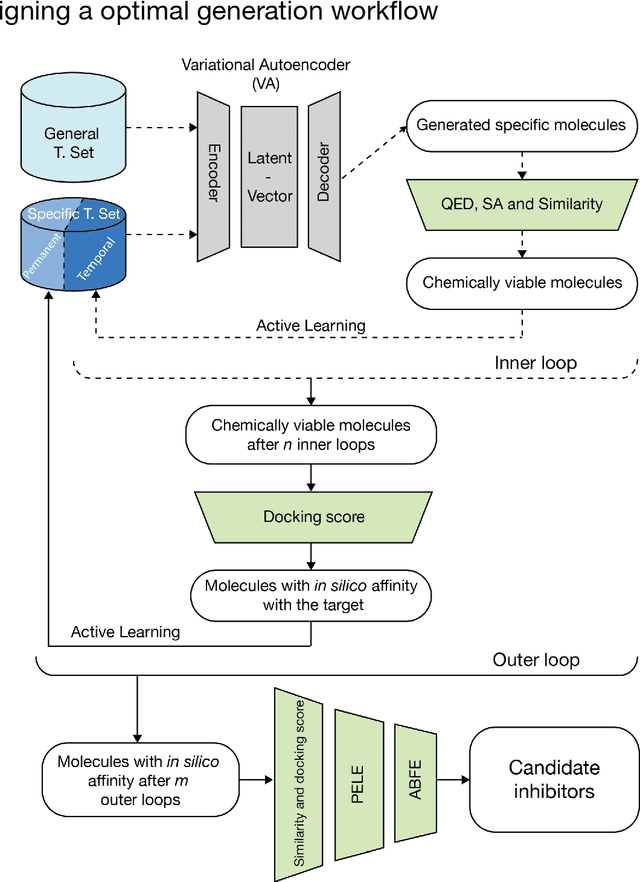
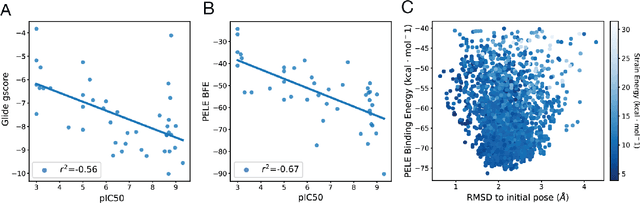
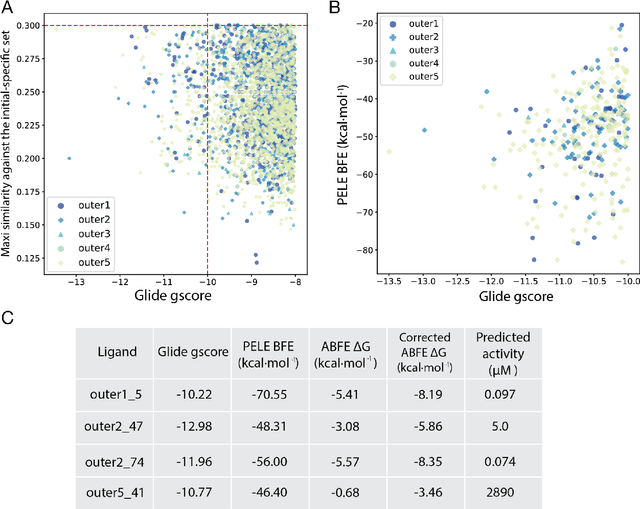
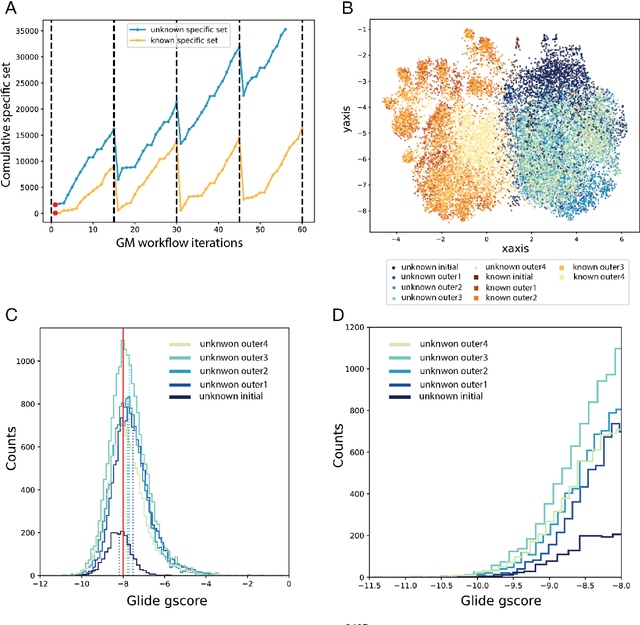
Traditional drug discovery programs are being transformed by the advent of machine learning methods. Among these, Generative AI methods (GM) have gained attention due to their ability to design new molecules and enhance specific properties of existing ones. However, current GM methods have limitations, such as low affinity towards the target, unknown ADME/PK properties, or the lack of synthetic tractability. To improve the applicability domain of GM methods, we have developed a workflow based on a variational autoencoder coupled with active learning steps. The designed GM workflow iteratively learns from molecular metrics, including drug likeliness, synthesizability, similarity, and docking scores. In addition, we also included a hierarchical set of criteria based on advanced molecular modeling simulations during a final selection step. We tested our GM workflow on two model systems, CDK2 and KRAS. In both cases, our model generated chemically viable molecules with a high predicted affinity toward the targets. Particularly, the proportion of high-affinity molecules inferred by our GM workflow was significantly greater than that in the training data. Notably, we also uncovered novel scaffolds significantly dissimilar to those known for each target. These results highlight the potential of our GM workflow to explore novel chemical space for specific targets, thereby opening up new possibilities for drug discovery endeavors.