 Add to Chrome
 Add to Firefox
 Add to Edge
Towards Unified and Data-Efficient Prognostics and Health Management with Tabular Foundation Models
Jun 03, 2026
Data-driven Prognostics and Health Management (PHM) uses time-varying condition-monitoring data to diagnose system states and estimate remaining useful life in engineered assets. These tasks are central to maintenance planning, but industrial PHM data are often fragmented, partially observed, and poorly labeled, which hinders supervised learning. Foundation models offer a route toward reusable predictive systems, yet most time-series foundation models are designed for forecasting and assume long, coherent, regularly sampled sequences. To address this gap, we propose a framework for applying Tabular Foundation Models to industrial time series using in-context learning, and we evaluate them on a variety of PHM tasks. By converting raw unit-level signals into tabular rows, we show that these models perform well across multiple tasks - including prognostics, and diagnostics - and are highly data efficient. We compare them directly with sequence models, transformer baselines, and gradient-boosted trees under a common evaluation protocol. The results indicate that tabular foundation models achieve the best average ranks across prognostic and diagnostic tasks. Our findings further show that PFN-based models are competitive in low-data regimes, that temporal context can be preserved in the tabular representation, and that performance depends on representative context construction under subsampling. These results demonstrate that tabular foundation models provide a practical and general interface for heterogeneous PHM problems.

From paper to benchmark: agentic, framework-based reproduction of under-specified methods in machine health intelligence
May 27, 2026Industrial Prognostics and Health Management (PHM) provides a representative case study for a broader challenge in applied machine learning: translating published papers into executable, benchmark-ready implementations. Reproducing under-specified methods in PHM is particularly difficult due to restricted access to industrial datasets, incomplete reporting of preprocessing and evaluation protocols, and implicit design choices (e.g., windowing, target construction, data splits) that critically affect performance. Existing paper-to-code systems generate implementations for individual papers, but these artifacts are often not directly comparable due to inconsistencies in assumptions and evaluation settings. We introduce \emph{agentic, framework-based PHM paper reproduction}, where an agent translates a paper into a shared PHM benchmark framework via a \emph{slot-binding interface}. This interface maps equations and protocol descriptions into structured components (task definitions, dataset adapters, windowing, targets, models, and evaluators), while explicitly recording unresolved assumptions. The resulting implementations are validated against standardized task contracts and evaluation hooks, enabling consistent and comparable benchmarking. We evaluate this approach on 16 PHM papers, comparing framework-enhanced, skill-based and prompt-based agentic reproduction against a recent framework-free paper-reproduction agent. We assess reproduction success, model-based code evaluation, framework binding of paper assumptions, and cross-paper benchmark comparability under standardized protocols. Our results show that coupling agentic generation with a shared framework transforms paper reproduction from isolated code synthesis into executable, assumption-aware, and systematically comparable benchmark implementations.
Picid: A Modular Evaluation Infrastructure for Reproducible PHM Across Tasks and Domains
May 27, 2026Progress in Prognostics and Health Management (PHM) is hindered by the lack of standardized and reusable evaluation practices across tasks, datasets, and application domains. Reported results are often difficult to reproduce and compare, as key protocol choices, such as data splits, preprocessing, label alignment, temporal windowing, and metrics, are often implicit or implemented ad hoc. We introduce \picid, a modular evaluation infrastructure that formalizes the PHM evaluation pipeline as an explicit, executable, and reproducible protocol. Through well-defined abstractions, \picid enforces deterministic, leakage-safe dataset construction while remaining flexible across diverse PHM settings. The framework supports fault detection, diagnostics, and prognostics through a unified interface and can be extended to new datasets and model classes without violating protocol invariants. By standardizing data contracts and evaluation boundaries, \picid also enables fair cross-task comparisons across diagnostics (classification) and prognostics (regression), allowing identical model families to be evaluated consistently across heterogeneous settings. We demonstrate \picid through an empirical evaluation of thirteen models on twelve datasets spanning batteries, bearings, turbofan engines, hydraulics, filtration systems, and buildings. This work establishes a reusable foundation for standardized, fair and reproducible evaluation in PHM.
HOPSE: Scalable Higher-Order Positional and Structural Encoder for Combinatorial Representations
May 21, 2025While Graph Neural Networks (GNNs) have proven highly effective at modeling relational data, pairwise connections cannot fully capture multi-way relationships naturally present in complex real-world systems. In response to this, Topological Deep Learning (TDL) leverages more general combinatorial representations -- such as simplicial or cellular complexes -- to accommodate higher-order interactions. Existing TDL methods often extend GNNs through Higher-Order Message Passing (HOMP), but face critical \emph{scalability challenges} due to \textit{(i)} a combinatorial explosion of message-passing routes, and \textit{(ii)} significant complexity overhead from the propagation mechanism. To overcome these limitations, we propose HOPSE (Higher-Order Positional and Structural Encoder) -- a \emph{message passing-free} framework that uses Hasse graph decompositions to derive efficient and expressive encodings over \emph{arbitrary higher-order domains}. Notably, HOPSE scales linearly with dataset size while preserving expressive power and permutation equivariance. Experiments on molecular, expressivity and topological benchmarks show that HOPSE matches or surpasses state-of-the-art performance while achieving up to 7 $times$ speedups over HOMP-based models, opening a new path for scalable TDL.
Topological Deep Learning with State-Space Models: A Mamba Approach for Simplicial Complexes
Sep 18, 2024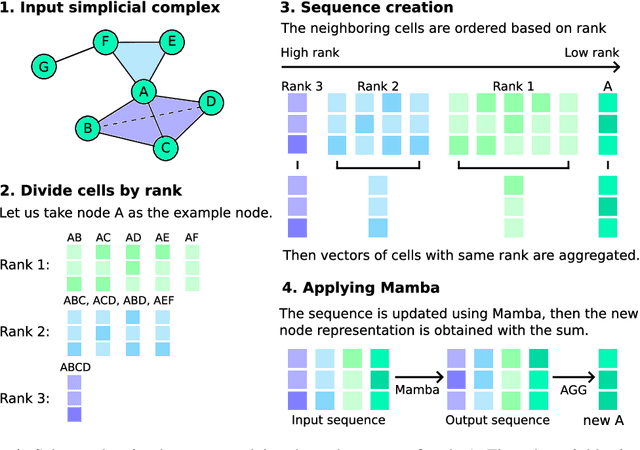
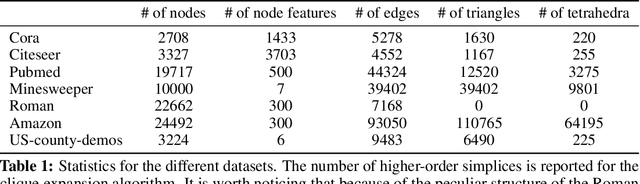
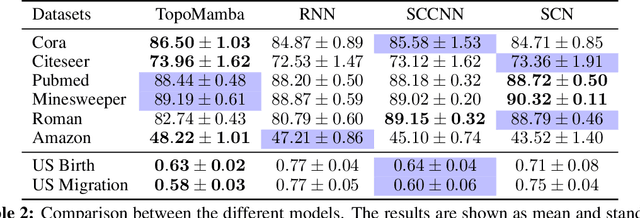
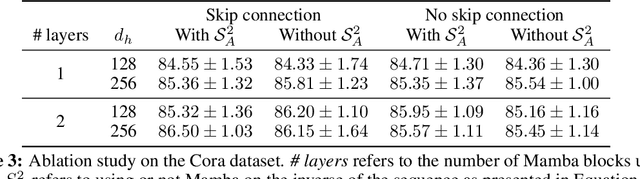
Graph Neural Networks based on the message-passing (MP) mechanism are a dominant approach for handling graph-structured data. However, they are inherently limited to modeling only pairwise interactions, making it difficult to explicitly capture the complexity of systems with $n$-body relations. To address this, topological deep learning has emerged as a promising field for studying and modeling higher-order interactions using various topological domains, such as simplicial and cellular complexes. While these new domains provide powerful representations, they introduce new challenges, such as effectively modeling the interactions among higher-order structures through higher-order MP. Meanwhile, structured state-space sequence models have proven to be effective for sequence modeling and have recently been adapted for graph data by encoding the neighborhood of a node as a sequence, thereby avoiding the MP mechanism. In this work, we propose a novel architecture designed to operate with simplicial complexes, utilizing the Mamba state-space model as its backbone. Our approach generates sequences for the nodes based on the neighboring cells, enabling direct communication between all higher-order structures, regardless of their rank. We extensively validate our model, demonstrating that it achieves competitive performance compared to state-of-the-art models developed for simplicial complexes.
ICML Topological Deep Learning Challenge 2024: Beyond the Graph Domain
Sep 08, 2024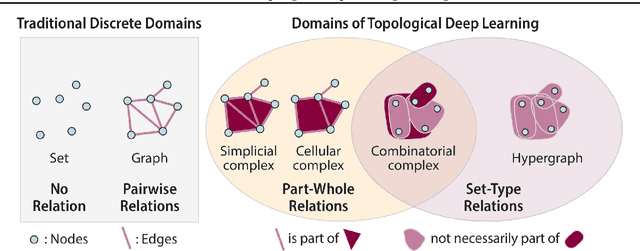
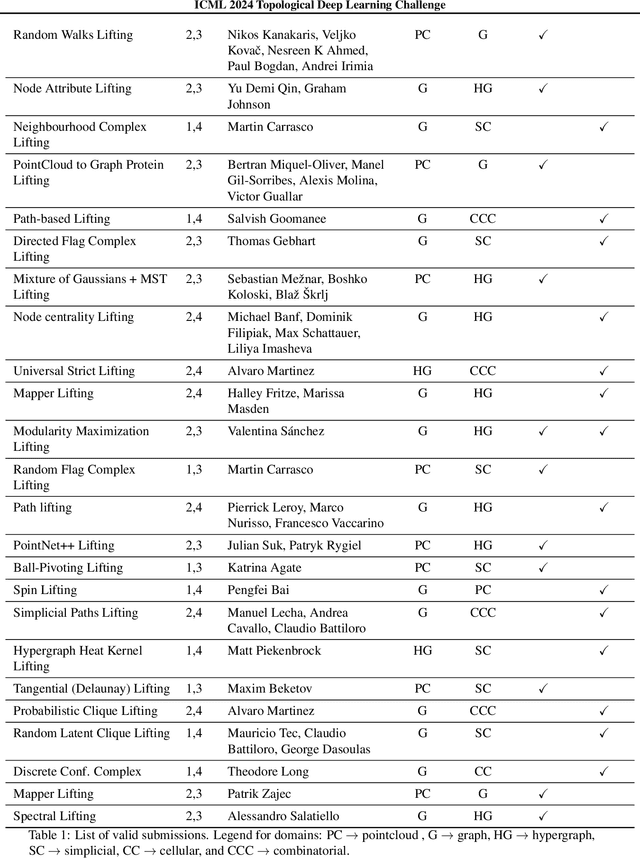
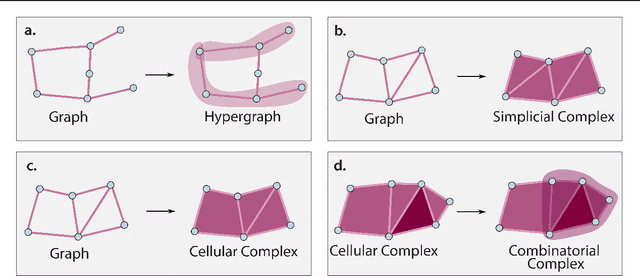
This paper describes the 2nd edition of the ICML Topological Deep Learning Challenge that was hosted within the ICML 2024 ELLIS Workshop on Geometry-grounded Representation Learning and Generative Modeling (GRaM). The challenge focused on the problem of representing data in different discrete topological domains in order to bridge the gap between Topological Deep Learning (TDL) and other types of structured datasets (e.g. point clouds, graphs). Specifically, participants were asked to design and implement topological liftings, i.e. mappings between different data structures and topological domains --like hypergraphs, or simplicial/cell/combinatorial complexes. The challenge received 52 submissions satisfying all the requirements. This paper introduces the main scope of the challenge, and summarizes the main results and findings.
TopoBenchmarkX: A Framework for Benchmarking Topological Deep Learning
Jun 09, 2024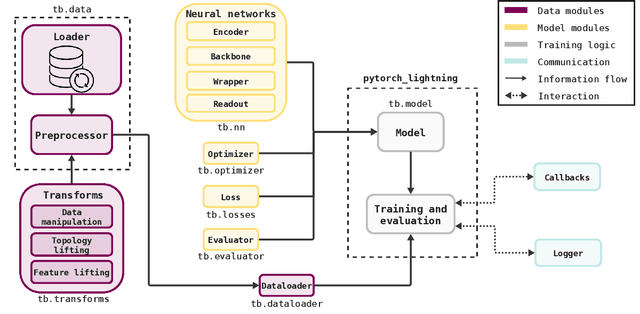
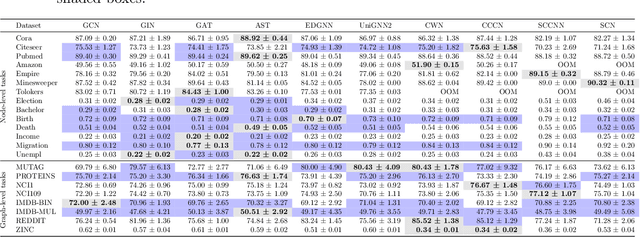
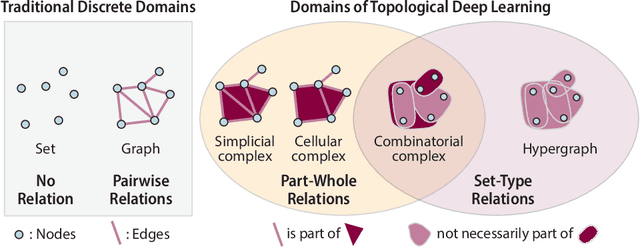
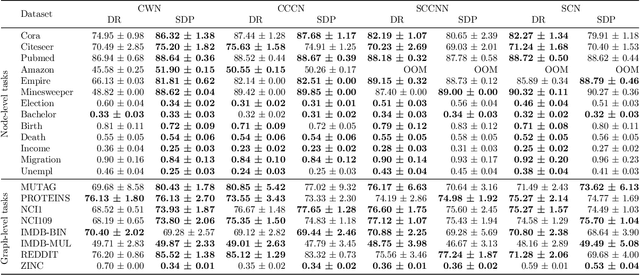
This work introduces TopoBenchmarkX, a modular open-source library designed to standardize benchmarking and accelerate research in Topological Deep Learning (TDL). TopoBenchmarkX maps the TDL pipeline into a sequence of independent and modular components for data loading and processing, as well as model training, optimization, and evaluation. This modular organization provides flexibility for modifications and facilitates the adaptation and optimization of various TDL pipelines. A key feature of TopoBenchmarkX is that it allows for the transformation and lifting between topological domains. This enables, for example, to obtain richer data representations and more fine-grained analyses by mapping the topology and features of a graph to higher-order topological domains such as simplicial and cell complexes. The range of applicability of TopoBenchmarkX is demonstrated by benchmarking several TDL architectures for various tasks and datasets.
TopoX: A Suite of Python Packages for Machine Learning on Topological Domains
Feb 07, 2024

We introduce topox, a Python software suite that provides reliable and user-friendly building blocks for computing and machine learning on topological domains that extend graphs: hypergraphs, simplicial, cellular, path and combinatorial complexes. topox consists of three packages: toponetx facilitates constructing and computing on these domains, including working with nodes, edges and higher-order cells; topoembedx provides methods to embed topological domains into vector spaces, akin to popular graph-based embedding algorithms such as node2vec; topomodelx is built on top of PyTorch and offers a comprehensive toolbox of higher-order message passing functions for neural networks on topological domains. The extensively documented and unit-tested source code of topox is available under MIT license at https://github.com/pyt-team.
Hypergraph Neural Networks through the Lens of Message Passing: A Common Perspective to Homophily and Architecture Design
Oct 11, 2023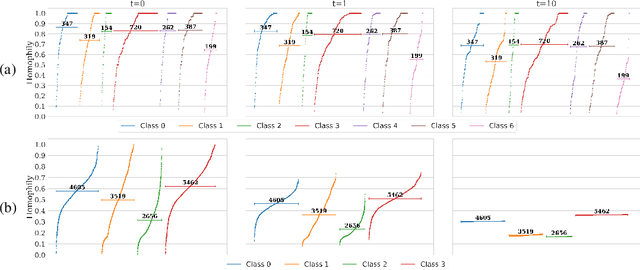
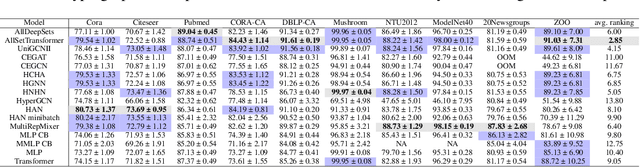

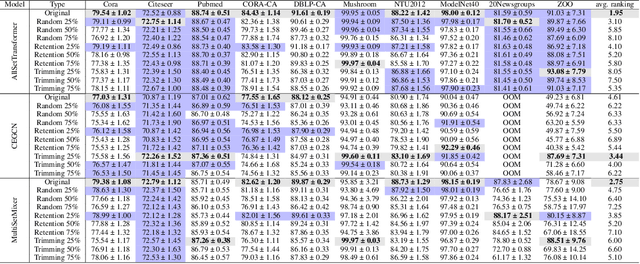
Most of the current hypergraph learning methodologies and benchmarking datasets in the hypergraph realm are obtained by lifting procedures from their graph analogs, simultaneously leading to overshadowing hypergraph network foundations. This paper attempts to confront some pending questions in that regard: Can the concept of homophily play a crucial role in Hypergraph Neural Networks (HGNNs), similar to its significance in graph-based research? Is there room for improving current hypergraph architectures and methodologies? (e.g. by carefully addressing the specific characteristics of higher-order networks) Do existing datasets provide a meaningful benchmark for HGNNs? Diving into the details, this paper proposes a novel conceptualization of homophily in higher-order networks based on a message passing scheme; this approach harmonizes the analytical frameworks of datasets and architectures, offering a unified perspective for exploring and interpreting complex, higher-order network structures and dynamics. Further, we propose MultiSet, a novel message passing framework that redefines HGNNs by allowing hyperedge-dependent node representations, as well as introduce a novel architecture MultiSetMixer that leverages a new hyperedge sampling strategy. Finally, we provide an extensive set of experiments that contextualize our proposals and lead to valuable insights in hypergraph representation learning.
ICML 2023 Topological Deep Learning Challenge : Design and Results
Oct 02, 2023

This paper presents the computational challenge on topological deep learning that was hosted within the ICML 2023 Workshop on Topology and Geometry in Machine Learning. The competition asked participants to provide open-source implementations of topological neural networks from the literature by contributing to the python packages TopoNetX (data processing) and TopoModelX (deep learning). The challenge attracted twenty-eight qualifying submissions in its two-month duration. This paper describes the design of the challenge and summarizes its main findings.