 Add to Chrome
 Add to Firefox
 Add to Edge
RIO: Flexible Real-Time Robot I/O for Cross-Embodiment Robot Learning
May 12, 2026
Despite recent efforts to collect multi-task, multi-embodiment datasets, to design recipes for training Vision-Language-Action models (VLAs), and to showcase these models on different robot platforms, generalist cross-embodiment robot capabilities remains a largely elusive ideal. Progress is limited by fragmented infrastructure: most robot code is highly specific to the exact setup the user decided on, which adds major overhead when attempting to reuse, recycle, or share artifacts between users. We present RIO (Robot I/O), an open source Python framework that provides flexible, lightweight components for robot control, teleoperation, data formatting, sensor configuration, and policy deployment across diverse hardware platforms and morphologies. RIO provides abstractions that enable users to make any choice and to switch between them, with minimal reconfiguration effort. We validate RIO on VLA deployment workflows across three morphologies (single-arm, bimanual, humanoid) and four hardware platforms with varying grippers and cameras. Using teleoperated data collected with RIO, we fine-tune state-of-the-art VLAs including $π_{0.5}$ and GR00T on household tasks such as pick-and-place, folding, and bowl scrubbing. By open sourcing all our efforts, we hope the community can accelerate their pace of robot learning on real-world robot hardware. Additional details at: https://robot-i-o.github.io

Stabilizing Reinforcement Learning in Differentiable Multiphysics Simulation
Dec 16, 2024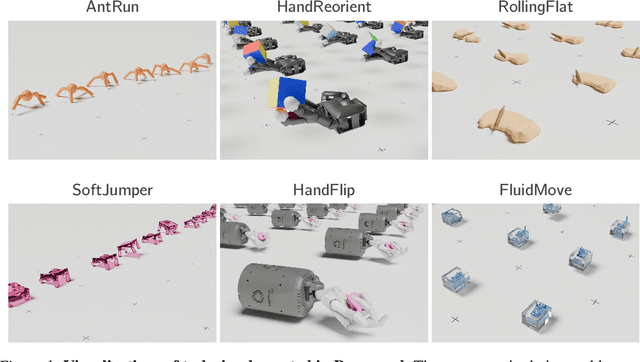
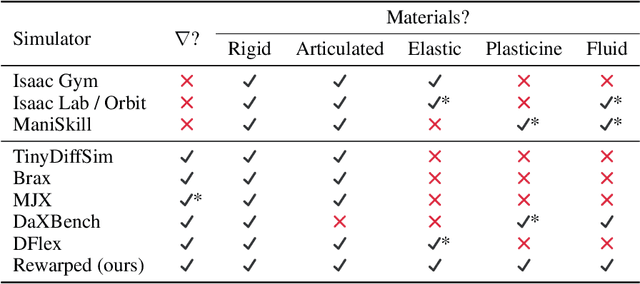
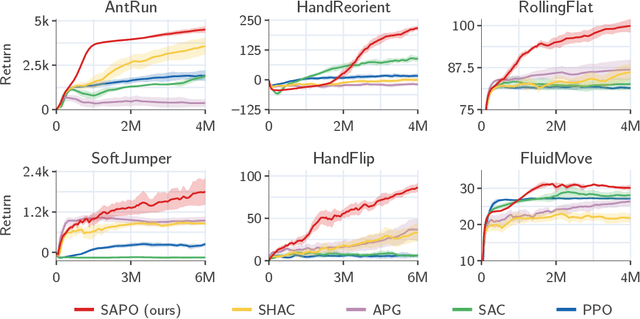
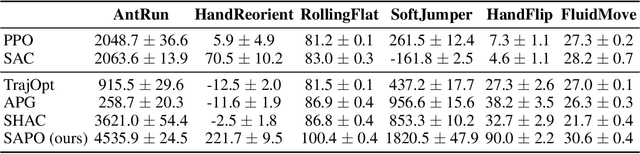
Recent advances in GPU-based parallel simulation have enabled practitioners to collect large amounts of data and train complex control policies using deep reinforcement learning (RL), on commodity GPUs. However, such successes for RL in robotics have been limited to tasks sufficiently simulated by fast rigid-body dynamics. Simulation techniques for soft bodies are comparatively several orders of magnitude slower, thereby limiting the use of RL due to sample complexity requirements. To address this challenge, this paper presents both a novel RL algorithm and a simulation platform to enable scaling RL on tasks involving rigid bodies and deformables. We introduce Soft Analytic Policy Optimization (SAPO), a maximum entropy first-order model-based actor-critic RL algorithm, which uses first-order analytic gradients from differentiable simulation to train a stochastic actor to maximize expected return and entropy. Alongside our approach, we develop Rewarped, a parallel differentiable multiphysics simulation platform that supports simulating various materials beyond rigid bodies. We re-implement challenging manipulation and locomotion tasks in Rewarped, and show that SAPO outperforms baselines over a range of tasks that involve interaction between rigid bodies, articulations, and deformables.