 Add to Chrome
 Add to Firefox
 Add to Edge
RIO: Flexible Real-Time Robot I/O for Cross-Embodiment Robot Learning
May 12, 2026
Despite recent efforts to collect multi-task, multi-embodiment datasets, to design recipes for training Vision-Language-Action models (VLAs), and to showcase these models on different robot platforms, generalist cross-embodiment robot capabilities remains a largely elusive ideal. Progress is limited by fragmented infrastructure: most robot code is highly specific to the exact setup the user decided on, which adds major overhead when attempting to reuse, recycle, or share artifacts between users. We present RIO (Robot I/O), an open source Python framework that provides flexible, lightweight components for robot control, teleoperation, data formatting, sensor configuration, and policy deployment across diverse hardware platforms and morphologies. RIO provides abstractions that enable users to make any choice and to switch between them, with minimal reconfiguration effort. We validate RIO on VLA deployment workflows across three morphologies (single-arm, bimanual, humanoid) and four hardware platforms with varying grippers and cameras. Using teleoperated data collected with RIO, we fine-tune state-of-the-art VLAs including $π_{0.5}$ and GR00T on household tasks such as pick-and-place, folding, and bowl scrubbing. By open sourcing all our efforts, we hope the community can accelerate their pace of robot learning on real-world robot hardware. Additional details at: https://robot-i-o.github.io

RT-cache: Efficient Robot Trajectory Retrieval System
May 14, 2025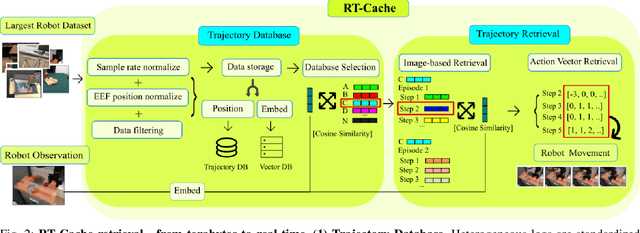
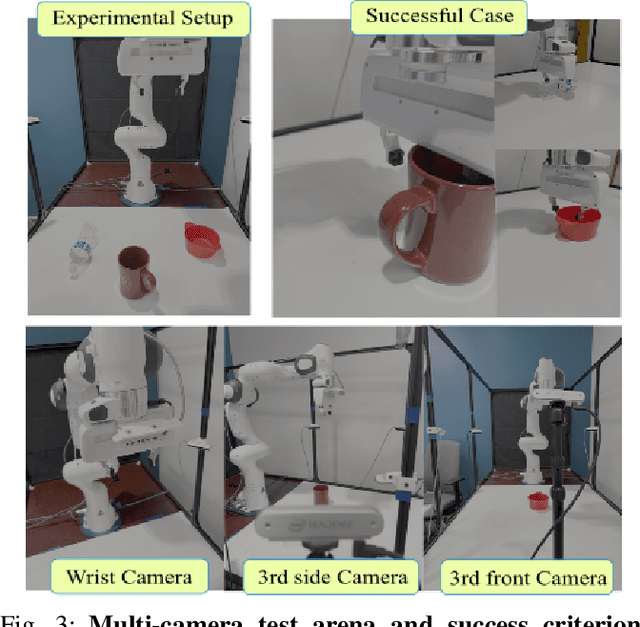
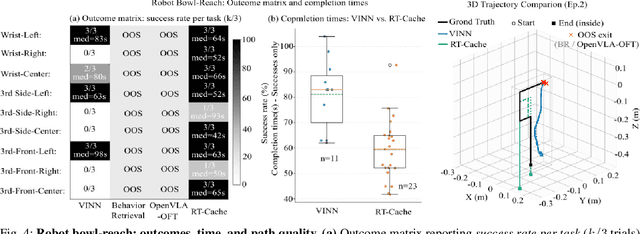
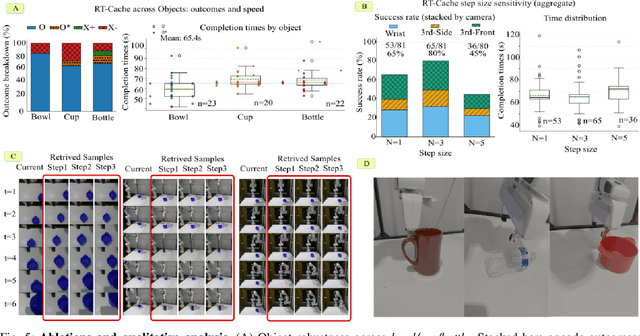
This paper introduces RT-cache, a novel trajectorymemory pipeline that accelerates real-world robot inference by leveraging big-data retrieval and learning from experience. While modern Vision-Language-Action (VLA) models can handle diverse robotic tasks, they often incur high per-step inference costs, resulting in significant latency, sometimes minutes per task. In contrast, RT-cache stores a large-scale Memory of previously successful robot trajectories and retrieves relevant multistep motion snippets, drastically reducing inference overhead. By integrating a Memory Builder with a Trajectory Retrieval, we develop an efficient retrieval process that remains tractable even for extremely large datasets. RT-cache flexibly accumulates real-world experiences and replays them whenever the current scene matches past states, adapting quickly to new or unseen environments with only a few additional samples. Experiments on the Open-X Embodiment Dataset and other real-world data demonstrate that RT-cache completes tasks both faster and more successfully than a baseline lacking retrieval, suggesting a practical, data-driven solution for real-time manipulation.