 Add to Chrome
 Add to Firefox
 Add to Edge
MergeOver: Post-Training Token Merging for Recursive Vision Transformers
Aug 13, 2026
Vision Transformers (ViTs) demonstrate exceptional performance in computer vision but suffer from large parameter counts and quadratic computational complexity, severely limiting their deployment on resource-constrained edge hardware. While recursive weight-sharing reduces parameter counts and token merging mitigates computational and memory bottlenecks, integrating these two paradigms without costly retraining is non-trivial, leaving this intersection largely unexplored. We propose MergeOver, a post-training approach that integrates Token Merging (ToMe) into the recursively weight-shared Sliced Recursive Transformer (SReT). Through an Unmerge tracking stack, constraint-safe merge-rate adjustment, and synchronised token-mass tracking across spatial permutations, MergeOver resolves the spatial and merging constraints of this integration. We further employ a stage-wise single-shot schedule that performs token reduction at the first block of each stage and maintains a fixed sequence length throughout its subsequent recursive iterations. Benchmarked on ImageNet-1K, our selected configuration reduces top-1 accuracy by 1.47 percentage points. On the GPU, it reduces peak activation memory by 37.3% and 38.4% at batch sizes 1 and 16, while throughput decreases by 21.7% at batch size 1 but increases by 21.7% at batch size 16. On a Raspberry Pi 5 (ARM CPU), it reduces latency by 2.4% and 17.6% at batch sizes 1 and 16. These results show that MergeOver can recover a meaningful part of the throughput and memory cost that recursive weight-sharing introduces, without retraining, and provides a baseline for combining token merging with hierarchical recursive transformers.

RIO: Flexible Real-Time Robot I/O for Cross-Embodiment Robot Learning
May 12, 2026Despite recent efforts to collect multi-task, multi-embodiment datasets, to design recipes for training Vision-Language-Action models (VLAs), and to showcase these models on different robot platforms, generalist cross-embodiment robot capabilities remains a largely elusive ideal. Progress is limited by fragmented infrastructure: most robot code is highly specific to the exact setup the user decided on, which adds major overhead when attempting to reuse, recycle, or share artifacts between users. We present RIO (Robot I/O), an open source Python framework that provides flexible, lightweight components for robot control, teleoperation, data formatting, sensor configuration, and policy deployment across diverse hardware platforms and morphologies. RIO provides abstractions that enable users to make any choice and to switch between them, with minimal reconfiguration effort. We validate RIO on VLA deployment workflows across three morphologies (single-arm, bimanual, humanoid) and four hardware platforms with varying grippers and cameras. Using teleoperated data collected with RIO, we fine-tune state-of-the-art VLAs including $π_{0.5}$ and GR00T on household tasks such as pick-and-place, folding, and bowl scrubbing. By open sourcing all our efforts, we hope the community can accelerate their pace of robot learning on real-world robot hardware. Additional details at: https://robot-i-o.github.io
Inverse k-visibility for RSSI-based Indoor Geometric Mapping
Aug 14, 2024In recent years, the increased availability of WiFi in indoor environments has gained an interest in the robotics community to leverage WiFi signals for enhancing indoor SLAM (Simultaneous Localization and Mapping) systems. SLAM technology is widely used, especially for the navigation and control of autonomous robots. This paper discusses various works in developing WiFi-based localization and challenges in achieving high-accuracy geometric maps. This paper introduces the concept of inverse k-visibility developed from the k-visibility algorithm to identify the free space in an unknown environment for planning, navigation, and obstacle avoidance. Comprehensive experiments, including those utilizing single and multiple RSSI signals, were conducted in both simulated and real-world environments to demonstrate the robustness of the proposed algorithm. Additionally, a detailed analysis comparing the resulting maps with ground-truth Lidar-based maps is provided to highlight the algorithm's accuracy and reliability.
M^3RS: Multi-robot, Multi-objective, and Multi-mode Routing and Scheduling
Mar 24, 2024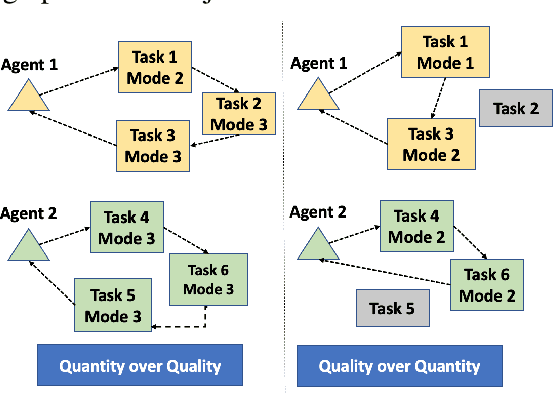
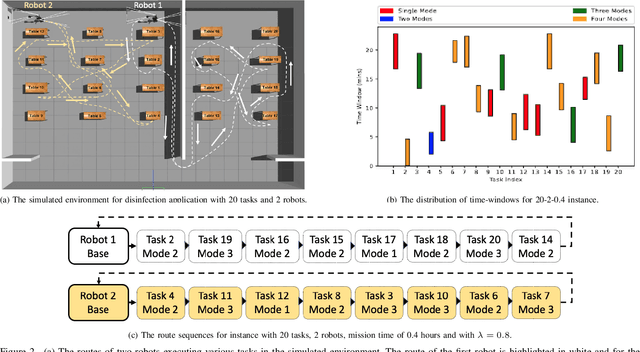
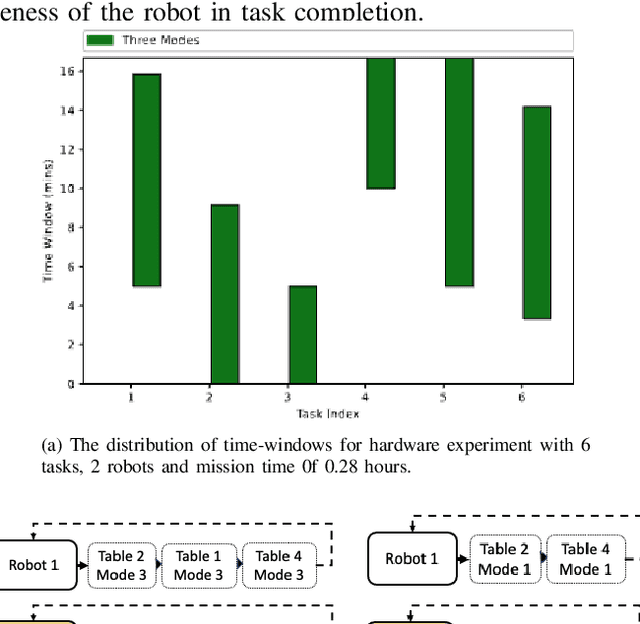
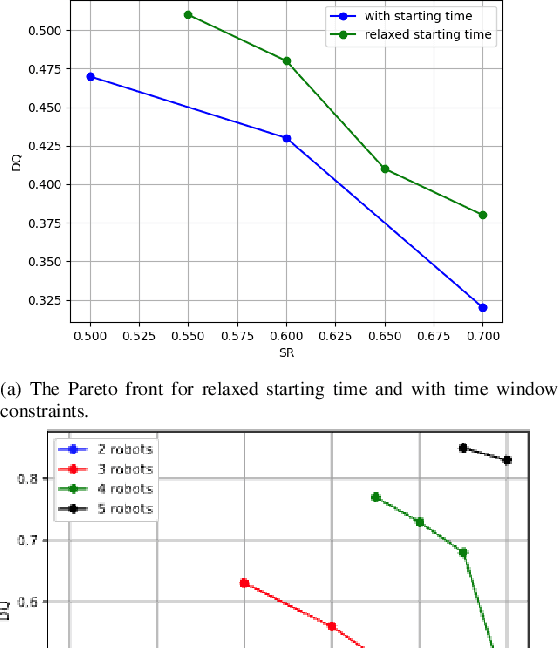
In this paper, we present a novel problem coined multi-robot, multi-objective, and multi-mode routing and scheduling (M^3RS). The formulation for M^3RS is introduced for time-bound multi-robot, multi-objective routing and scheduling missions where each task has multiple execution modes. Different execution modes have distinct resource consumption, associated execution time, and quality. M^3RS assigns the optimal sequence of tasks and the execution modes to each agent. The routes and associated modes depend on user preferences for different objective criteria. The need for M^3RS comes from multi-robot applications in which a trade-off between multiple criteria arises from different task execution modes. We use M^3RS for the application of multi-robot disinfection in public locations. The objectives considered for disinfection application are disinfection quality and number of tasks completed. A mixed-integer linear programming model is proposed for M^3RS. Then, a time-efficient column generation scheme is presented to tackle the issue of computation times for larger problem instances. The advantage of using multiple modes over fixed execution mode is demonstrated using experiments on synthetic data. The results suggest that M^3RS provides flexibility to the user in terms of available solutions and performs well in joint performance metrics. The application of the proposed problem is shown for a team of disinfection robots.} The videos for the experiments are available on the project website: https://sites.google.com/view/g-robot/m3rs/ .
Visual Inertial Odometry using Focal Plane Binary Features (BIT-VIO)
Mar 14, 2024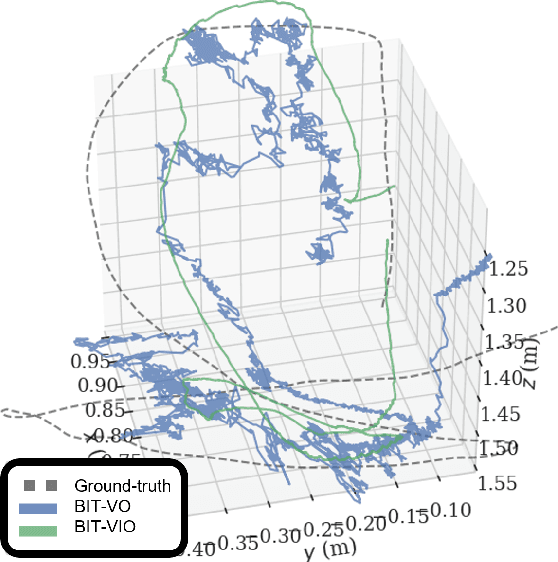
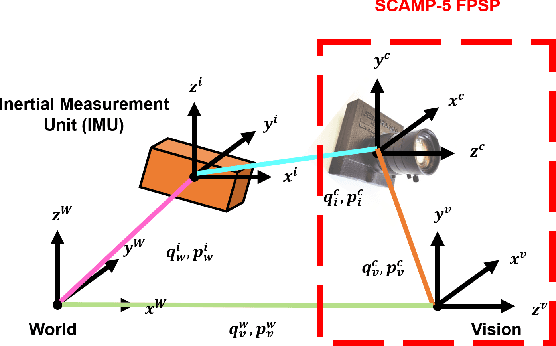
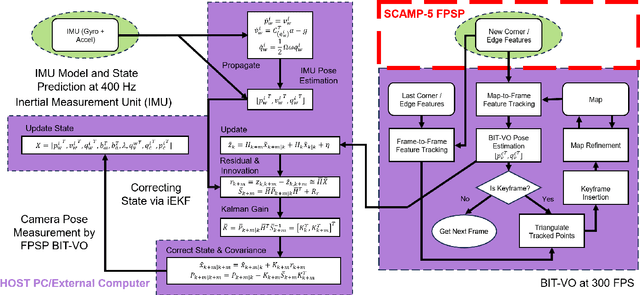
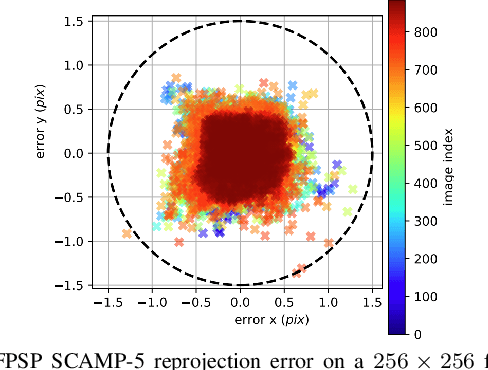
Focal-Plane Sensor-Processor Arrays (FPSP)s are an emerging technology that can execute vision algorithms directly on the image sensor. Unlike conventional cameras, FPSPs perform computation on the image plane -- at individual pixels -- enabling high frame rate image processing while consuming low power, making them ideal for mobile robotics. FPSPs, such as the SCAMP-5, use parallel processing and are based on the Single Instruction Multiple Data (SIMD) paradigm. In this paper, we present BIT-VIO, the first Visual Inertial Odometry (VIO) which utilises SCAMP-5.BIT-VIO is a loosely-coupled iterated Extended Kalman Filter (iEKF) which fuses together the visual odometry running fast at 300 FPS with predictions from 400 Hz IMU measurements to provide accurate and smooth trajectories.
Structure from WiFi (SfW): RSSI-based Geometric Mapping of Indoor Environments
Mar 04, 2024With the rising prominence of WiFi in common spaces, efforts have been made in the robotics community to take advantage of this fact by incorporating WiFi signal measurements in indoor SLAM (Simultaneous Localization and Mapping) systems. SLAM is essential in a wide range of applications, especially in the control of autonomous robots. This paper describes recent work in the development of WiFi-based localization and addresses the challenges currently faced in achieving WiFi-based geometric mapping. Inspired by the field of research into k-visibility, this paper presents the concept of inverse k-visibility and proposes a novel algorithm that allows robots to build a map of the free space of an unknown environment, essential for planning, navigation, and avoiding obstacles. Experiments performed in simulated and real-world environments demonstrate the effectiveness of the proposed algorithm.