 Add to Chrome
 Add to Firefox
 Add to Edge
Assistants, Not Architects: The Role of LLMs in Networked Systems Design
Apr 28, 2026
Designing the architecture of modern networked systems requires navigating a large, combinatorial space of hardware, systems, and configuration choices with complex cross-layer interactions. Architects must balance competing objectives such as performance, cost, and deployability while satisfying compatibility and resource constraints, often relying on scattered rules-of-thumb drawn from benchmarks, papers, documentation, and expert experience. This raises a natural question: can large language models (LLMs) reliably perform this kind of architectural reasoning? We find that they cannot. While LLMs produce plausible configurations, they frequently miss critical constraints, encode incorrect assumptions, and exhibit ``stickiness'' to familiar patterns. A natural workaround--iterative validation via simulation or experimentation--is often prohibitively expensive at scale and, in many cases, infeasible, particularly when comparing hardware-dependent alternatives. Motivated by this gap, we present Kepler, a lightweight reasoning framework for architecture design that combines structured, expert-driven specifications with SMT-based optimization. Kepler encodes architecturally significant properties--requirements, incompatibilities, and qualitative trade-offs--about systems, hardware, and workloads as constraints, and synthesizes feasible designs that optimize user-defined objectives. It operates at an abstract level, capturing ``rules-of-thumb'' rather than detailed system behavior, enabling tractable reasoning while preserving key interactions, and provides explanations for its decisions. Through experiments and case studies, we show that Kepler uncovers interactions missed by LLMs and supports systematic, explainable design exploration.

Throughput-Fairness Tradeoffs in Mobility Platforms
May 25, 2021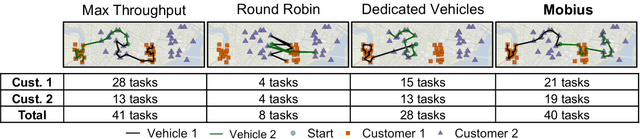
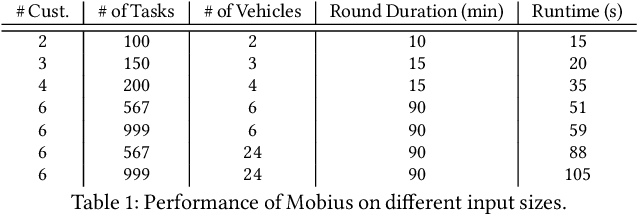
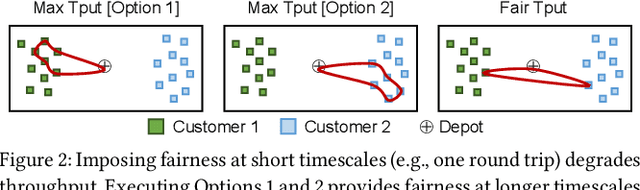
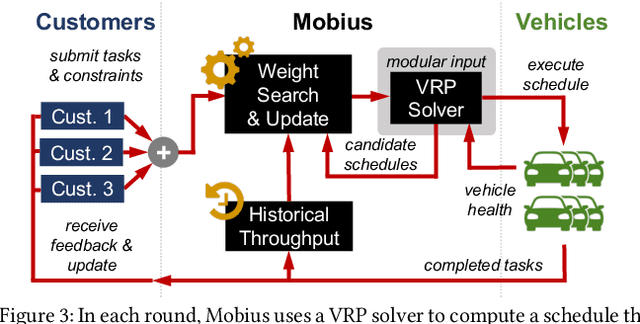
This paper studies the problem of allocating tasks from different customers to vehicles in mobility platforms, which are used for applications like food and package delivery, ridesharing, and mobile sensing. A mobility platform should allocate tasks to vehicles and schedule them in order to optimize both throughput and fairness across customers. However, existing approaches to scheduling tasks in mobility platforms ignore fairness. We introduce Mobius, a system that uses guided optimization to achieve both high throughput and fairness across customers. Mobius supports spatiotemporally diverse and dynamic customer demands. It provides a principled method to navigate inherent tradeoffs between fairness and throughput caused by shared mobility. Our evaluation demonstrates these properties, along with the versatility and scalability of Mobius, using traces gathered from ridesharing and aerial sensing applications. Our ridesharing case study shows that Mobius can schedule more than 16,000 tasks across 40 customers and 200 vehicles in an online manner.