 Add to Chrome
 Add to Firefox
 Add to Edge
Better than Average: Spatially-Aware Aggregation of Segmentation Uncertainty Improves Downstream Performance
Mar 31, 2026
Uncertainty Quantification (UQ) is crucial for ensuring the reliability of automated image segmentations in safety-critical domains like biomedical image analysis or autonomous driving. In segmentation, UQ generates pixel-wise uncertainty scores that must be aggregated into image-level scores for downstream tasks like Out-of-Distribution (OoD) or failure detection. Despite routine use of aggregation strategies, their properties and impact on downstream task performance have not yet been comprehensively studied. Global Average is the default choice, yet it does not account for spatial and structural features of segmentation uncertainty. Alternatives like patch-, class- and threshold-based strategies exist, but lack systematic comparison, leading to inconsistent reporting and unclear best practices. We address this gap by (1) formally analyzing properties, limitations, and pitfalls of common strategies; (2) proposing novel strategies that incorporate spatial uncertainty structure and (3) benchmarking their performance on OoD and failure detection across ten datasets that vary in image geometry and structure. We find that aggregators leveraging spatial structure yield stronger performance in both downstream tasks studied. However, the performance of individual aggregators depends heavily on dataset characteristics, so we (4) propose a meta-aggregator that integrates multiple aggregators and performs robustly across datasets.

How Shift Equivariance Impacts Metric Learning for Instance Segmentation
Jan 14, 2021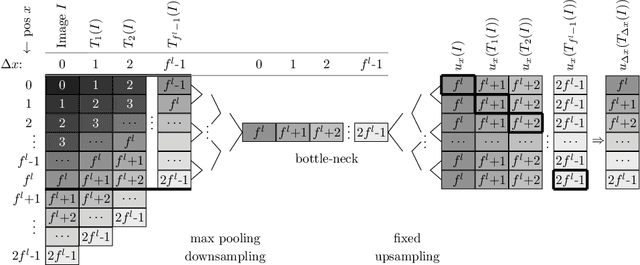
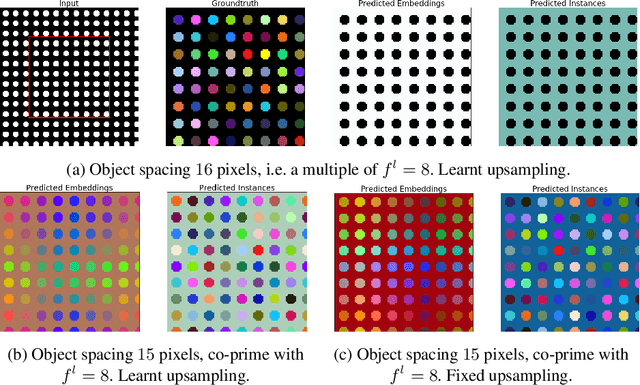
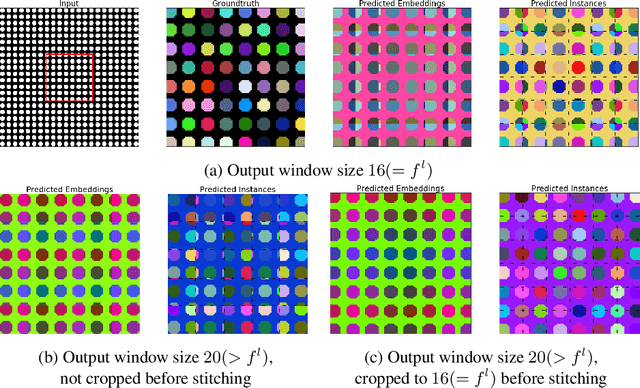
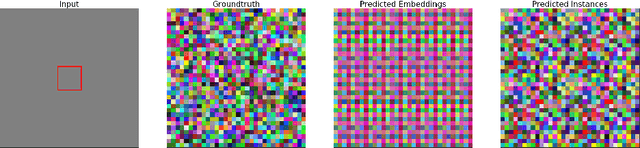
Metric learning has received conflicting assessments concerning its suitability for solving instance segmentation tasks. It has been dismissed as theoretically flawed due to the shift equivariance of the employed CNNs and their respective inability to distinguish same-looking objects. Yet it has been shown to yield state of the art results for a variety of tasks, and practical issues have mainly been reported in the context of tile-and-stitch approaches, where discontinuities at tile boundaries have been observed. To date, neither of the reported issues have undergone thorough formal analysis. In our work, we contribute a comprehensive formal analysis of the shift equivariance properties of encoder-decoder-style CNNs, which yields a clear picture of what can and cannot be achieved with metric learning in the face of same-looking objects. In particular, we prove that a standard encoder-decoder network that takes $d$-dimensional images as input, with $l$ pooling layers and pooling factor $f$, has the capacity to distinguish at most $f^{dl}$ same-looking objects, and we show that this upper limit can be reached. Furthermore, we show that to avoid discontinuities in a tile-and-stitch approach, assuming standard batch size 1, it is necessary to employ valid convolutions in combination with a training output window size strictly greater than $f^l$, while at test-time it is necessary to crop tiles to size $n\cdot f^l$ before stitching, with $n\geq 1$. We complement these theoretical findings by discussing a number of insightful special cases for which we show empirical results on synthetic data.