 Add to Chrome
 Add to Firefox
 Add to Edge
Better than Average: Spatially-Aware Aggregation of Segmentation Uncertainty Improves Downstream Performance
Mar 31, 2026
Uncertainty Quantification (UQ) is crucial for ensuring the reliability of automated image segmentations in safety-critical domains like biomedical image analysis or autonomous driving. In segmentation, UQ generates pixel-wise uncertainty scores that must be aggregated into image-level scores for downstream tasks like Out-of-Distribution (OoD) or failure detection. Despite routine use of aggregation strategies, their properties and impact on downstream task performance have not yet been comprehensively studied. Global Average is the default choice, yet it does not account for spatial and structural features of segmentation uncertainty. Alternatives like patch-, class- and threshold-based strategies exist, but lack systematic comparison, leading to inconsistent reporting and unclear best practices. We address this gap by (1) formally analyzing properties, limitations, and pitfalls of common strategies; (2) proposing novel strategies that incorporate spatial uncertainty structure and (3) benchmarking their performance on OoD and failure detection across ten datasets that vary in image geometry and structure. We find that aggregators leveraging spatial structure yield stronger performance in both downstream tasks studied. However, the performance of individual aggregators depends heavily on dataset characteristics, so we (4) propose a meta-aggregator that integrates multiple aggregators and performs robustly across datasets.

Arctique: An artificial histopathological dataset unifying realism and controllability for uncertainty quantification
Nov 11, 2024


Uncertainty Quantification (UQ) is crucial for reliable image segmentation. Yet, while the field sees continual development of novel methods, a lack of agreed-upon benchmarks limits their systematic comparison and evaluation: Current UQ methods are typically tested either on overly simplistic toy datasets or on complex real-world datasets that do not allow to discern true uncertainty. To unify both controllability and complexity, we introduce Arctique, a procedurally generated dataset modeled after histopathological colon images. We chose histopathological images for two reasons: 1) their complexity in terms of intricate object structures and highly variable appearance, which yields challenging segmentation problems, and 2) their broad prevalence for medical diagnosis and respective relevance of high-quality UQ. To generate Arctique, we established a Blender-based framework for 3D scene creation with intrinsic noise manipulation. Arctique contains 50,000 rendered images with precise masks as well as noisy label simulations. We show that by independently controlling the uncertainty in both images and labels, we can effectively study the performance of several commonly used UQ methods. Hence, Arctique serves as a critical resource for benchmarking and advancing UQ techniques and other methodologies in complex, multi-object environments, bridging the gap between realism and controllability. All code is publicly available, allowing re-creation and controlled manipulations of our shipped images as well as creation and rendering of new scenes.
BioTracker: An Open-Source Computer Vision Framework for Visual Animal Tracking
Mar 21, 2018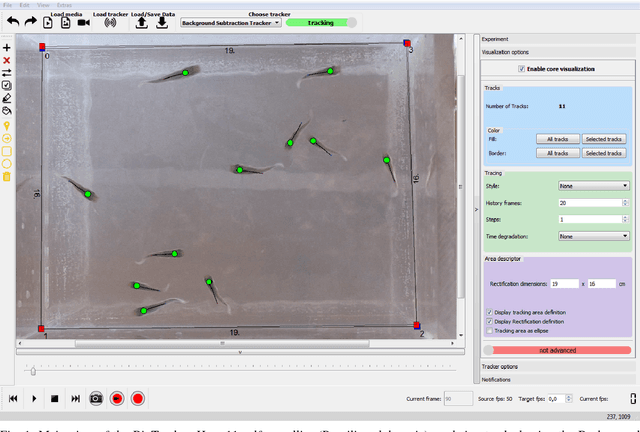
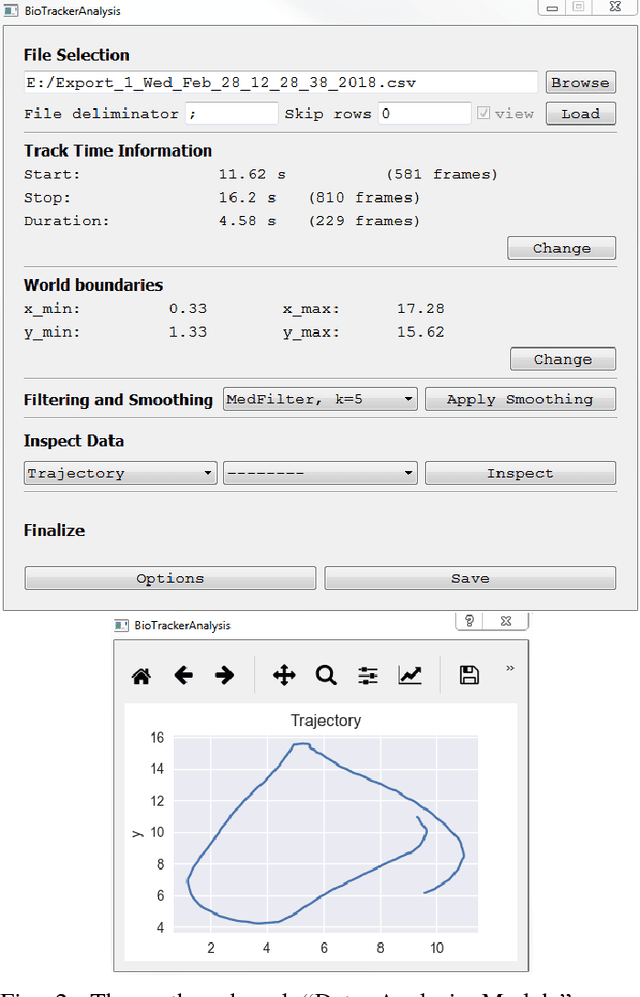
The study of animal behavior increasingly relies on (semi-) automatic methods for the extraction of relevant behavioral features from video or picture data. To date, several specialized software products exist to detect and track animals' positions in simple (laboratory) environments. Tracking animals in their natural environments, however, often requires substantial customization of the image processing algorithms to the problem-specific image characteristics. Here we introduce BioTracker, an open-source computer vision framework, that provides programmers with core functionalities that are essential parts of a tracking software, such as video I/O, graphics overlays and mouse and keyboard interfaces. BioTracker additionally provides a number of different tracking algorithms suitable for a variety of image recording conditions. The main feature of BioTracker is however the straightforward implementation of new problem-specific tracking modules and vision algorithms that can build upon BioTracker's core functionalities. With this open-source framework the scientific community can accelerate their research and focus on the development of new vision algorithms.