 Add to Chrome
 Add to Firefox
 Add to Edge
EgoBabyVLM: Benchmarking Cross-Modal Learning from Naturalistic Egocentric Video Data
May 18, 2026
Children acquire language grounding with remarkable robustness from limited visuo-linguistic input in ways that surpass today's best large multimodal models. Recent research suggests current vision-language models (VLMs) trained on curated web data fail to generalize to the sparse, weakly-aligned egocentric streams produced by wearable devices, embodied agents, and infant head-cams -- and no fixed evaluation pipeline exists for measuring progress on this regime. We train VLMs on datasets with varying degrees of semantic alignment between visual and linguistic inputs, including naturalistic infant and adult egocentric videos, and evaluate them with a comprehensive suite spanning multimodal language grounding and unimodal vision and language tasks. At the core of this suite is Machine-DevBench, a corpus-grounded benchmark of lexical and grammatical competence, automatically generated from the model's training vocabulary across logarithmic frequency bins to eliminate the train/eval mismatch and low statistical power of prior developmental benchmarks. Our results show that current VLM paradigms hinge on the tight semantic alignment of curated data and fail to exploit the weakly-aligned signal that dominates naturalistic egocentric input -- the very regime in which humans thrive. To motivate progress, we introduce the EgoBabyVLM Challenge to drive the development of models capable of grounded language learning from the kind of naturalistic data that human infants experience.

TextSeal: A Localized LLM Watermark for Provenance & Distillation Protection
May 12, 2026We introduce TextSeal, a state-of-the-art watermark for large language models. Building on Gumbel-max sampling, TextSeal introduces dual-key generation to restore output diversity, along with entropy-weighted scoring and multi-region localization for improved detection. It supports serving optimizations such as speculative decoding and multi-token prediction, and does not add any inference overhead. TextSeal strictly dominates baselines like SynthID-text in detection strength and is robust to dilution, maintaining confident localized detection even in heavily mixed human/AI documents. The scheme is theoretically distortion-free, and evaluation across reasoning benchmarks confirms that it preserves downstream performance; while a multilingual human evaluation (6000 A/B comparisons, 5 languages) shows no perceptible quality difference. Beyond its use for provenance detection, TextSeal is also ``radioactive'': its watermark signal transfers through model distillation, enabling detection of unauthorized use.
SpidR-Adapt: A Universal Speech Representation Model for Few-Shot Adaptation
Dec 24, 2025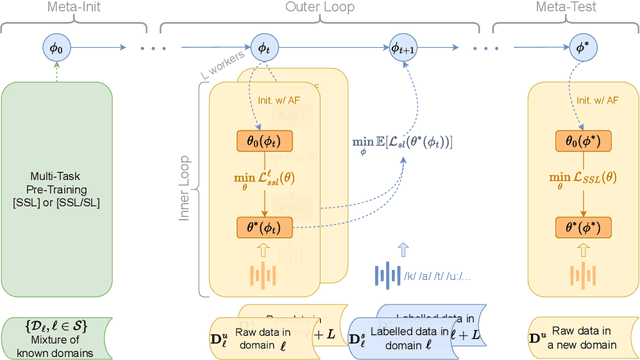
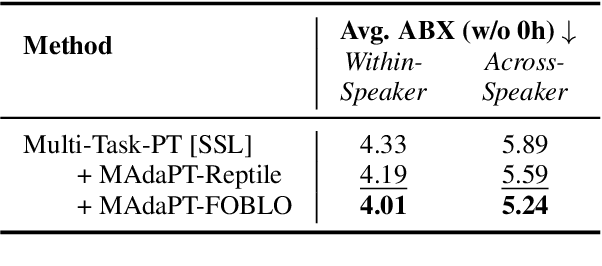
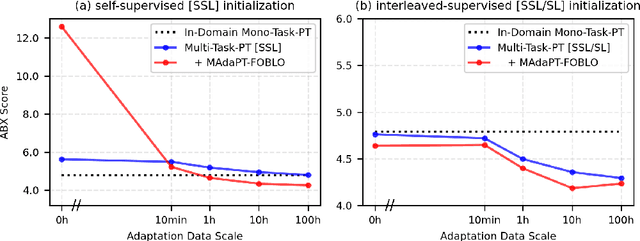
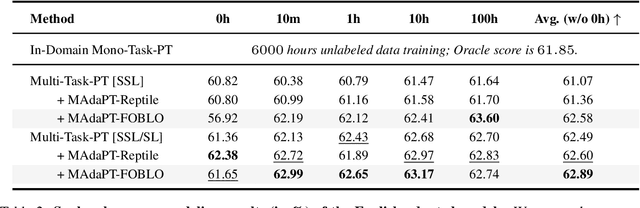
Human infants, with only a few hundred hours of speech exposure, acquire basic units of new languages, highlighting a striking efficiency gap compared to the data-hungry self-supervised speech models. To address this gap, this paper introduces SpidR-Adapt for rapid adaptation to new languages using minimal unlabeled data. We cast such low-resource speech representation learning as a meta-learning problem and construct a multi-task adaptive pre-training (MAdaPT) protocol which formulates the adaptation process as a bi-level optimization framework. To enable scalable meta-training under this framework, we propose a novel heuristic solution, first-order bi-level optimization (FOBLO), avoiding heavy computation costs. Finally, we stabilize meta-training by using a robust initialization through interleaved supervision which alternates self-supervised and supervised objectives. Empirically, SpidR-Adapt achieves rapid gains in phonemic discriminability (ABX) and spoken language modeling (sWUGGY, sBLIMP, tSC), improving over in-domain language models after training on less than 1h of target-language audio, over $100\times$ more data-efficient than standard training. These findings highlight a practical, architecture-agnostic path toward biologically inspired, data-efficient representations. We open-source the training code and model checkpoints at https://github.com/facebookresearch/spidr-adapt.