 Add to Chrome
 Add to Firefox
 Add to Edge
AnyTask: an Automated Task and Data Generation Framework for Advancing Sim-to-Real Policy Learning
Dec 19, 2025
Generalist robot learning remains constrained by data: large-scale, diverse, and high-quality interaction data are expensive to collect in the real world. While simulation has become a promising way for scaling up data collection, the related tasks, including simulation task design, task-aware scene generation, expert demonstration synthesis, and sim-to-real transfer, still demand substantial human effort. We present AnyTask, an automated framework that pairs massively parallel GPU simulation with foundation models to design diverse manipulation tasks and synthesize robot data. We introduce three AnyTask agents for generating expert demonstrations aiming to solve as many tasks as possible: 1) ViPR, a novel task and motion planning agent with VLM-in-the-loop Parallel Refinement; 2) ViPR-Eureka, a reinforcement learning agent with generated dense rewards and LLM-guided contact sampling; 3) ViPR-RL, a hybrid planning and learning approach that jointly produces high-quality demonstrations with only sparse rewards. We train behavior cloning policies on generated data, validate them in simulation, and deploy them directly on real robot hardware. The policies generalize to novel object poses, achieving 44% average success across a suite of real-world pick-and-place, drawer opening, contact-rich pushing, and long-horizon manipulation tasks. Our project website is at https://anytask.rai-inst.com .

Loose LIPS Sink Ships: Asking Questions in Battleship with Language-Informed Program Sampling
Feb 29, 2024
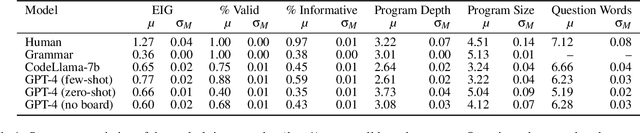
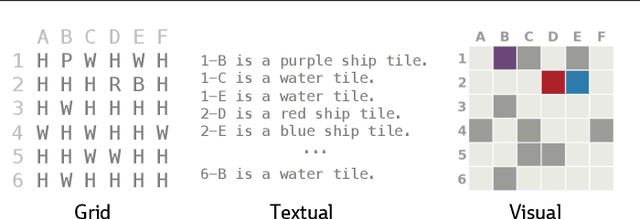
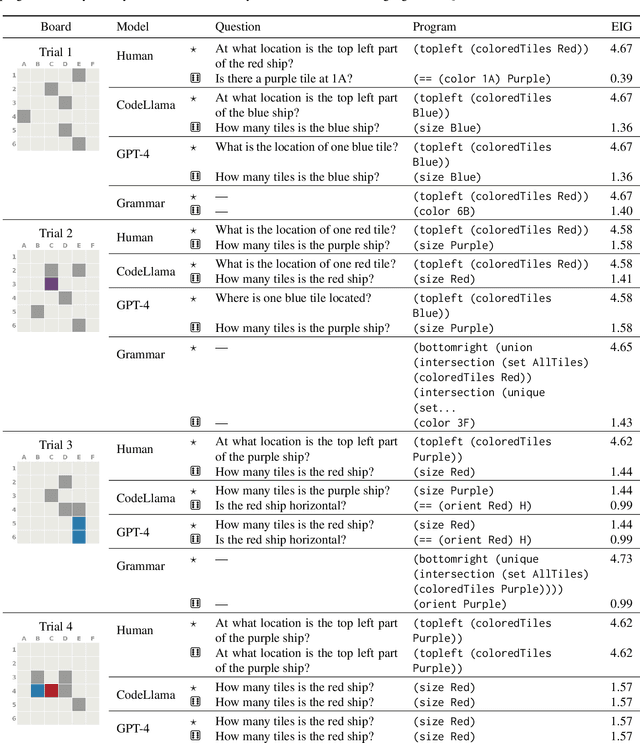
Questions combine our mastery of language with our remarkable facility for reasoning about uncertainty. How do people navigate vast hypothesis spaces to pose informative questions given limited cognitive resources? We study these tradeoffs in a classic grounded question-asking task based on the board game Battleship. Our language-informed program sampling (LIPS) model uses large language models (LLMs) to generate natural language questions, translate them into symbolic programs, and evaluate their expected information gain. We find that with a surprisingly modest resource budget, this simple Monte Carlo optimization strategy yields informative questions that mirror human performance across varied Battleship board scenarios. In contrast, LLM-only baselines struggle to ground questions in the board state; notably, GPT-4V provides no improvement over non-visual baselines. Our results illustrate how Bayesian models of question-asking can leverage the statistics of language to capture human priors, while highlighting some shortcomings of pure LLMs as grounded reasoners.